
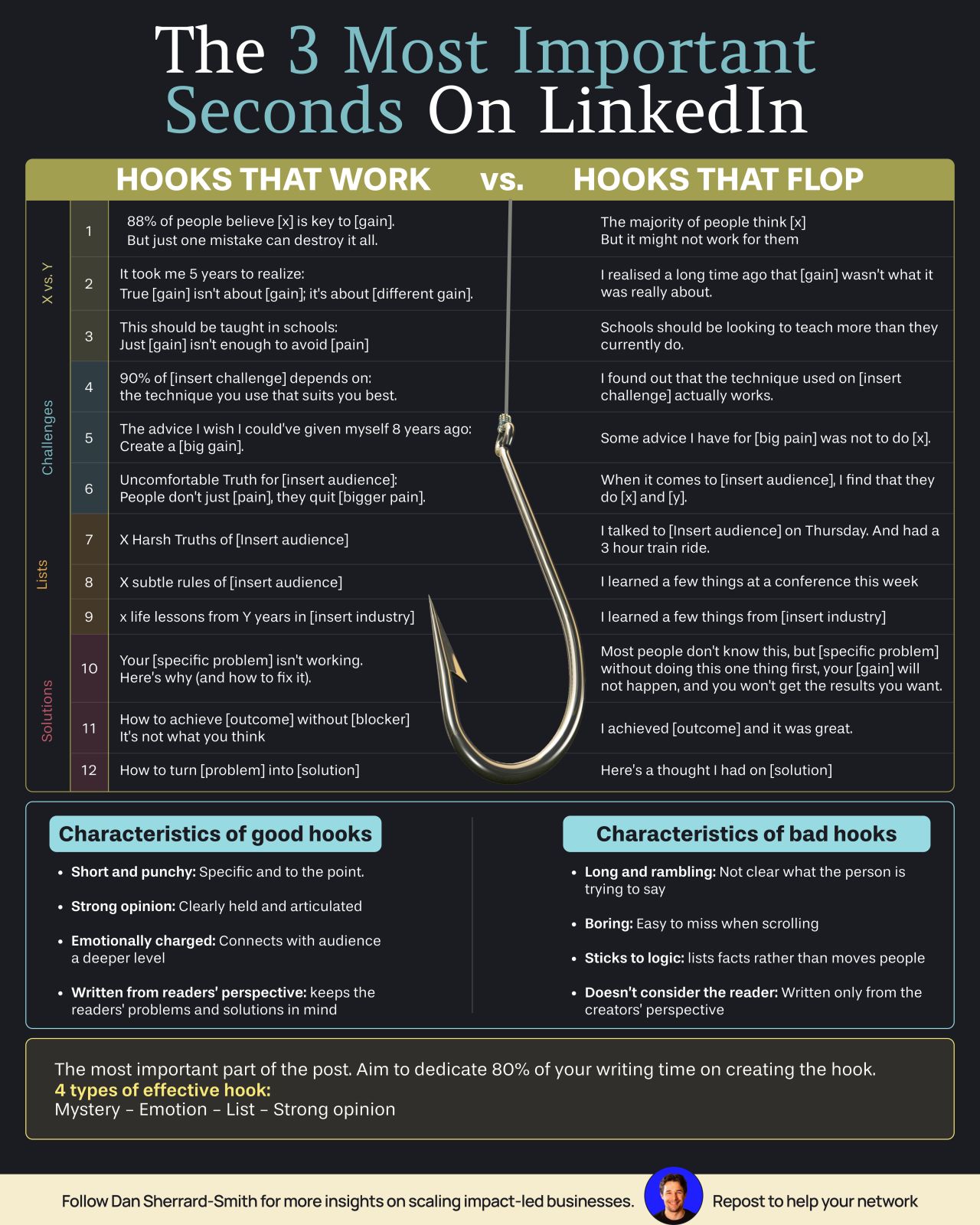
In a recent LinkedIn post, Dan Sherrard-Smith explores the critical importance of the opening lines of a social media post, particularly on platforms like LinkedIn where attention spans are short. Sherrard-Smith argues that many posts fail not due to poor content, but because the initial hook fails to give readers a compelling reason to continue reading.
He introduces a straightforward, three-word formula designed to capture and retain reader attention: Curiosity, Tension, Specificity. This framework, according to Sherrard-Smith, provides a structured approach to crafting hooks that effectively stop the scroll.
“Most first lines lose the reader before the second sentence. Not because the content is bad. Because the opening gives the reader no reason to stay.”
The Power of Curiosity and Tension
Sherrard-Smith details each component of his formula, beginning with triggering curiosity. He explains that curiosity works by opening a cognitive loop that the reader feels compelled to close. This is achieved by presenting a partial truth or a claim that raises questions, prompting the reader to engage further to find the answer.
As an example, Sherrard-Smith suggests hooks like:
“Most founders post consistently and still get zero leads.”
This type of statement, he notes, creates an information gap that naturally draws the reader in.
Following curiosity, Sherrard-Smith emphasizes the role of tension. He defines tension as the gap between a reader’s current situation and their desired outcome. By articulating this gap clearly, a post can resonate deeply with the reader’s challenges and aspirations.
“You’re posting 5x a week. Buyers still aren’t finding you.”
According to Sherrard-Smith, this specific and relatable scenario highlights an uncomfortable truth, thereby increasing engagement.
Adding Specificity for Impact
The final element of Sherrard-Smith’s formula is specificity, particularly the inclusion of a concrete number or detail. He asserts that vague hooks are ineffective, while precise details make a post more tangible and memorable.
“I spent 3 hours building a lead system. It now runs every week without me.”
Sherrard-Smith points out that the inclusion of a specific duration (“3 hours”) and a tangible outcome (“runs every week without me”) makes the claim believable and impactful, creating a strong contrast that makes the hook stick.
Prioritizing the Hook in Content Creation
A significant portion of Sherrard-Smith’s analysis is dedicated to the process of content creation itself. He observes that many LinkedIn users fail to adequately focus on their post’s hook. This often happens because the hook is either written as an afterthought or treated as just another part of the longer piece, rather than a distinct, crucial element.
The core of Sherrard-Smith’s advice is to shift the focus of writing time. He advocates for dedicating a substantial majority of the writing process—around 80%—to crafting and refining the hook. His reasoning is clear: if the opening fails to capture attention, the rest of the content, no matter how valuable, will likely go unread.
In conclusion, Dan Sherrard-Smith provides a practical and actionable framework for anyone looking to improve their engagement on social media. By prioritizing curiosity, tension, and specificity in the crucial first lines of a post, creators can significantly increase the chances of their message resonating with their audience.
📝 About This Content
This article is based on insights shared by Dan Sherrard-Smith on LinkedIn.
📅 Originally posted on July 4, 2026 | View original post on LinkedIn →