
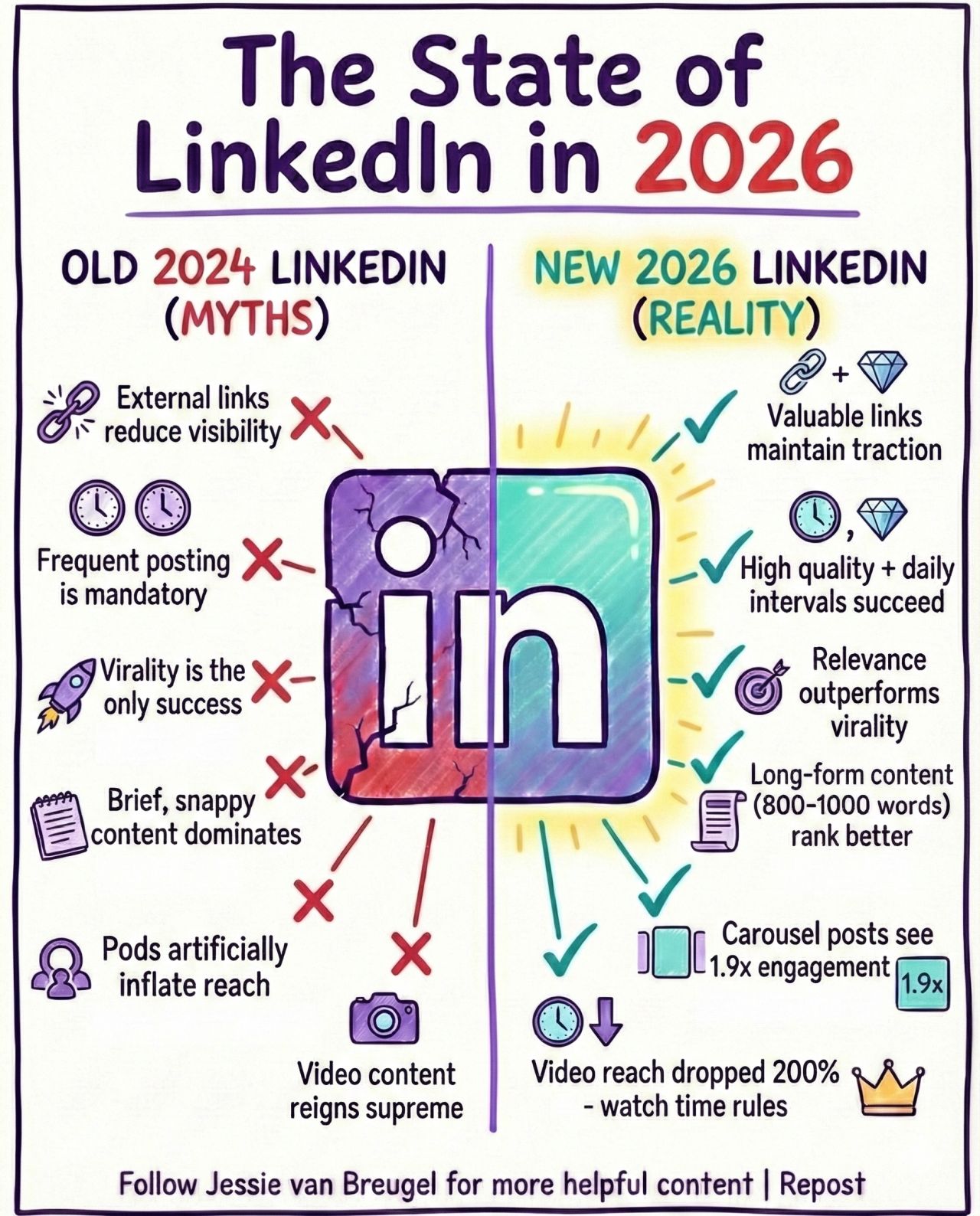
In a recent LinkedIn post, jessie van breugel 🟣 challenges conventional wisdom about the platform, arguing that many widely held beliefs about LinkedIn strategy are now outdated. The post, which has garnered significant attention, outlines six key areas where common tactics are no longer effective and offers alternative approaches that jessie van breugel 🟣 believes are crucial for success in 2024.
Rethinking Core LinkedIn Strategies
jessie van breugel 🟣 begins by addressing the long-standing notion that links negatively impact reach. Contrary to this, the author asserts that valuable links still perform well and encourages users not to shy away from sharing them. As jessie van breugel 🟣 notes:
Links with real value still perform. Stop being scared of linking out. Good content doesn’t get punished.
This perspective suggests a shift towards valuing the substance of shared content over algorithmic fears. The post also tackles the popular advice of posting frequently, with jessie van breugel 🟣 emphasizing that quality unequivocally trumps quantity. The recommendation is to maintain a minimum 24-hour gap between posts, stating, “One dialed-in post beats five forgettable ones.” This highlights a move away from sheer volume towards more impactful, well-crafted content.
The Demise of Virality and the Rise of Relevance
Another significant point raised by jessie van breugel 🟣 is the diminishing importance of going viral. The author argues strongly for prioritizing niche relevance over broad virality. In jessie van breugel 🟣’s view:
Relevance > Virality. Every single time. 200 ICP views > 50K from randoms who’ll never buy. The algorithm now rewards niche relevance.
This suggests that focusing on attracting the ideal client profile (ICP) is far more beneficial than achieving widespread, but irrelevant, reach. The post also critiques the idea that only short, punchy posts succeed. jessie van breugel 🟣 advocates for longer-form content, typically between 800–1000 words, citing “dwell time” as the critical metric that matters most. The implication is that users who spend more time engaging with a post are signaling greater interest to the algorithm.
Video’s Shifting Role and Engagement Pods
The effectiveness of video content is also re-examined. jessie van breugel 🟣 points out a significant drop in video reach, stating, “Video reach dropped 200%.” Instead, the author highlights that carousels are now achieving 1.9 times more engagement. This reinforces the focus on dwell time, suggesting that interactive formats like carousels can be more effective than video for keeping users engaged. Furthermore, jessie van breugel 🟣 dismisses the utility of engagement pods, declaring them “dead.” The advice is to focus on creating genuinely valuable content that resonates with the target audience, rather than relying on artificial engagement tactics. As jessie van breugel 🟣 puts it:
Pods are dead. Create better content (for real). Carousels people actually want to swipe through. Real engagement > fake comments.
Positioning as the Foundational Element
Perhaps the most critical takeaway from jessie van breugel 🟣’s analysis is the emphasis on positioning. The author concludes that even mastering all algorithmic tricks will yield no results if the fundamental positioning is incorrect. “None of this matters if your positioning is off,” jessie van breugel 🟣 stresses. The core message is that clear, targeted positioning, ensuring you are connecting with the right audience, must come first. Once positioning is established, the tactical shifts discussed can then be leveraged effectively.
📝 About This Content
This article is based on insights shared by jessie van breugel 🟣 on LinkedIn.
📅 Originally posted on February 7, 2026 | View original post on LinkedIn →