
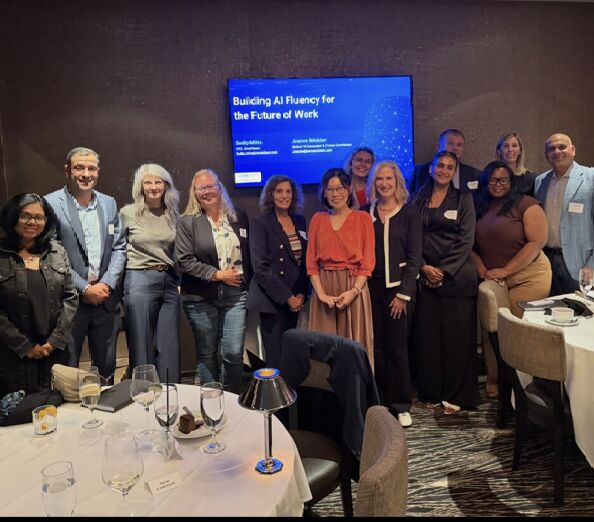
In a recent LinkedIn post, Jeanne C. M. shares key takeaways from a dinner discussion with senior leaders in Talent Acquisition, Learning & Development, and Talent Management in the Chicago area, co-hosted with the Simplilearn team. The conversation delved into critical questions surrounding the integration of Artificial Intelligence in the workplace, focusing on the definition of AI fluency, the ownership of time saved through AI, and the readiness of employers to adapt their value propositions.
The Crucial Need to Define AI Fluency
Jeanne C. M. highlights the evolving landscape of AI in professional settings, noting that AI fluency is rapidly shifting from a desirable skill to a baseline expectation for career progression. However, she emphasizes that organizations must go beyond simply mandating AI fluency. A deeper definition, tailored to specific roles and functions, is essential for both current employees and prospective hires. A significant concern raised during the discussion, as noted by Jeanne C. M., is the potential impact on critical thinking skills.
“At the same time, leaders are raising an important concern: As employees increasingly rely on AI, how do we preserve and strengthen critical thinking and judgment?”
According to Jeanne C. M., this poses a significant challenge for organizations aiming to leverage AI effectively without compromising fundamental cognitive abilities. She argues that a clear framework for AI fluency should encompass not only technical proficiency but also the ability to apply AI tools judiciously.
Who Owns the Time Saved by AI?
Another central theme explored by Jeanne C. M. revolves around the tangible benefits of AI adoption, particularly the time employees reclaim. Referencing SAP research, she points out that employees are saving over five hours per week by integrating AI into their workflows, freeing them from administrative tasks to focus on higher-value work. The critical question that emerges, as articulated by Jeanne C. M., is the ownership of this reclaimed time.
“But who owns that reclaimed time—the employee or the employer? According to SAP, 46% of employees believe the time they save using AI belongs to them, not their organization.”
Jeanne C. M. stresses that this divergence in perception necessitates proactive leadership. She advocates for explicit conversations between managers and their teams to ensure that this additional capacity is strategically utilized, aligning employee expectations with organizational goals. This, she suggests, is a leadership imperative in the age of AI.
Integrating AI Fluency into the Employee Value Proposition
The discussion, as detailed by Jeanne C. M., also touched upon the strategic importance of incorporating AI fluency into the employer’s value proposition. She highlights that many HR and Learning leaders, even those who consider themselves AI power users, believe companies must demonstrate a commitment to continuous investment in their employees’ AI development. Jeanne C. M. explains that AI fluency is not a static skill but requires ongoing learning and adaptation.
“This is especially important since AI fluency is no longer a one-time training initiative—it requires ongoing development as employees become builders of #AI not just users of AI.”
In Jeanne C. M.’s view, organizations need to prepare for a workforce that expects continuous upskilling in AI as a core component of the employer brand. This proactive approach, she concludes, is vital for attracting and retaining top talent in an increasingly AI-driven professional world. Ultimately, Jeanne C. M. urges a focus on the changing work norms driven by AI, not just on adopting new tools.
📝 About This Content
This article is based on insights shared by Jeanne C M. on LinkedIn.
📅 Originally posted on July 8, 2026 | View original post on LinkedIn →