
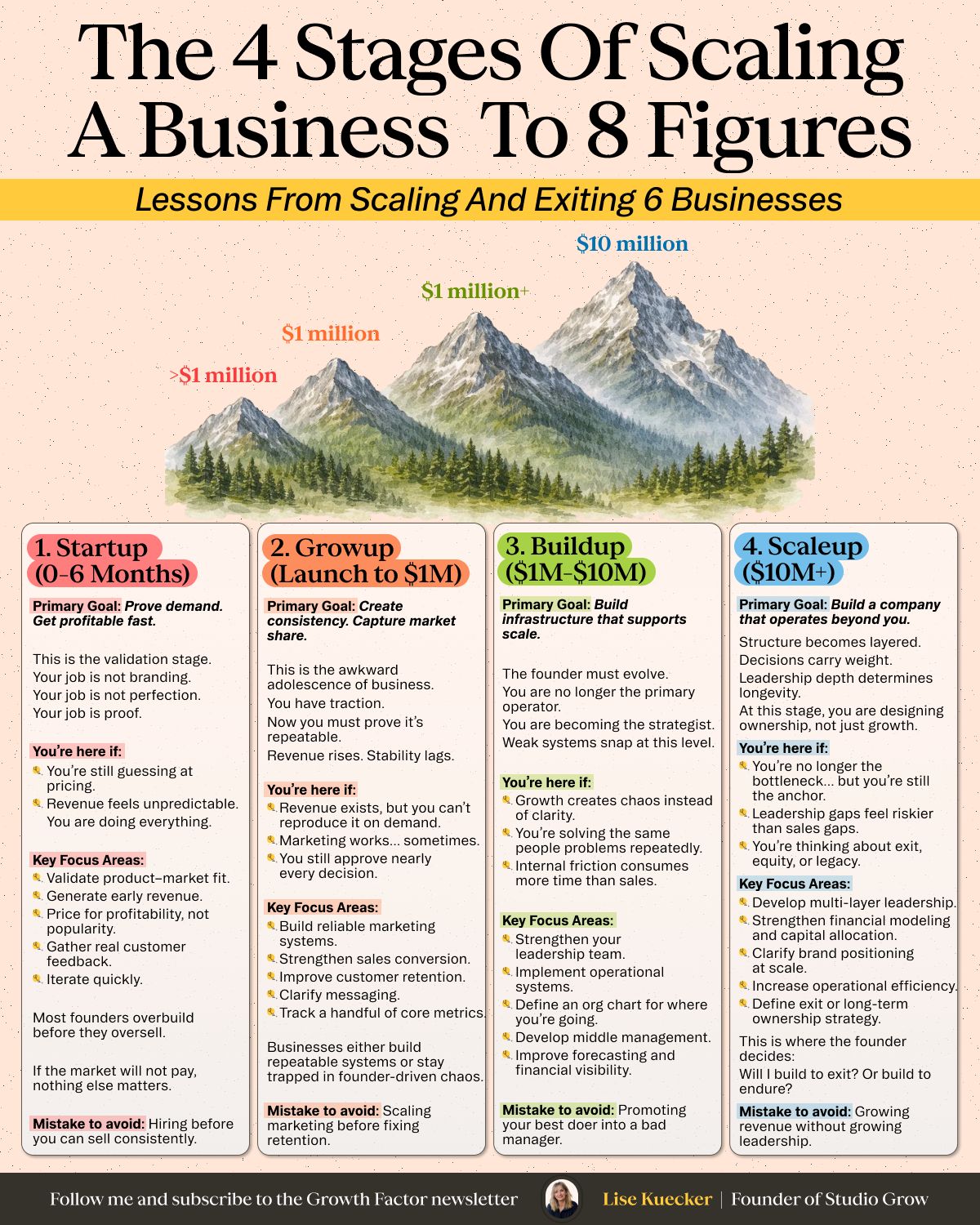
In a recent LinkedIn post, Lise Kuecker discusses the critical importance of strategic direction in business growth, warning that unchecked expansion can prove costly for founders. Kuecker highlights that many entrepreneurs, while understanding the necessity of growth, often lack clarity on what that growth should specifically entail at different business stages. This ambiguity, she argues, can lead to premature scaling, ill-advised hiring decisions, and burnout before achieving long-term objectives.
Kuecker emphasizes that to build a business that serves its owner, a clear understanding of the desired endpoint is paramount. This vision acts as a guiding principle throughout the entrepreneurial journey.
Growth without direction is expensive. Most founders learn that too late.
Kuecker outlines four distinct stages of business growth, each with its own objectives and focus areas:
The Four Stages of Business Growth
1. Startup (0-6 Months)
During this initial phase, Kuecker advises founders to concentrate on validating demand and achieving profitability quickly. The emphasis is on laying a strong foundation, with the founder typically handling multiple roles. Key actions include validating product-market fit and actively gathering customer feedback. Kuecker cautions against early hiring, suggesting it should only occur once consistent sales are established.
2. Growup (Launch to $1M)
The ‘Growup’ stage, spanning from launch to $1 million in revenue, is characterized by the need to make processes consistent and capture market share. While traction may have been gained, Kuecker notes that founders must still prove their business model’s repeatability. The focus shifts to building reliable systems and enhancing customer retention. She advises against over-investing in marketing before a solid client base is secured.
3. Buildup ($1M-$10M)
As businesses move into the $1 million to $10 million revenue range, Kuecker explains that the primary goal becomes building the infrastructure necessary for sustained scaling. In this phase, founders transition from being the primary ‘doer’ to a more strategic role. Kuecker stresses the importance of strengthening the leadership team and refining internal systems. A common pitfall to avoid, she points out, is neglecting investment in the team’s ongoing development.
The goal here is to build infrastructure that supports scale. You’re not wearing as many hats anymore. Instead, you’re more of the strategist.
4. Scaleup ($10M+)
For businesses exceeding $10 million in revenue, Kuecker describes the ‘Scaleup’ stage as building an organization that can operate independently of the founder. This involves further delegation and trusting the core team. The focus expands to nurturing leaders and developing a long-term strategic vision. Crucially, Kuecker advises against focusing solely on revenue, advocating instead for concurrent growth in leadership capacity.
Now you’re building a company that operates beyond you. You’re letting go of being the ‘doer’ even more as you trust your core team.
Defining Personal Success: The ‘North Star’
Beyond these stages, Kuecker strongly advocates for defining a personal endgame for the business. This personal definition of ‘enough’ serves as the ultimate ‘North Star.’ She points out that a founder’s scaleup goal might not align with a specific revenue figure but could instead be about achieving financial security, maintaining work-life balance, or enabling a desired lifestyle.
Your scaleup might not be $10 million. It could be a comfortable nest egg for yourself, or not missing your kid’s soccer game, or a business that supports you traveling across the world.
Kuecker concludes by urging founders to clearly define their personal objectives, as this clarity prevents either exiting too early or remaining in the entrepreneurial game indefinitely without purpose. The choice of the business’s ultimate endpoint, she reminds readers, is entirely up to the founder.
📝 About This Content
This article is based on insights shared by Lise Kuecker on LinkedIn.
📅 Originally posted on February 26, 2026 | View original post on LinkedIn →