
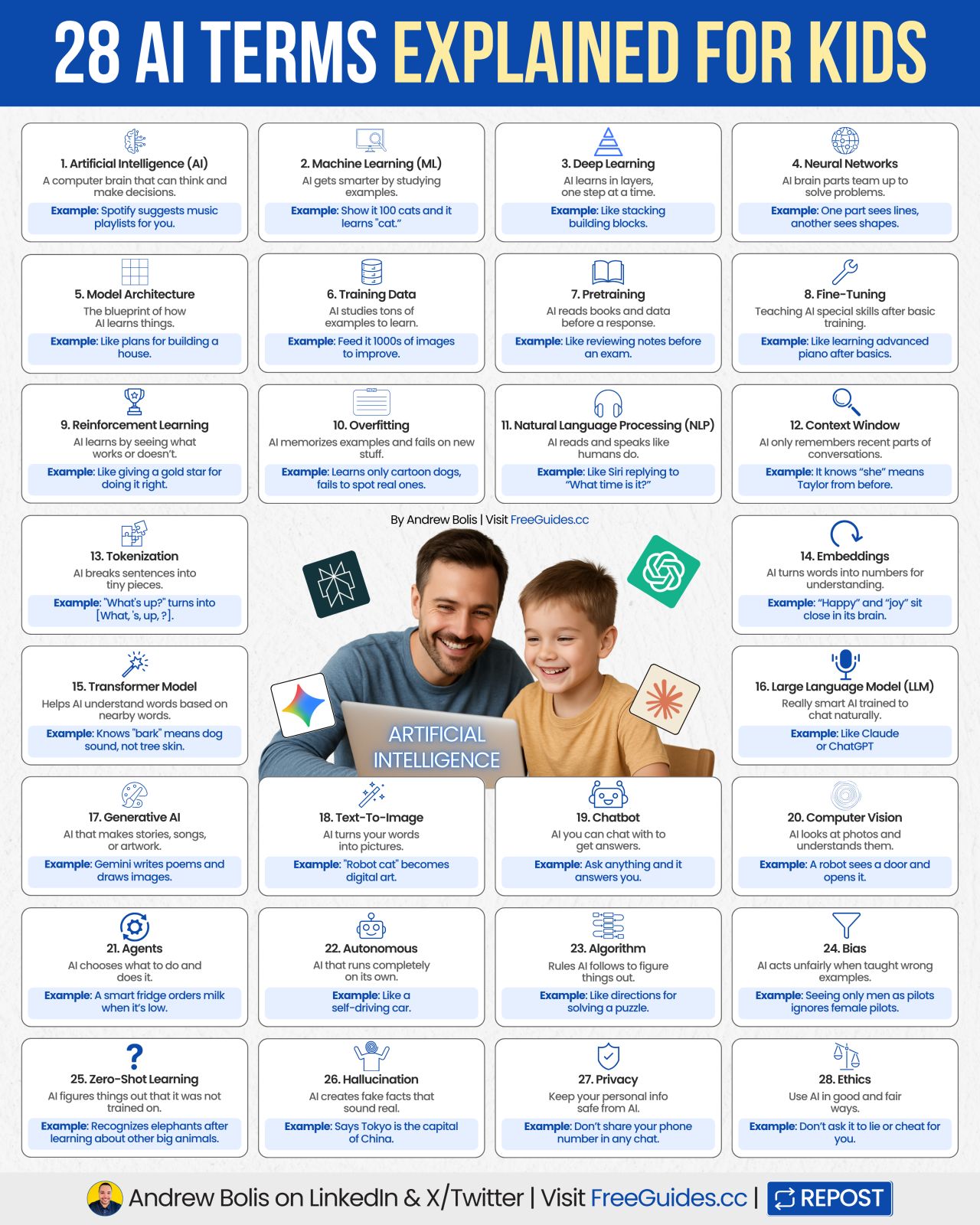
In a recent LinkedIn post, Andrew Bolis addresses the common confusion surrounding artificial intelligence (AI) terminology, offering simplified definitions to make the field more accessible. Bolis aims to demystify the buzzwords that often complicate discussions about AI, presenting a glossary designed for easy comprehension.
Bolis highlights the need for clear, concise explanations, stating:
“All the AI buzzwords can be confusing. Here are simple definitions to understand AI.”
The post then proceeds to define a range of AI terms, from fundamental concepts to more nuanced aspects of the technology. Bolis’s approach focuses on analogies and straightforward language, making complex ideas digestible.
Breaking Down Core AI Concepts
Andrew Bolis begins by defining the foundational elements of AI. According to Bolis, Artificial Intelligence itself is essentially a ‘computer brain that helps and learns’. This simplified analogy immediately grounds the concept, moving away from abstract technical jargon.
He further elaborates on how AI systems learn and evolve. Bolis explains Machine Learning as the process where ‘AI learns by studying examples.’ This is followed by a definition of Deep Learning:
“Deep Learning – AI learns step by step in layers.”
These definitions, as presented by Bolis, emphasize the learning and adaptive nature of AI systems. He also touches upon the underlying structures that enable these processes. Bolis defines Neural Networks as ‘AI parts work together to solve tasks,’ and Model Architecture as ‘The setup for how AI learns,’ providing a basic understanding of the components involved.
Understanding AI Training and Learning Processes
A significant portion of Bolis’s post is dedicated to explaining the data and methods used to train AI. He defines Training Data as the ‘Info AI uses to get smarter,’ underscoring the critical role of data in AI development. Bolis also introduces the concepts of Pretraining and Fine-Tuning.
Pretraining, in Bolis’s simplified terms, means ‘AI reads first to get ready.’ This is followed by Fine-Tuning, described as ‘Extra training after basics.’ This distinction helps clarify the stages of AI development, from initial learning to specialized refinement.
Bolis also touches upon Reinforcement Learning, defining it as when ‘AI learns from rewards or mistakes.’ This highlights a key method by which AI agents improve their performance through iterative feedback. He also addresses a common challenge in AI development:
“Overfitting – AI memorizes too much and messes up.”
This definition of overfitting is particularly useful, as it explains a scenario where an AI model performs poorly on new data because it has become too specialized in its training examples.
AI in Communication and Memory
Further simplifying the application of AI, Andrew Bolis explains Natural Language Processing (NLP) as the ability for ‘AI reads and talks like us.’ This relates AI’s interaction capabilities to human communication.
He also defines a key concept in modern large language models: Context Window. Bolis explains this as ‘AI remembers just the recent words,’ offering a straightforward explanation of how these models manage conversational memory. This helps users understand the limitations and capabilities of AI in maintaining context during interactions.
Bolis concludes his post by encouraging readers to save the information and follow him for more insights. He also promotes a link to learn about free AI tools, reinforcing his commitment to making AI knowledge accessible. As Andrew Bolis demonstrates, AI doesn’t have to be complicated, and clear definitions are a crucial first step for broader understanding and adoption.
📝 About This Content
This article is based on insights shared by Andrew Bolis on LinkedIn.
📅 Originally posted on February 23, 2026 | View original post on LinkedIn →