
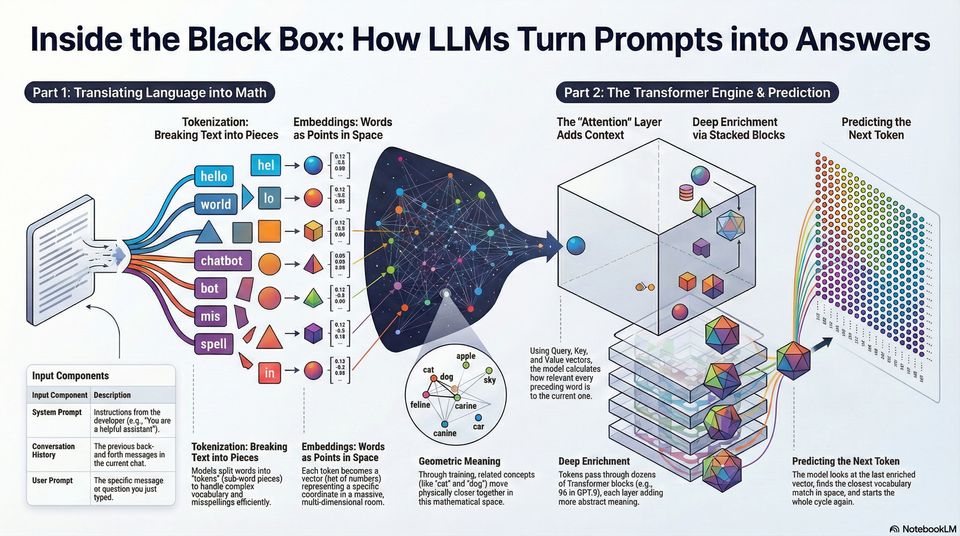
In a recent LinkedIn post, Teresa Torres delves into the inner workings of large language models (LLMs) like ChatGPT, Claude, and Gemini, aiming to make the complex technology accessible to a non-technical audience. Torres frames the discussion by posing a question to her readers: “If someone asked you to explain what actually happens when you type a prompt into Claude or ChatGPT, what would you say?” This sets the stage for her detailed, yet plain-English, explanation of the processes that occur when users interact with these powerful AI tools.
The core of Torres’s post is a comprehensive guide that breaks down the “magic” behind LLMs, moving beyond the simplified notion of “predicting the next token.” She emphasizes that understanding these models doesn’t require an engineering background. As Teresa Torres notes:
“This comprehensive guide breaks down the magic behind ChatGPT, Claude, and Gemini in plain English – no engineering background required.”
The Journey from Text to Tokens and Beyond
Teresa Torres meticulously outlines the journey of user input through the LLM. She begins by explaining how text is transformed into tokens and then into embedding vectors, which are essentially points in a high-dimensional space. This initial step is crucial for the model to begin processing the input numerically.
Inside the Transformer: Attention and Context
A significant portion of Torres’s explanation focuses on the “black box” of transformer blocks and their attention layers. According to Teresa Torres, these attention mechanisms are key to how LLMs gather context. She elaborates:
“How attention lets tokens gather context from each other (solving the ‘not great’ vs ‘great’ problem)”
This ability to weigh the importance of different tokens relative to each other allows the model to understand nuances and resolve ambiguities, a critical step in generating coherent and relevant responses. Torres highlights that this process enables the model to grasp the difference between seemingly similar phrases that have vastly different meanings based on context.
Predictive Power and Iterative Generation
Torres further clarifies the predictive nature of LLMs. She points out that after the complex processing within the transformer blocks, the model ultimately relies on the last enriched token to predict what comes next. This predictive step is then repeated iteratively for every single word in the generated response.
The guide, as described by Torres, walks readers through concepts such as Query/Key/Value vectors, the necessity of thousands of dimensions for embeddings, and how multiple transformer blocks work in concert. According to Teresa Torres, this layered approach allows the model to progressively build understanding, moving from basic patterns to more abstract relationships.
Key Takeaways from Torres’s Explanation
Teresa Torres’s post serves as an invaluable resource for anyone seeking to understand the fundamental mechanics of modern AI language models. By demystifying concepts like tokenization, embeddings, and the attention mechanism, she empowers readers with a clearer picture of how their prompts are translated into AI-generated text.
As Torres concludes her post, she prompts further engagement by asking her audience:
“What surprised you most about how LLMs actually work under the hood? Share your thoughts in the comments below.”
This invitation underscores her goal of fostering a deeper, shared understanding of AI technologies within the business and tech community.
📝 About This Content
This article is based on insights shared by Teresa Torres on LinkedIn.
📅 Originally posted on January 21, 2026 | View original post on LinkedIn →