
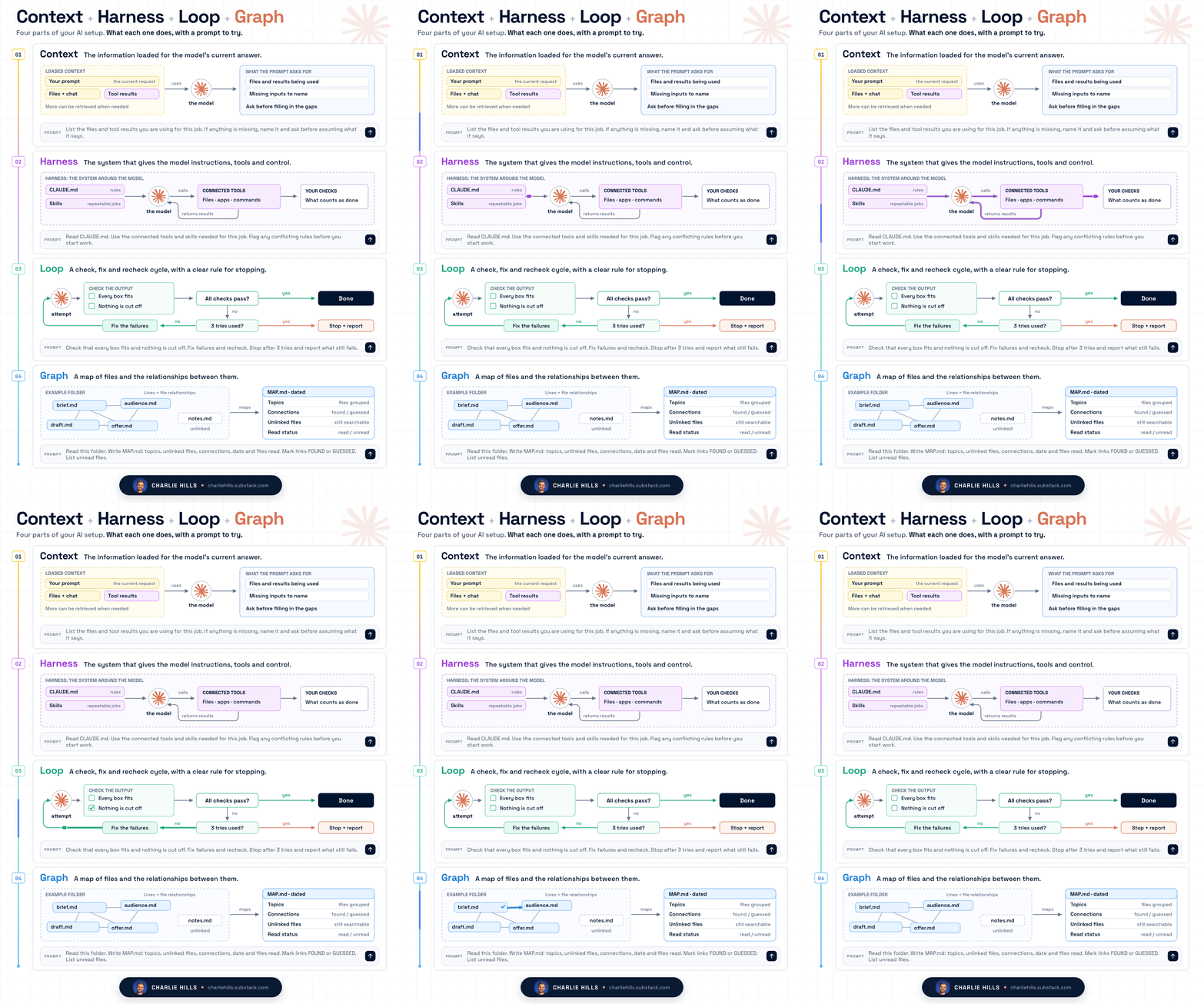
In a recent LinkedIn post, Charlie Hills 🦩 offers a pragmatic breakdown of essential, yet often complex, elements involved in managing modern AI systems. The post addresses the feeling of being overwhelmed by the rapid pace of AI development, acknowledging that even full-time practitioners struggle to keep up. Hills 🦩’s core message is that while the AI landscape is constantly evolving, fundamental concepts like context, harness, loop, and graph engineering remain crucial for effective AI implementation.
The Core AI Concepts Explained
Charlie Hills 🦩 identifies four key areas that contribute to a more robust and manageable AI workflow. These concepts, while sometimes overlapping, serve distinct purposes in optimizing how AI systems operate and interact with data and instructions.
1. Context: Understanding the AI’s View
The first element Hills 🦩 details is ‘Context,’ which pertains to what the AI can ‘see’ or access. This includes the immediate prompt and any loaded files. Hills 🦩 emphasizes the importance of clarity in defining the AI’s operational boundaries:
“Use the files I gave you for this job. If you need anything else, tell me which file and why before you assume what’s in it.”
As Charlie Hills 🦩 points out, this directive ensures the AI operates from a defined set of information, preventing assumptions and reducing errors. It clarifies the AI’s working environment, making its decision-making process more transparent.
2. Harness: Establishing Operational Boundaries
Next, Hills 🦩 discusses ‘Harness,’ which refers to the setup of rules, tools, and skills that govern the AI’s capabilities. This is where users define what the AI can and cannot do, and how it should verify its actions. Hills 🦩 illustrates this with an example:
“Read CLAUDE.md before you start. Follow the rules for this job, use the tools I’ve connected where needed, and flag any conflicting instructions.”
According to Charlie Hills 🦩, this ‘harnessing’ mechanism allows for the pre-definition of operational protocols, meaning users don’t have to reiterate every rule for each task. This streamlines interaction and ensures consistent adherence to established guidelines.
3. Loop: Enabling Self-Correction and Iteration
The ‘Loop’ concept, as explained by Charlie Hills 🦩, focuses on the AI’s ability to self-check, correct, and repeat processes. This iterative capability is crucial for refining outputs and ensuring accuracy. Hills 🦩 provides a concrete example of setting up a self-checking mechanism:
“Check the rendered graphic: every box fits and nothing is cut off. Fix any failures and check again. Stop after 3 tries and report anything still failing.”
This systematic approach, as Charlie Hills 🦩 highlights, allows the AI to identify and rectify errors independently, with defined stopping points and reporting procedures for persistent issues. This significantly enhances the reliability of AI-generated results.
4. Graph: Mapping and Connecting Data
Finally, Charlie Hills 🦩 introduces ‘Graph’ engineering, which involves mapping the connections between files and data sources. This allows for better organization and retrieval of information, even for unlinked files. Hills 🦩’s example for this is detailed:
“Read the files in this folder and write MAP.md with four parts: 1) topics and their files, ranked by inbound links, 2) files with no inbound links, as a count and percentage, 3) connections between files, naming both files and why they connect, 4) a header with the date, files read and files you couldn’t read. Mark each connection FOUND when both files state it, or GUESSED when you inferred it. Don’t count an unread file as read.”
In Charlie Hills 🦩’s view, this ‘graph’ approach creates a navigable structure for complex datasets, ensuring that users can trace relationships and locate information efficiently. It transforms a collection of files into an interconnected knowledge base.
Navigating the AI Landscape
Charlie Hills 🦩’s post serves as a valuable guide for professionals navigating the intricate world of AI. By demystifying concepts like context, harness, loop, and graph engineering, Hills 🦩 provides actionable insights for implementing and managing AI systems more effectively. The emphasis on clear instructions and structured workflows underscores the ongoing need for human oversight and strategic planning in the age of artificial intelligence.
📝 About This Content
This article is based on insights shared by Charlie Hills 🦩 on LinkedIn.
📅 Originally posted on September 14, 2026 | View original post on LinkedIn →