
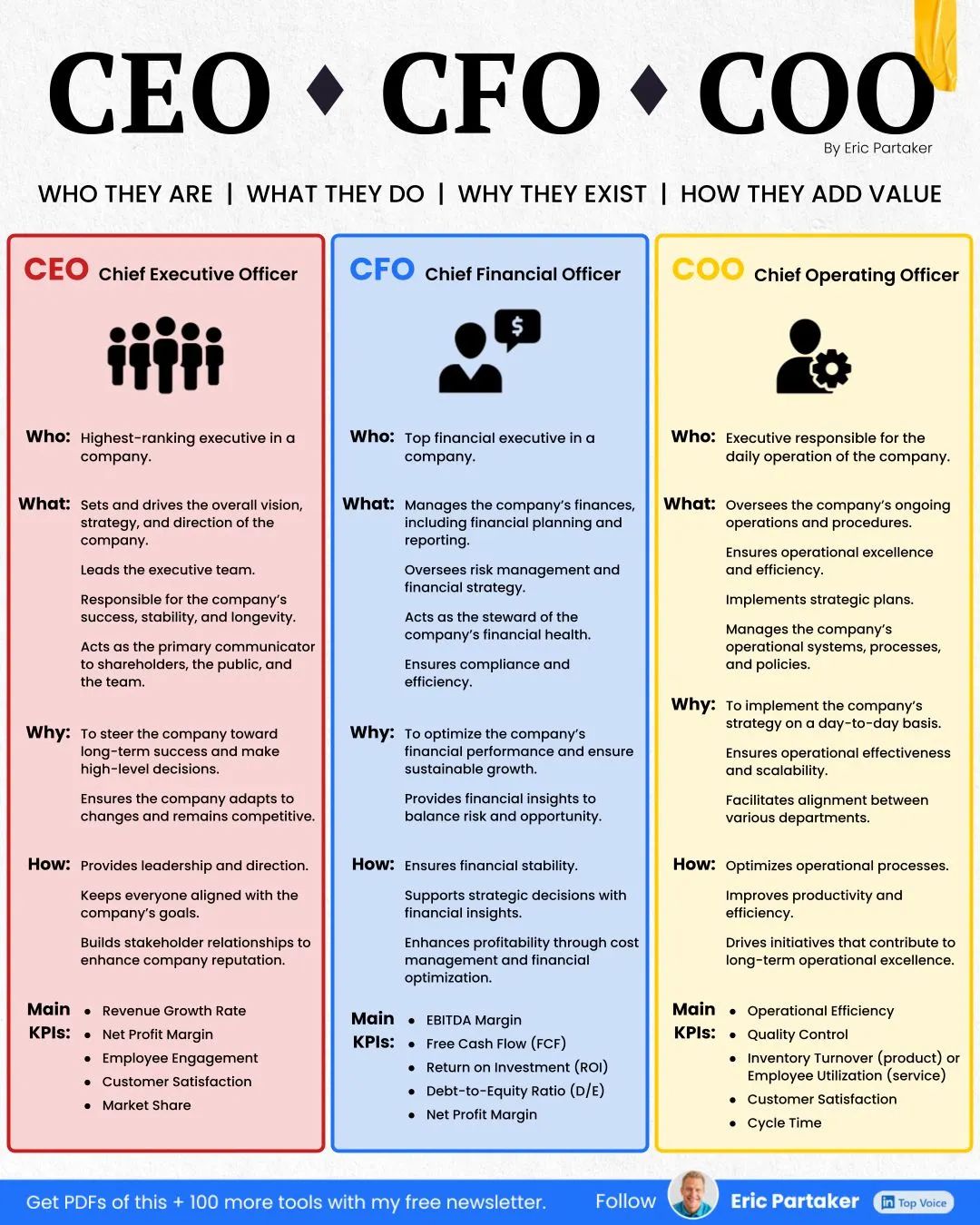
In a recent LinkedIn post, Eric Partaker offers a concise breakdown of three pivotal C-suite roles: CEO, CFO, and COO, emphasizing the importance of understanding their distinct functions for career growth and business collaboration. Partaker frames these roles not just as managerial positions but as fundamental drivers of a company’s culture, innovation, and overall direction.
Understanding the Core Functions
Partaker begins by outlining the primary responsibilities associated with each role. The CEO is defined by ‘Vision. Strategy. Leadership.’ The CFO is characterized by ‘Finance. Stability. Stewardship.’ Meanwhile, the COO is associated with ‘Operations. Efficiency. Execution.’ This clear delineation, Partaker suggests, is crucial for anyone navigating the corporate landscape.
The CEO: Vision. Strategy. Leadership. The CFO: Finance. Stability. Stewardship. The COO: Operations. Efficiency. Execution.
According to Partaker, grasping these distinctions is not merely an academic exercise. He argues that this understanding directly benefits individuals in several key ways:
- Clarifying one’s own career path within an organization.
- Strengthening collaborative efforts between different departments and leadership levels.
- Improving the ability to secure necessary buy-in and support for initiatives.
Partaker highlights that this knowledge is invaluable whether one is ‘Climbing the ladder,’ already ‘in a leadership role,’ or simply ‘curious about how companies work.’
Beyond Management: Shaping the Organization
The insights shared by Partaker extend beyond the basic definitions of these roles. He stresses their profound impact on the broader organizational ecosystem. As Eric Partaker notes, these positions don’t just manage a business; they actively shape its fundamental characteristics.
Because these roles don’t just manage a business… they shape culture, drive innovation, and set the tone for everything.
This perspective underscores the idea that leadership at the highest levels is about more than just operational oversight. It involves setting the strategic direction, fostering an environment conducive to new ideas, and establishing the ethical and operational standards that permeate the entire company. Partaker’s post encourages readers to consider these broader implications.
A Call to Action and Further Engagement
Concluding his post, Partaker frames understanding these roles as a foundational step for anyone aspiring to leadership. He prompts readers to consider their own journey, stating, ‘Tomorrow, you might be in one of these seats.’ He also invites further discussion by asking, ‘What did I miss? Which other roles are pivotal?’
The post also includes promotional information for Partaker’s upcoming workshops and accelerator program, offering opportunities for deeper engagement with topics related to sales growth, scaling a company, and world-class leadership. This provides a pathway for those who resonate with his insights to seek further guidance and development.
📝 About This Content
This article is based on insights shared by Eric Partaker on LinkedIn.
📅 Originally posted on December 8, 2025 | View original post on LinkedIn →