
In a recent LinkedIn post, Mark O’Donnell addresses a common but often frustrating leadership challenge: knowing your team isn’t performing at its best, but struggling to pinpoint the exact cause. O’Donnell frames this as a difficult position for leaders, where nothing appears overtly broken, yet the team’s full potential remains untapped. He proposes that this gap in performance typically stems from three core areas: structure, clarity, and rhythm.
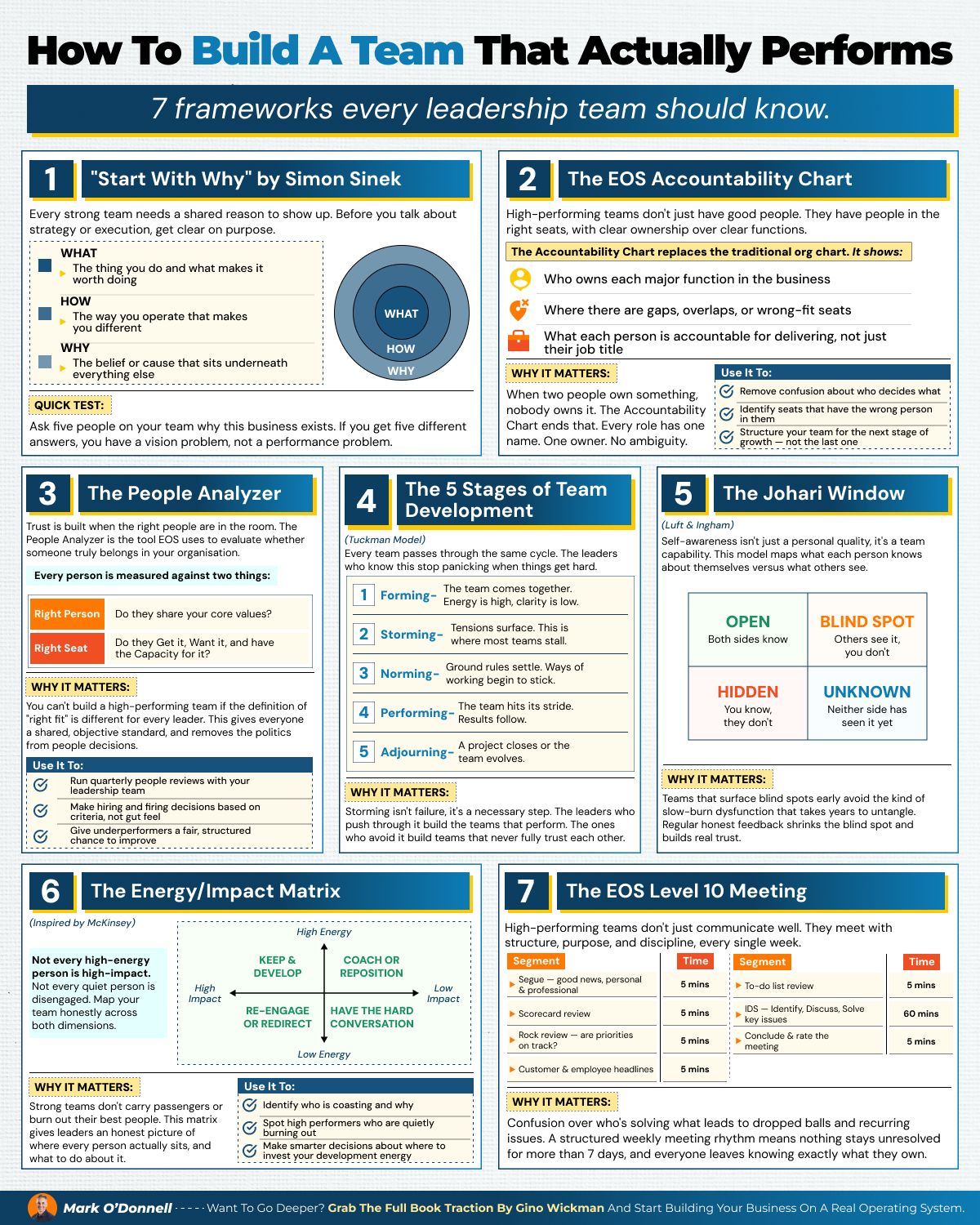
To help leaders diagnose these issues, O’Donnell shared seven frameworks designed to identify what might be hindering team effectiveness. He emphasizes that these tools can serve as a diagnostic guide, allowing leaders to select the framework most relevant to their current team challenges.
“Most leaders I talk to already know their team isn’t operating at its best. They just can’t put their finger on why. Something’s off with your team. You can feel it. But you can’t quite name it.”
Understanding the Root Causes of Underperformance
Mark O’Donnell highlights that the feeling of underperformance, while intangible, is a valid signal for leaders. He argues that by systematically applying certain frameworks, leaders can move from a state of vague unease to concrete action.
Vision and Structure
One of O’Donnell’s suggested frameworks is Simon Sinek’s “Start With Why.” As O’Donnell explains, this involves asking team members about the business’s purpose. Significant variations in answers indicate a foundational problem with the team’s vision.
Another tool O’Donnell references is the “Accountability Chart” from the Entrepreneurial Operating System (EOS). This framework, according to O’Donnell, replaces traditional organizational charts with a clear designation of ownership for each function, ensuring that there is “one seat, one name, and no ambiguity about who decides what.”
“High-performing teams need a shared standard for who belongs. In EOS, every person is evaluated on two things: 1. Do they share your core value? 2. Do they Get it, Want it, and have the Capacity for their role?”
Navigating Team Dynamics and Communication
Beyond structural elements, O’Donnell delves into team dynamics and individual contributions. He points to Tuckman’s Stages of Group Development, noting that the “Storming” phase, while uncomfortable, is crucial for building trust. Leaders who navigate this stage effectively, O’Donnell suggests, foster stronger, more cohesive teams.
The Johari Window is presented as a method for uncovering blind spots. O’Donnell advises that surfacing these discrepancies between self-perception and how others perceive an individual can prevent long-term dysfunction.
Optimizing Energy and Impact
O’Donnell also introduces the “Energy/Impact Matrix” as a practical tool for assessing team members. This matrix categorizes individuals based on their energy levels and the impact of their work, providing clear guidance for leadership actions:
- High Energy + High Impact: Keep and develop.
- High Energy + Low Impact: Re-engage or redirect.
- Low Energy + High Impact: Coach or reposition.
- Low Energy + Low Impact: Have the hard conversation.
This framework, as O’Donnell outlines, offers a structured approach to performance management, moving beyond subjective feelings to objective assessment.
Establishing Effective Rhythms
Finally, O’Donnell emphasizes the importance of consistent operational rhythms, particularly through the EOS “Level 10 Meeting.” He argues that a structured, 90-minute weekly meeting with a fixed agenda is vital for ensuring that issues are resolved promptly, accountability remains visible, and no critical tasks are overlooked.
“A 90-minute weekly rhythm with a fixed agenda is highly necessary. Issues get solved within 7 days, accountability stays visible, and nothing falls through the cracks.”
O’Donnell concludes by positioning these frameworks as a practical guide for leaders seeking to move beyond recurring problems and build consistently high-performing teams. He also directs readers to his new book, “Issues,” and his newsletter, “Clarity Break Thoughts,” for further insights into leadership clarity and systems-based approaches.
📝 About This Content
This article is based on insights shared by Mark O'Donnell on LinkedIn.
📅 Originally posted on March 10, 2026 | View original post on LinkedIn →