
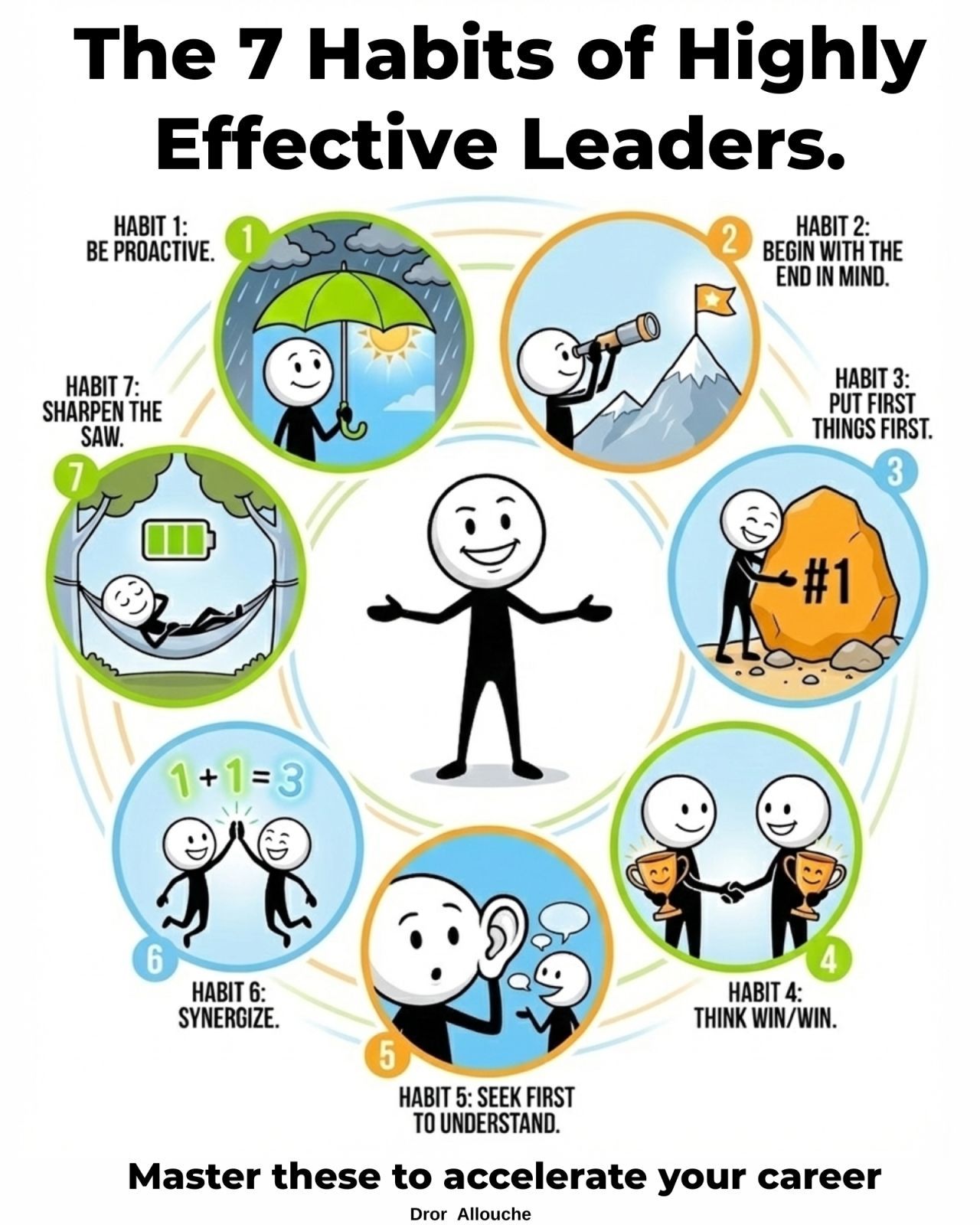
In a recent LinkedIn post, Dror Allouche distills the core principles of Stephen Covey’s seminal work, “The 7 Habits of Highly Effective People,” into actionable advice for leaders. Allouche frames the post by emphasizing that while many may not read the entire book, its lessons are crucial for effective leadership and personal growth.
Allouche shares his personal connection to the book, stating:
“The 7 Habits of Highly Effective People by Stephen Covey. A book that changed my life and could change yours. I’ve read it over 10 times in 20 years, each time, it changes me a little more.”
The post presents a condensed, visual summary of the seven habits, offering a “2-minute summary on personal effectiveness.” Allouche breaks down each habit with a “Do” and “Don’t” approach, making complex concepts easily digestible for his audience.
Habit 1: Be Proactive – Taking Ownership
Allouche highlights the foundational habit of proactivity, urging readers to embrace personal responsibility. According to Allouche, the key is to acknowledge that individuals are in charge of their own choices and outcomes.
Do: Take responsibility for your actions and choices. Don’t: Blame others or circumstances for your outcomes.
This principle, as Dror Allouche points out, forms the bedrock of personal effectiveness, enabling individuals to shape their circumstances rather than being shaped by them.
Habit 2 & 3: Vision and Prioritization
Moving to the next steps, Allouche addresses the importance of having a clear direction and managing time effectively. “Begin with the End in Mind” encourages leaders to visualize their goals and ensure their daily actions are aligned with this vision. Allouche cautions against aimless drifting through tasks without a clear purpose.
Furthermore, the habit of “Put First Things First” is presented as critical for avoiding the pitfalls of urgency over importance. As Dror Allouche emphasizes, effective leaders must learn to prioritize what truly matters, resisting the constant pull of distractions.
The Power of Proactive Prioritization
Allouche’s breakdown of “Put First Things First” underscores a common challenge in modern workplaces: the tyranny of the urgent. He advises:
Do: Prioritize important tasks over urgent ones. Don’t: Let distractions dictate your schedule.
This distinction, according to Allouche, is vital for sustained productivity and meaningful progress.
Habit 4, 5 & 6: Interpersonal Effectiveness
The latter half of Covey’s framework, as summarized by Allouche, shifts focus to interpersonal dynamics and collaboration. “Think Win/Win” promotes seeking mutually beneficial solutions, a stark contrast to a competitive or zero-sum mindset. Dror Allouche argues that true leadership involves fostering environments where all parties feel they have gained.
The habit of “Seek First to Understand, Then to Be Understood” is presented as a cornerstone of effective communication. Allouche stresses the importance of active listening, encouraging empathy before asserting one’s own viewpoint. Finally, “Synergize” calls for collaboration, highlighting that teamwork can unlock greater potential than individual efforts.
Habit 7: Continuous Renewal
The final habit, “Sharpen the Saw,” addresses the indispensable need for self-care and continuous improvement. Allouche frames this as an investment in long-term well-being and effectiveness, cautioning against sacrificing personal renewal for short-term gains.
In his concluding remarks, Dror Allouche reiterates the transformative potential of these habits, suggesting that mastering them can significantly accelerate career trajectories. He prompts his network to consider which habits resonate most, encouraging engagement and sharing of the insights.
📝 About This Content
This article is based on insights shared by Dror Allouche on LinkedIn.
📅 Originally posted on July 11, 2026 | View original post on LinkedIn →