
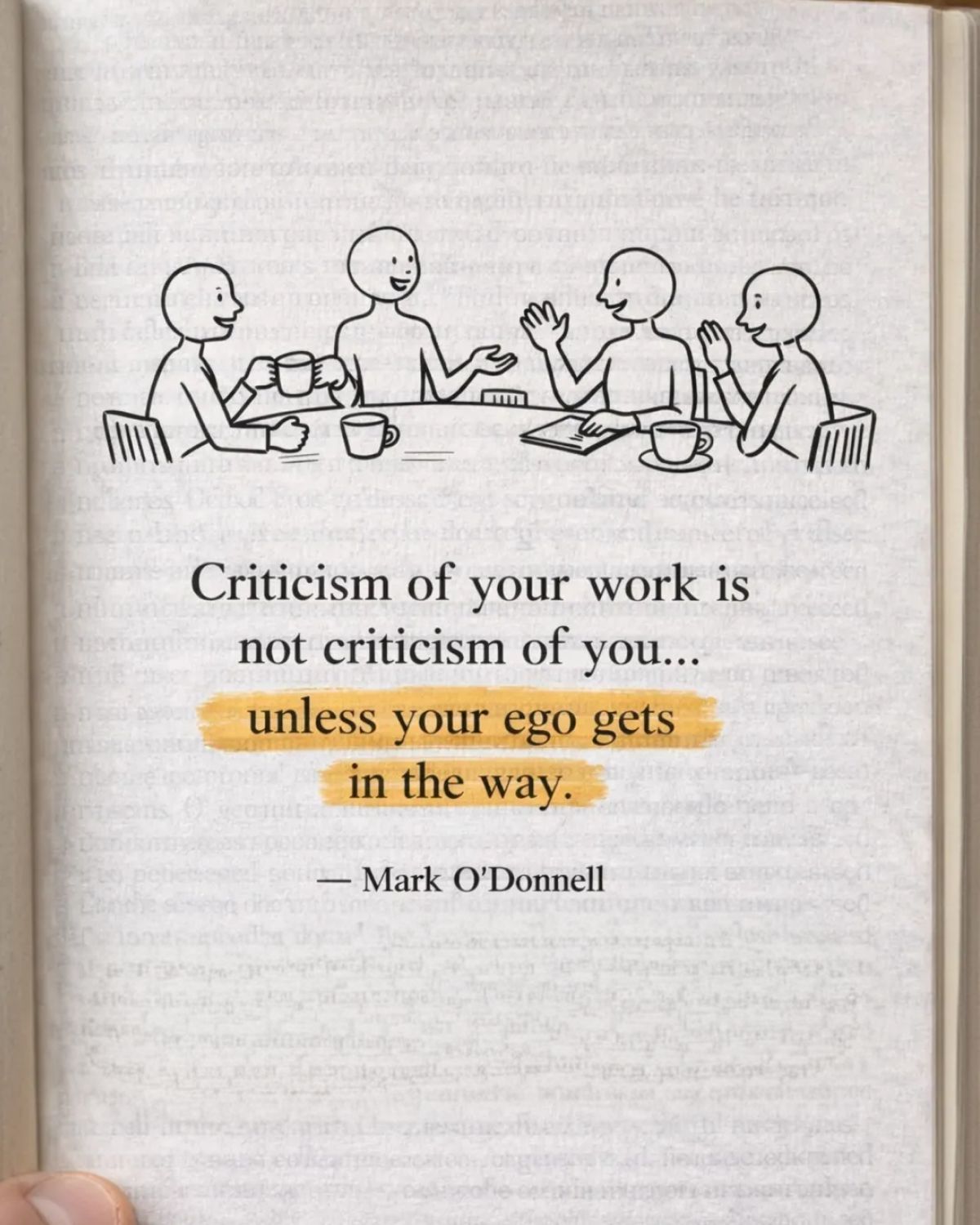
In a recent LinkedIn post, Mark O’Donnell tackles a critical aspect of leadership: the ability to receive feedback without letting ego interfere. O’Donnell argues that while many leaders believe they are open to criticism, their team’s perception often differs significantly, particularly when their ideas are challenged in a public setting.
He highlights the common reaction where defensiveness takes over, leading leaders to immediately justify their original concept rather than genuinely considering the critique. O’Donnell frames this reaction not as leadership, but as ego at play.
“That right there is ego, not leadership.”
O’Donnell emphasizes that this difficulty in separating personal identity from one’s work is a major maturity gap he observes in leadership teams. When leaders cannot accept feedback on their work without feeling personally attacked, it erodes trust and psychological safety within the team.
The Impact of Defensiveness on Team Dynamics
According to Mark O’Donnell, the consequence of a leader’s defensiveness is a chilling effect on open communication. Team members, learning that their input is not valued or will lead to conflict, tend to suppress their true opinions. This leads to a scenario where genuine collaboration is replaced by compliance.
As O’Donnell points out, this dynamic prevents the best ideas from surfacing and being adopted.
“And when that happens, the best idea stops winning. The leader’s idea wins. Every time.”
This, in O’Donnell’s view, is a direct path to organizational stagnation, where innovation is stifled because dissenting or alternative perspectives are not effectively integrated.
Strategies for Cultivating Feedback-Resilient Leadership
To address this pervasive issue, O’Donnell offers practical strategies for leaders to become more receptive to feedback and manage their ego. He suggests a shift in approach, moving from declarative statements of defense to a more inquisitive stance.
Key Feedback Strategies from O’Donnell:
- Ask questions instead of making statements: O’Donnell advises replacing phrases like “Here’s why that won’t work” with “Help me understand what you’re seeing.” This encourages dialogue rather than shutting down discussion.
- Separate the idea from your identity: A crucial step is to consciously remind oneself that feedback pertains to the work itself, not to one’s personal worth.
- Look for the 10% that’s true: Even when disagreeing with the majority of the feedback, O’Donnell encourages leaders to identify and acknowledge any valid points within the critique.
- Thank people for pushing back: Leaders should actively foster an environment where challenging ideas is safe. Expressing gratitude, such as “I appreciate you raising that,” reinforces this safety.
- Track how often you change your mind: O’Donnell suggests self-monitoring as a signal of progress. If a leader cannot recall the last time feedback genuinely shifted their perspective, it indicates a potential issue.
The ultimate goal, as outlined by O’Donnell, is not to blindly accept all criticism, but to cultivate an environment where feedback serves to enhance the work and prevent team members from shutting down. He terms this the hallmark of true leadership maturity.
“The goal isn’t to accept every piece of criticism. It’s to create an environment where feedback makes the work better instead of making people shut down.”
O’Donnell concludes by linking these principles to his new book, “Issues,” which focuses on building cultures where the best ideas prevail and ego is minimized.
📝 About This Content
This article is based on insights shared by Mark O'Donnell on LinkedIn.
📅 Originally posted on February 16, 2026 | View original post on LinkedIn →