
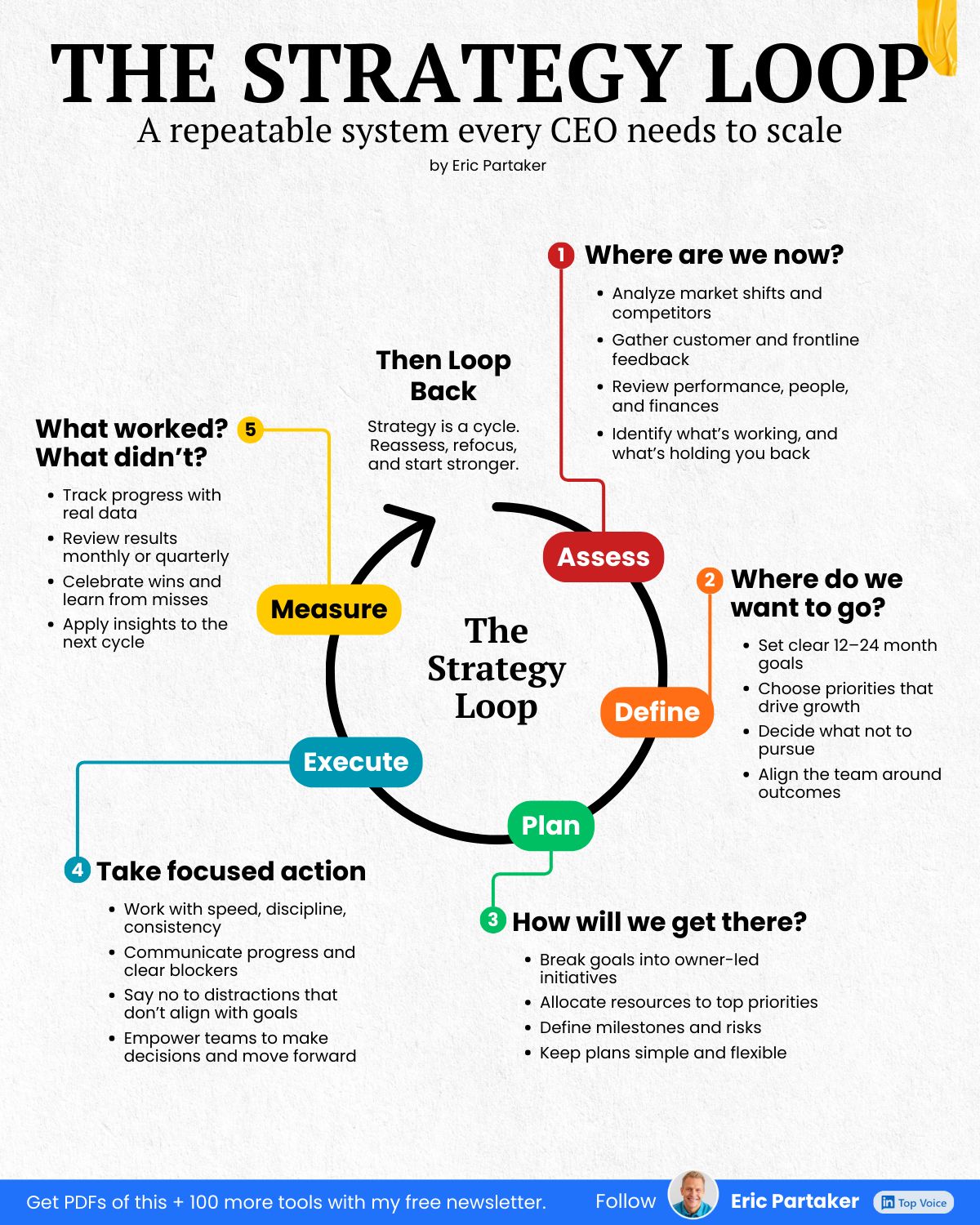
In a recent LinkedIn post, Eric Partaker discusses a more agile approach to business strategy, moving away from traditional annual planning cycles. Partaker argues that static, year-long strategies are insufficient in today’s rapidly changing markets and proposes a dynamic 90-day “loop” as a superior alternative for maintaining competitive advantage.
Partaker highlights common pitfalls that hinder the effectiveness of traditional strategy, noting:
“Strategy decks gather dust while competitors move faster.”
The post outlines a five-step system designed to foster continuous adaptation and execution. This system, according to Partaker, aims to keep teams focused and aligned, driving consistent growth quarter after quarter.
The Limitations of Annual Strategy
Eric Partaker begins by identifying several key issues with strategies that are set only once a year. He points out that while plans might be finalized annually, market conditions often shift on a monthly basis. This disconnect can leave businesses outdated and reactive. Furthermore, Partaker touches upon the common phenomenon where initial alignment achieved during strategic retreats dissipates quickly, with teams falling back into silos by the start of the work week.
He elaborates on the execution gap:
“Goals look great on paper, but execution gets lost in daily fires.”
According to Partaker, this disconnect between planning and execution is a significant barrier to realizing strategic objectives. The continuous “daily fires” often distract from the larger, more critical strategic initiatives.
Introducing the 90-Day Strategy Loop
To counter these challenges, Partaker introduces his “Strategy Loop” system. He emphasizes that strategy should be a continuous rhythm rather than a singular event. The core of this system involves a cyclical process repeated every 90 days.
The Five Steps of the Strategy Loop
Partaker breaks down the 90-day loop into five distinct phases:
- Assess: This initial step involves facing reality by gathering crucial insights from customers, internal teams, and performance data.
- Define: Partaker advises defining a focused set of objectives, suggesting leaders pick “3 battles” to fight, emphasizing quality and winnability over quantity.
- Plan: This phase focuses on resource allocation, recommending that leaders “stack resources” and assign their best people to the most significant opportunities.
- Execute: Partaker stresses the importance of speed and discipline in execution, advocating for weekly tracking rather than annual reviews.
- Measure: The final step involves celebrating wins, learning from outcomes, and applying these insights to the next 90-day cycle.
As Partaker explains the benefit of this approach:
“Because real growth doesn’t come from a once-a-year strategy retreat. It comes from building a leadership rhythm that: Adapts faster than markets change, Keeps your team focused, Executes with consistency, Improves every cycle.”
This continuous cycle, according to Partaker, builds a leadership rhythm that is inherently more adaptive and effective than traditional methods. It ensures that the organization remains agile, focused, and consistently improving.
Gaining a Competitive Edge
Partaker concludes by framing the 90-day loop as a significant competitive advantage. He suggests that by implementing this system, businesses can stay ahead of competitors who are still operating on slower, annual planning cycles.
“Your competition is still waiting for January,” Partaker writes, implying that adopting a quarterly strategic rhythm allows businesses to be “three loops ahead.” He encourages leaders to save and share this framework, suggesting it be implemented immediately.
📝 About This Content
This article is based on insights shared by Eric Partaker on LinkedIn.
📅 Originally posted on February 27, 2026 | View original post on LinkedIn →