
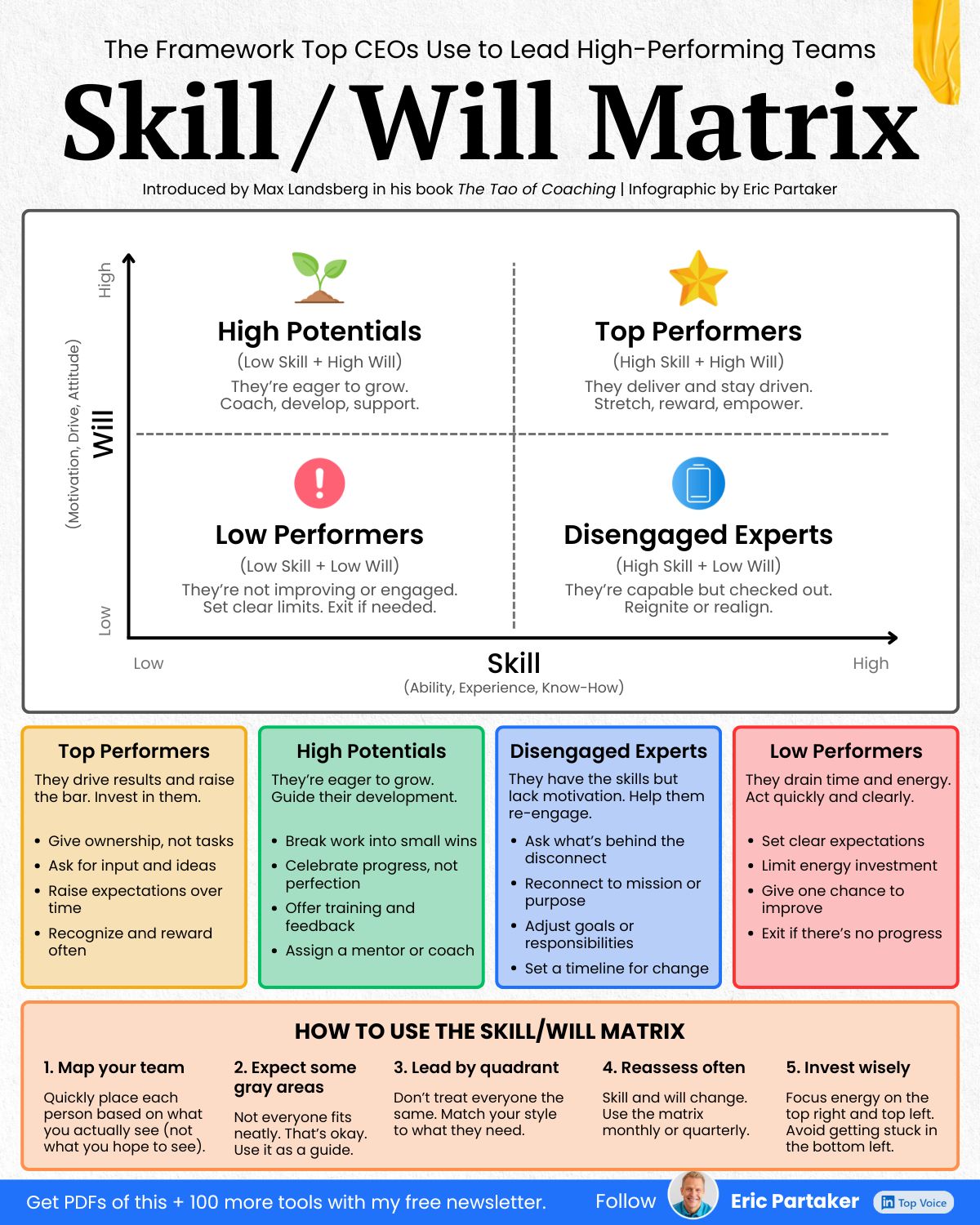
In a recent LinkedIn post, Eric Partaker discusses a strategic approach to team leadership, emphasizing the importance of individualizing management styles based on an employee’s skill and motivation levels. Drawing on his experience coaching over 650 CEOs, Partaker highlights a common pattern among successful leaders: their refusal to adopt a one-size-fits-all management strategy.
Instead, as Eric Partaker notes, these leaders “diagnose each person individually and adjust their approach to fit.” This tailored methodology is centered around the Skill/Will Matrix, a framework developed by Max Landsberg. The matrix categorizes individuals based on their proficiency (skill) and drive (will), resulting in four distinct employee profiles, each demanding a unique leadership response.
“The leaders with the strongest teams refuse to manage everyone the same way.”
Understanding the Four Employee Archetypes
Partaker breaks down the four quadrants of the Skill/Will Matrix:
1. Top Performers (High Skill, High Will)
These individuals, according to Partaker, are the backbone of a thriving organization. They possess both the ability and the motivation to excel, consistently raising the bar for their colleagues. Eric Partaker advises leaders to build the company’s future around these individuals by granting them ownership, seeking their input, increasing expectations, and providing frequent recognition. However, he cautions against overloading them solely due to their capacity, stressing the need for both stretching and investing in their development.
2. High Potentials (Low Skill, High Will)
Characterized by enthusiasm and a strong desire to grow, these team members are eager but currently lack the necessary skills. Partaker suggests that the key to developing High Potentials lies in providing ample opportunities for practice and learning. His recommendations include coaching, breaking down tasks into manageable steps, celebrating progress, and pairing them with mentors. “These are your future Top Performers if you develop them well,” Eric Partaker asserts.
“They are eager, hungry, and ready to grow. They just need reps.”
3. Disengaged Experts (High Skill, Low Will)
This group presents a unique challenge, possessing the expertise but lacking the motivation. Partaker suggests this disengagement might stem from boredom, burnout, or feeling outgrown in their current role. He recommends leaders actively explore the root cause of the disconnect, attempt to re-align the employee with the company’s mission, and adjust responsibilities or goals. A clear timeline for improvement should be set, and if the situation doesn’t change, Partaker implies that a difficult decision may be necessary.
4. Low Performers (Low Skill, Low Will)
These employees, as described by Partaker, can negatively impact team morale and productivity due to a deficiency in both skill and motivation. Eric Partaker advocates for setting explicit expectations and offering a single opportunity for improvement. If performance does not meet the required standard, he advises a respectful exit. “Keeping them in place tells everyone else that your standards are negotiable,” he warns.
“The point of the matrix is to lead each person according to where they are right now.”
The Compounding Effect of Tailored Leadership
Partaker emphasizes that while individuals may not always fit perfectly into one category and their skill and will can fluctuate over time, the Skill/Will Matrix serves as a vital tool for effective leadership. The core principle, as Eric Partaker argues, is to “lead each person according to where they are right now.” By applying this individualized approach, leaders can ensure their efforts are concentrated where they will yield the greatest returns, thereby compounding their positive impact on the team and the organization.
📝 About This Content
This article is based on insights shared by Eric Partaker on LinkedIn.
📅 Originally posted on July 24, 2026 | View original post on LinkedIn →