
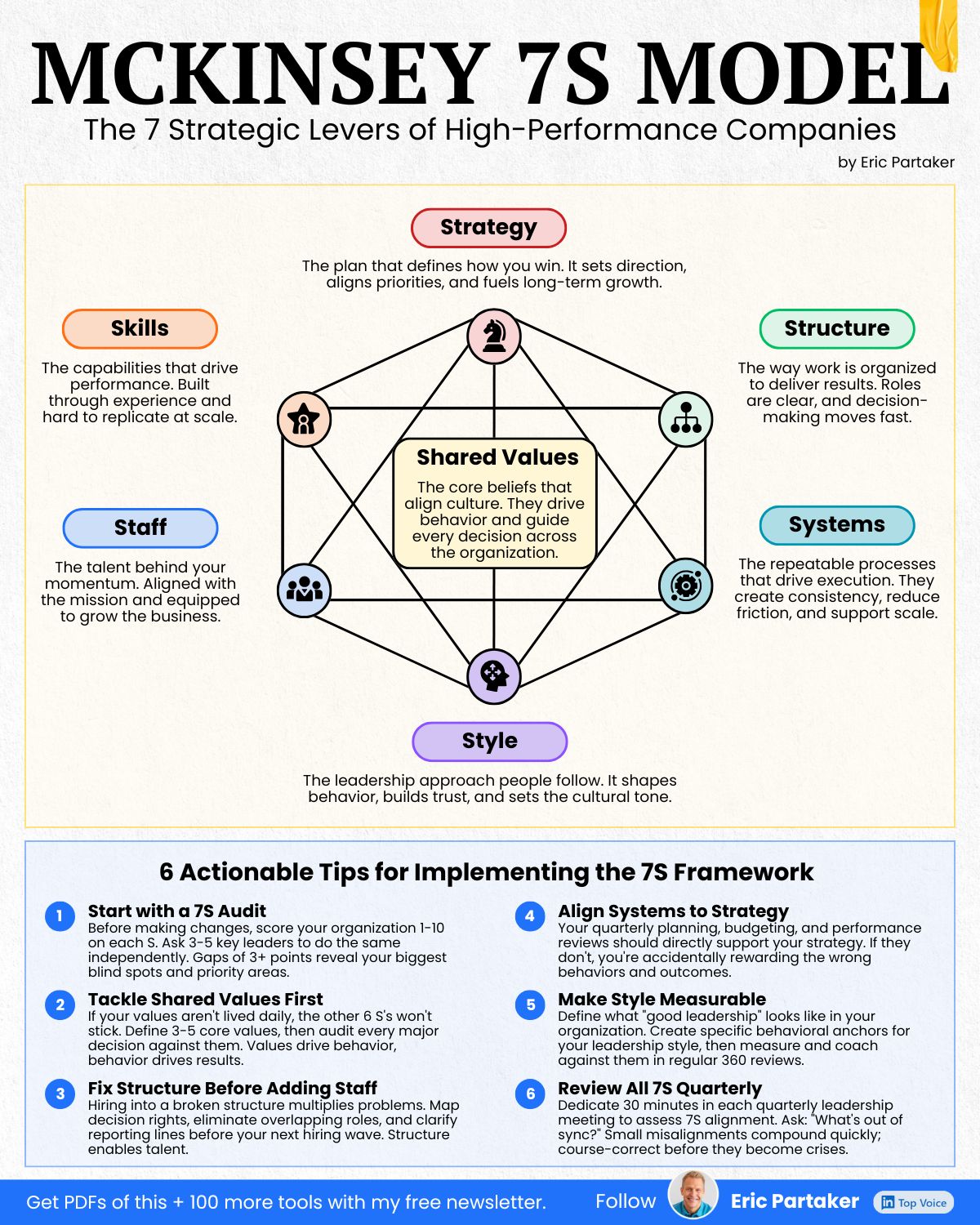
In a recent LinkedIn post, Eric Partaker delves into the fundamental components that drive business performance, identifying seven critical “engines” that high-performing companies must align. Partaker, a seasoned entrepreneur and investor, argues that many leaders overlook key areas, leading to underperformance.
According to Partaker, most businesses only focus on a fraction of these essential elements. He outlines these seven engines as:
“SHARED VALUES – The Mission Engine
↳ The core beliefs everyone shares
↳ Guides choices without asking
↳ Skip this? Teams pull apart”
Partaker emphasizes that these engines are not isolated but interconnected. He posits that a failure in one area can have cascading negative effects on others. The post highlights a common pattern observed in companies:
- Great companies align all 7
- Stuck companies fix only 3-4
- Failing companies ignore 5+
The Seven Engines of Business Success
Partaker elaborates on each of the seven engines, providing a concise description of their role and the consequences of neglecting them. He stresses that these are not mere theoretical concepts but practical operational necessities.
1. Shared Values (The Mission Engine)
This engine represents the foundational beliefs that guide a company’s actions. As Partaker notes, when values are clear and shared, employees can make decisions autonomously, aligning with the company’s mission without constant oversight. Neglecting this, he warns, leads to teams working at cross-purposes.
2. Strategy (The Direction Engine)
This refers to the company’s plan for competitive advantage. Partaker explains that a well-defined strategy clarifies priorities and directs focus. Without it, he argues, confusion pervades the organization.
3. Structure (The Organization Engine)
Here, Partaker discusses the importance of clear roles and decision-making authority. He points out that an effective structure facilitates speed and efficiency, while a poorly designed one leads to stagnation.
4. Systems (The Process Engine)
This engine encompasses the playbooks and processes that enable repeatable success. Partaker states that skipping systemization means teams must reinvent solutions daily, a significant drain on resources.
“Your step-by-step playbooks
↳ Makes success repeatable
↳ Skip this? Start from zero daily”
5. Style (The Leadership Engine)
Partaker differentiates between what leaders say and what they do, asserting that leadership actions, or “style,” ultimately shape the organizational culture. He cautions against inauthenticity, stating, “Fake it? Teams know.”
6. Staff (The Talent Engine)
This engine focuses on having the right people in the right roles, all aligned towards common goals. Partaker indicates that misaligned talent will prevent any business from functioning effectively.
7. Skills (The Capability Engine)
Finally, Partaker highlights the necessary abilities and competencies within the workforce. He argues that these skills are built through practice and application, not just theoretical learning, and are crucial for staying competitive.
Common Leadership Pitfalls
Partaker identifies several significant mistakes leaders often make, which hinder their ability to harness these seven engines. He criticizes the common assumption that superficial changes, like new organizational charts or good strategies alone, can overcome poor execution or a weak culture.
“Believe good strategy beats bad execution”
He also calls out the misconception that technology can replace effective leadership or that employees will spontaneously acquire necessary skills. In Partaker’s view, these are critical blind spots that prevent businesses from reaching their full potential.
The Power of Integrated Systems
When all seven engines are functioning in harmony, Partaker asserts, the results are transformative. He suggests that decisions accelerate dramatically, team conflicts diminish, and growth becomes more organic. The ultimate outcome, he concludes, is a business that operates cohesively, like a well-oiled machine, rather than a collection of disparate parts.
“When all 7 parts work together:
✅ Decisions happen 10x faster.
✅ Teams stop fighting each other.
✅ Growth becomes automatic.”
Partaker’s post serves as a comprehensive framework for leaders to assess and optimize their organizations, urging them to move beyond fixing only what is convenient or visible, and instead address the entire system.
📝 About This Content
This article is based on insights shared by Eric Partaker on LinkedIn.
📅 Originally posted on July 31, 2026 | View original post on LinkedIn →