
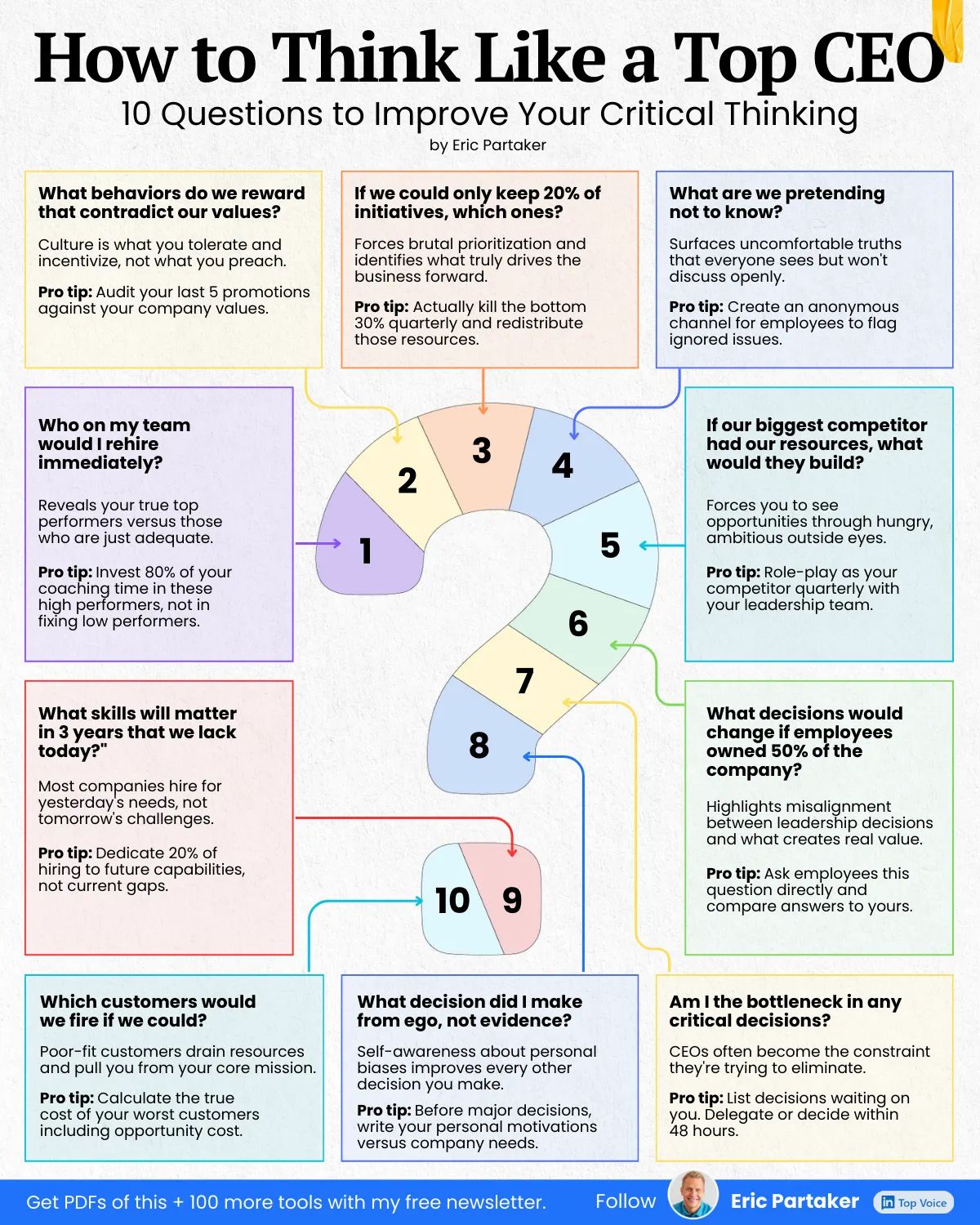
In a recent LinkedIn post, Eric Partaker delves into a critical aspect of effective leadership: the nature of questions asked by Chief Executive Officers. Partaker contends that many CEOs pose the “comfortable” or “safe” questions, which ultimately hinder their companies’ growth and can lead to stagnation.
He highlights a common pitfall: asking questions that avoid conflict or uncomfortable truths. According to Partaker, this avoidance is detrimental. He states:
Most CEOs ask the wrong questions. The comfortable ones. The safe ones. The ones that won’t upset anyone. And their companies slowly die because of it.
Partaker then introduces seven specific questions he believes can fundamentally alter a leader’s perspective and drive significant business improvement. These questions are designed to provoke deeper thought and encourage decisive action, moving beyond superficial concerns.
Challenging Assumptions and Prioritizing Initiatives
One of the core themes in Partaker’s post is the necessity of ruthless prioritization. He questions the common practice of spreading resources too thinly across numerous projects. As Partaker suggests:
What if we could only keep 20% of initiatives? ↳ Forces brutal prioritization ↳ Kills pet projects ↳ Creates focus
This line of questioning, according to Partaker, compels leaders to identify and focus on the initiatives that truly drive value, rather than getting bogged down by less impactful endeavors. He emphasizes that this focus can unlock the potential of top performers, enabling them to achieve exponentially greater results.
Identifying and Addressing Internal Blind Spots
Another critical area Partaker addresses is the concept of organizational blind spots, or “elephants in the room.” He argues that successful leaders must actively seek out and confront these issues, rather than ignoring them. Partaker poses a direct question to leaders:
What are we pretending not to know? ↳ Every company has elephants ↳ The failing product ↳ The checked-out executive
He advocates for creating mechanisms, such as anonymous channels, to uncover these hidden problems. Partaker’s underlying message is that acknowledging and tackling these uncomfortable truths is essential for a company’s survival and success. He further stresses the importance of self-awareness, asking leaders to consider their own role in potential bottlenecks.
Rethinking Customer Relationships and Resource Allocation
Partaker also turns the focus to customer relationships, suggesting that not all customers are equally valuable. He challenges leaders to consider the cost of serving less profitable or demanding clients, which can divert resources and attention from core objectives. Partaker asks:
Which customers would we fire? ↳ Bad customers drain resources ↳ Pull focus from your mission ↳ Demand features that dilute product
By calculating the true cost, including opportunity cost, associated with certain client relationships, leaders can make more strategic decisions about resource allocation. Partaker concludes by reinforcing his central thesis: great leaders embrace uncomfortable questions, while average leaders shy away from them.
📝 About This Content
This article is based on insights shared by Eric Partaker on LinkedIn.
📅 Originally posted on January 12, 2026 | View original post on LinkedIn →