
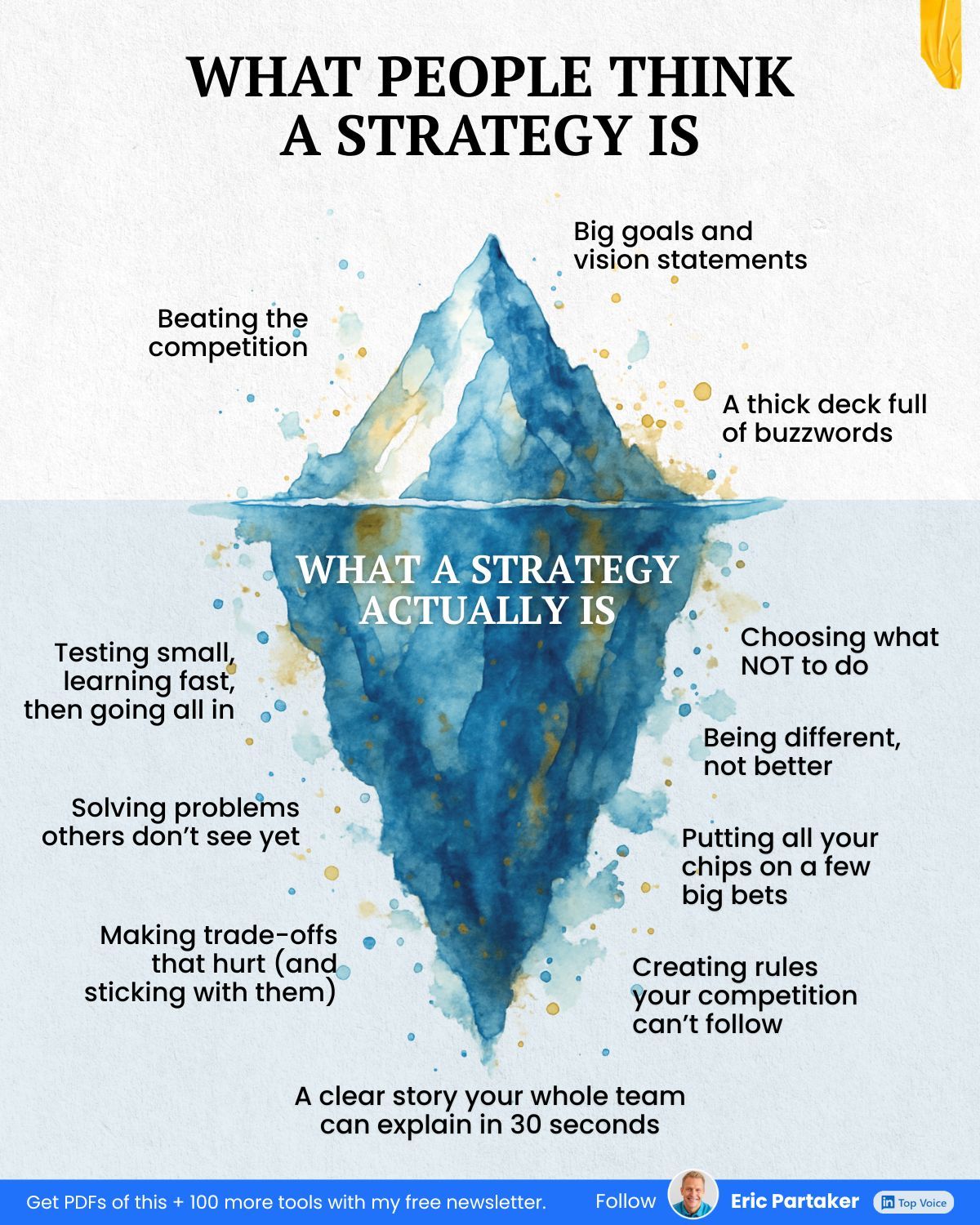
In a recent LinkedIn post, Eric Partaker offers a sharp critique of common business strategy practices, arguing that many organizations mistake elaborate plans for genuine strategic direction. Partaker contends that true strategy is often uncomfortable and requires difficult choices, contrasting it with what he describes as “wish lists” or “pretty decks.” He emphasizes that effective strategy is less about broad ambition and more about focused execution.
Defining Real Strategy: Beyond Buzzwords
Partaker challenges the conventional approach to strategy, which he observes often results in inaction. He points out that many founders create extensive presentations filled with “buzzwords and vision statements,” aiming to “beat the competition” and “dominate the market.” However, he notes the frequent outcome of such efforts:
“Then 6 months later? Nothing has changed.”
According to Partaker, this failure stems from a misunderstanding of what strategy truly entails. He delineates the common misconceptions:
- Acknowledge that strategy is not merely a visually appealing document that remains unused.
- Reject the idea of simply imitating competitors, even with perceived improvements.
- Understand that ambitious goals must be coupled with difficult decisions, not just aspirations.
- Avoid the trap of trying to cater to every possible customer or market segment.
He contrasts these non-strategies with the core tenets of genuine strategic thinking. Partaker argues that effective strategy is fundamentally about making deliberate choices, particularly about what not to pursue.
The Power of Focused Bets and Trade-offs
Partaker highlights that real strategy involves making “trade-offs that make you sweat” and choosing to be “different, not better.” He illustrates this point with a powerful anecdote about a founder who made a radical decision to achieve focus:
“A founder who shut down 3 profitable product lines to focus on just one. His board thought he was crazy. His team was terrified. Even his wife questioned it.”
This drastic measure, Partaker explains, was rooted in the understanding that strategy requires commitment. As he puts it, “Strategy is about putting all your chips on a few big bets. Not hedging. Not playing it safe. Going all in.” This bold move, he reports, led to a tenfold increase in revenue for the remaining product line within 18 months, underscoring the power of decisive focus.
Testing for True Strategy
To help leaders identify whether they possess a genuine strategy or merely a set of aspirations, Partaker proposes a simple yet rigorous test. He suggests that a real strategy should meet several criteria:
- It must be easily explainable by even the newest employee in a short amount of time, ideally 30 seconds.
- It must necessitate saying “no” to attractive, yet ultimately distracting, opportunities.
- It should establish unique operating principles that competitors find difficult or impossible to replicate.
Partaker concludes that if a plan doesn’t meet these demanding standards, it likely falls short of being a true strategy. He asserts that “Most leaders want strategy to be comfortable. But real strategy should make you uncomfortable.” Instead of seeking comfort, he advocates for a process of iterative testing, rapid learning, and decisive commitment once a viable path is identified.
📝 About This Content
This article is based on insights shared by Eric Partaker on LinkedIn.
📅 Originally posted on March 21, 2026 | View original post on LinkedIn →