
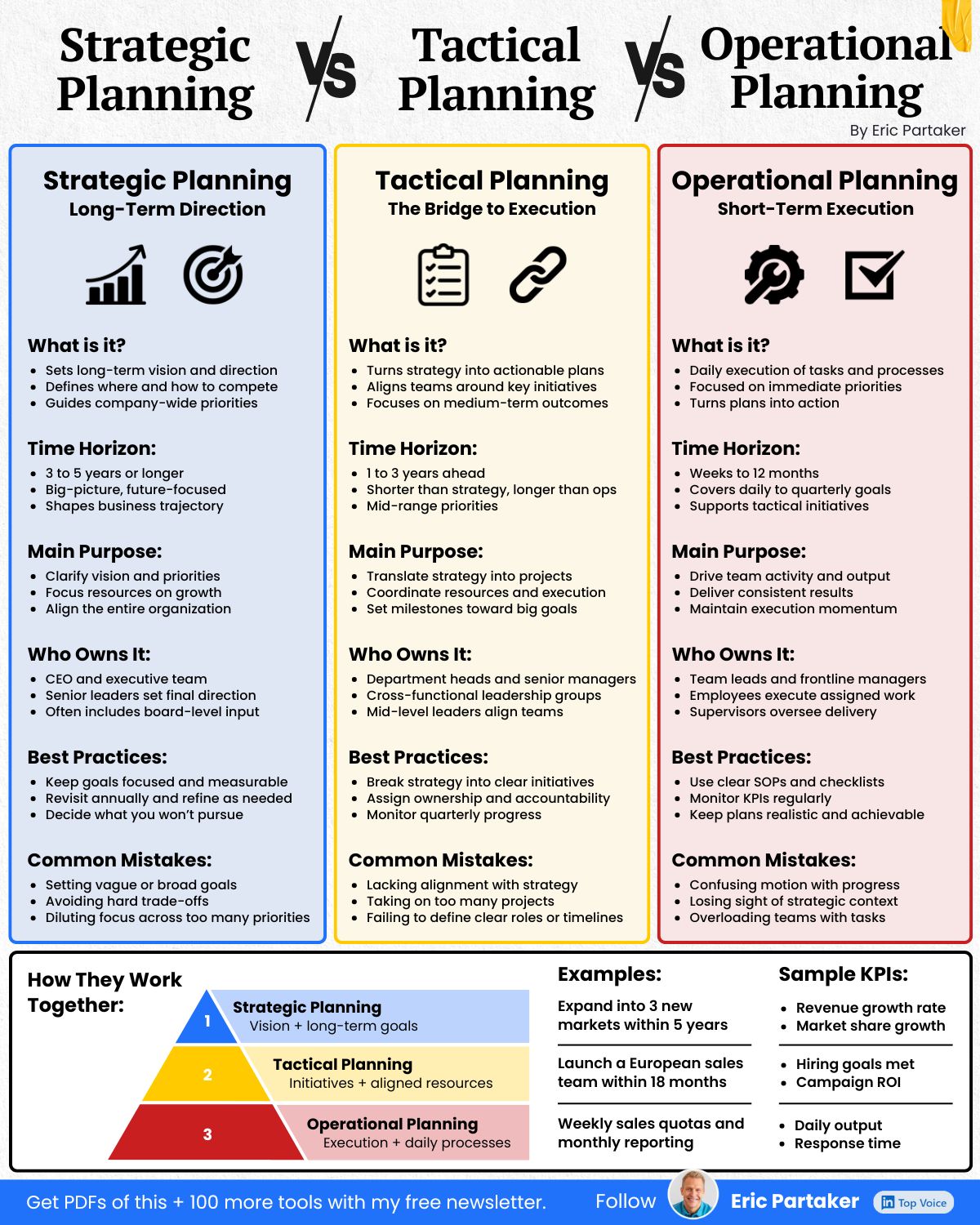
In a recent LinkedIn post, Eric Partaker argues that the common overuse of the term “strategy” is hindering effective business execution and scaling. Partaker contends that this broad application of the word “strategy” has led to a conflation of distinct planning layers, ultimately resulting in a lack of clarity and precision within organizations.
According to Eric Partaker, the term “strategy” has become a catch-all phrase encompassing goals, vision, tactics, planning, and execution. This ambiguity, he suggests, prevents companies from achieving the focused execution necessary for growth.
“Because when everything is strategy, nothing gets executed with precision.”
Partaker proposes a clear delineation of these planning levels to foster clarity and enable scaling without chaos. He breaks down the distinct roles of strategic, tactical, and operational planning.
Deconstructing the Planning Layers
Eric Partaker outlines three essential layers of planning, each with a specific purpose:
Strategic Planning: Setting the Direction
As Eric Partaker notes, strategic planning is responsible for establishing the long-term direction of a company. This layer involves clarifying the organization’s competitive position and defining what initiatives or opportunities will not be pursued.
Tactical Planning: Bridging Vision and Execution
Tactical planning, according to Partaker, translates the overarching strategy into focused initiatives. This level aligns teams around shared milestones, effectively bridging the gap between the high-level vision and the practical steps needed for implementation.
“Translates strategy into focused initiatives. Aligns teams around shared milestones. Bridges vision and execution.”
Operational Planning: Driving Day-to-Day Execution
The final layer, operational planning, is focused on driving the day-to-day execution of tasks. Partaker explains that this level turns strategic objectives into concrete actions, habits, and measurable output, ensuring teams remain synchronized and productive.
The Perils of a Blended Approach
Partaker highlights a common pitfall where companies blend these three distinct planning layers into a single, often bloated, “strategy document.” This lack of separation, he argues, leads to several detrimental outcomes:
- Teams struggle with unclear priorities.
- Daily tasks fail to connect with overarching objectives.
- Projects may run in parallel but lack true alignment.
The result, as Eric Partaker points out, is often a disconnect between strategic intent and operational reality.
“Most companies blend all 3 into 1 bloated “strategy doc.” The result? Teams are unclear on priorities Daily tasks don’t ladder up to big goals Projects run in parallel but not in alignment”
Achieving Scalability Through Clarity
When these planning layers are clearly separated, Partaker asserts that the entire organizational dynamic shifts. Strategy moves from being purely theoretical to having practical implications, tactical plans gain tangible impact, and operations begin to drive meaningful progress.
Eric Partaker concludes by emphasizing that great companies scale by setting direction at the top, building a bridge in the middle through tactical planning, and executing relentlessly at the bottom through operations. He suggests that leadership teams need clarity on which planning level they are operating at and why it matters, rather than simply being assigned more tasks.
“Strategy sets the destination. Tactics chart the course. Operations drive the car. Alignment lives here.”
By separating these planning layers, leaders can foster faster decision-making, tighter focus, and improved execution, ultimately paving the way for sustainable growth.
📝 About This Content
This article is based on insights shared by Eric Partaker on LinkedIn.
📅 Originally posted on April 6, 2026 | View original post on LinkedIn →