
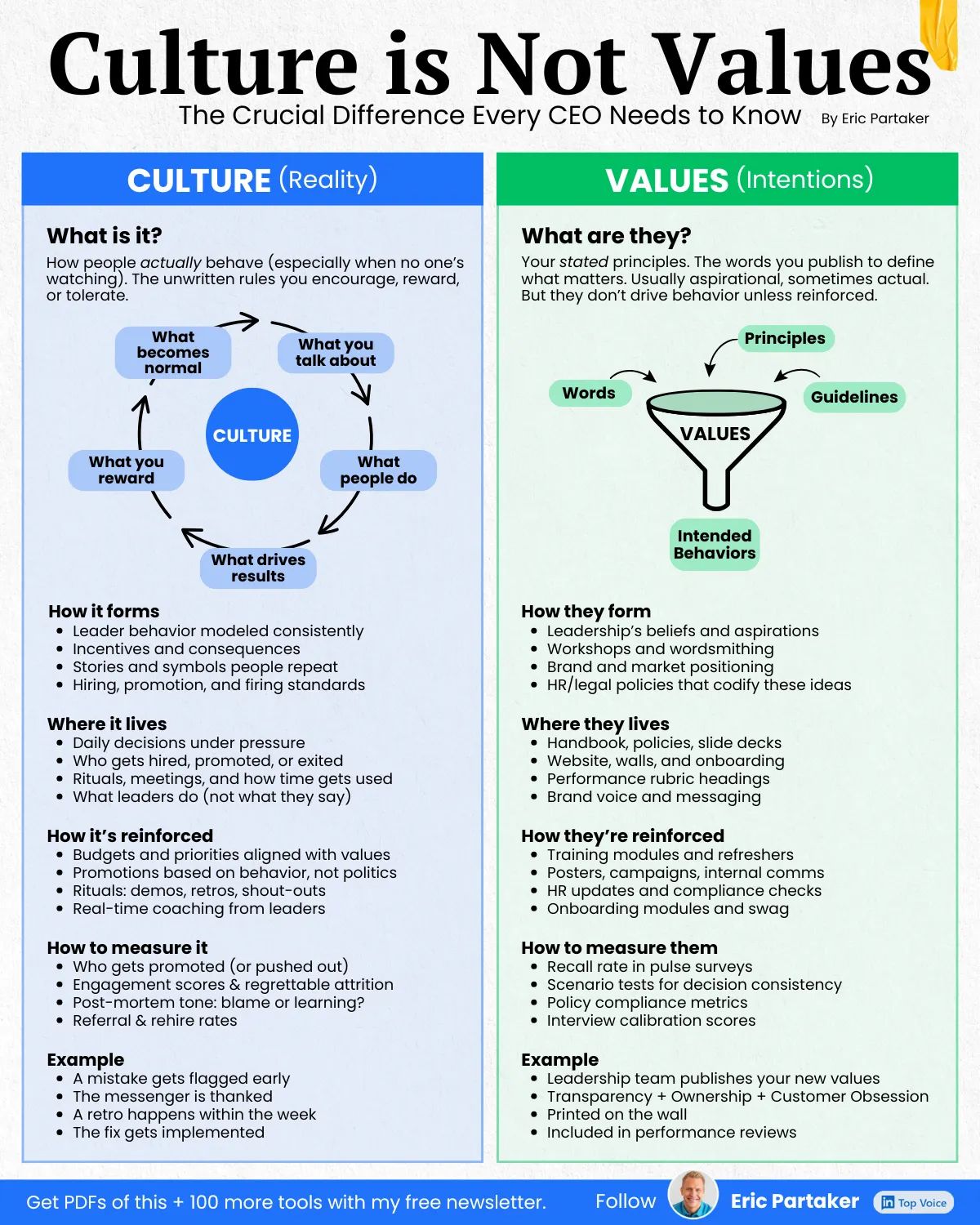
In a recent LinkedIn post, Eric Partaker argues that many business leaders mistakenly equate stated company values with actual company culture, a distinction he emphasizes is critical for sustainable growth and trust. Partaker, a prominent entrepreneur and CEO coach, highlights that while values are aspirational statements, culture is the lived reality of an organization’s behavior, particularly when no one is watching.
He begins by challenging the common assumption that having well-defined values is sufficient for building a strong culture. “Your values aren’t your culture,” Partaker states directly in his post. “They’re just what you hope people believe.” This assertion sets the stage for his core argument: that culture is not about what is written on a website or a wall, but about the observable actions and decisions that occur daily.
The Disconnect Between Values and Reality
Partaker elaborates on this crucial difference, explaining that values often remain abstract ideals, while culture manifests in concrete actions. He points out that the true culture of a company is revealed during moments of pressure, failure, or ethical ambiguity. “Culture is what actually happens when Slack goes quiet. When the deadline slips. When someone screws up and no one’s watching,” he writes.
This passive culture, according to Partaker, can lead to significant business losses. “Most CEOs don’t realize they’re leaking trust, speed, and talent. Not because of bad intentions, But because of passive culture,” he observes. He contends that leaders who fail to actively shape and manage their culture are inadvertently allowing undesirable behaviors to take root and become the accepted norm.
“Values live on your website. Culture lives in your hiring decisions.”
This stark contrast underscores Partaker’s point that culture is embedded in the practical, day-to-day operations and decisions of a company, especially in critical areas like recruitment and promotion. He suggests that if a company promotes an employee who exhibits poor behavior but achieves results, its stated values are undermined, and a different, less desirable culture is being reinforced.
Actively Shaping Culture is Non-Negotiable
The post further emphasizes that leadership’s role is to actively define, reinforce, and correct behaviors to align with the desired culture. Partaker warns that inaction is a form of action: “If you’re not actively shaping your culture, you’re passively allowing it. What you allow… What you tolerate… You teach.” This teaching, he explains, can inadvertently signal that deadlines are unimportant, internal politics outweigh performance, feedback is disregarded, or toxic behavior is acceptable if it drives revenue.
Culture as Repeatable Behaviors
For Partaker, culture is fundamentally about the patterns of behavior that are consistently repeated, rewarded, or corrected within an organization. “Culture is the behaviors you repeat. The actions you reward. The things you never say out loud, but everyone knows,” he defines. He posits that building a high-performing team requires a deliberate focus on cultivating a culture that promotes speed, accountability, and ownership.
“Want to build a team that ➟ Moves fast ➟ Owns results ➟ Stays accountable? Then stop polishing your value statements. And start protecting your culture like your business depends on it. Because it does.”
Partaker concludes by urging leaders to shift their focus from merely stating values to actively safeguarding and nurturing their company’s culture. He frames this as a fundamental requirement for business success, suggesting that a strong, positive culture is not a ‘nice-to-have’ but a core business imperative.
📝 About This Content
This article is based on insights shared by Eric Partaker on LinkedIn.
📅 Originally posted on December 13, 2025 | View original post on LinkedIn →