
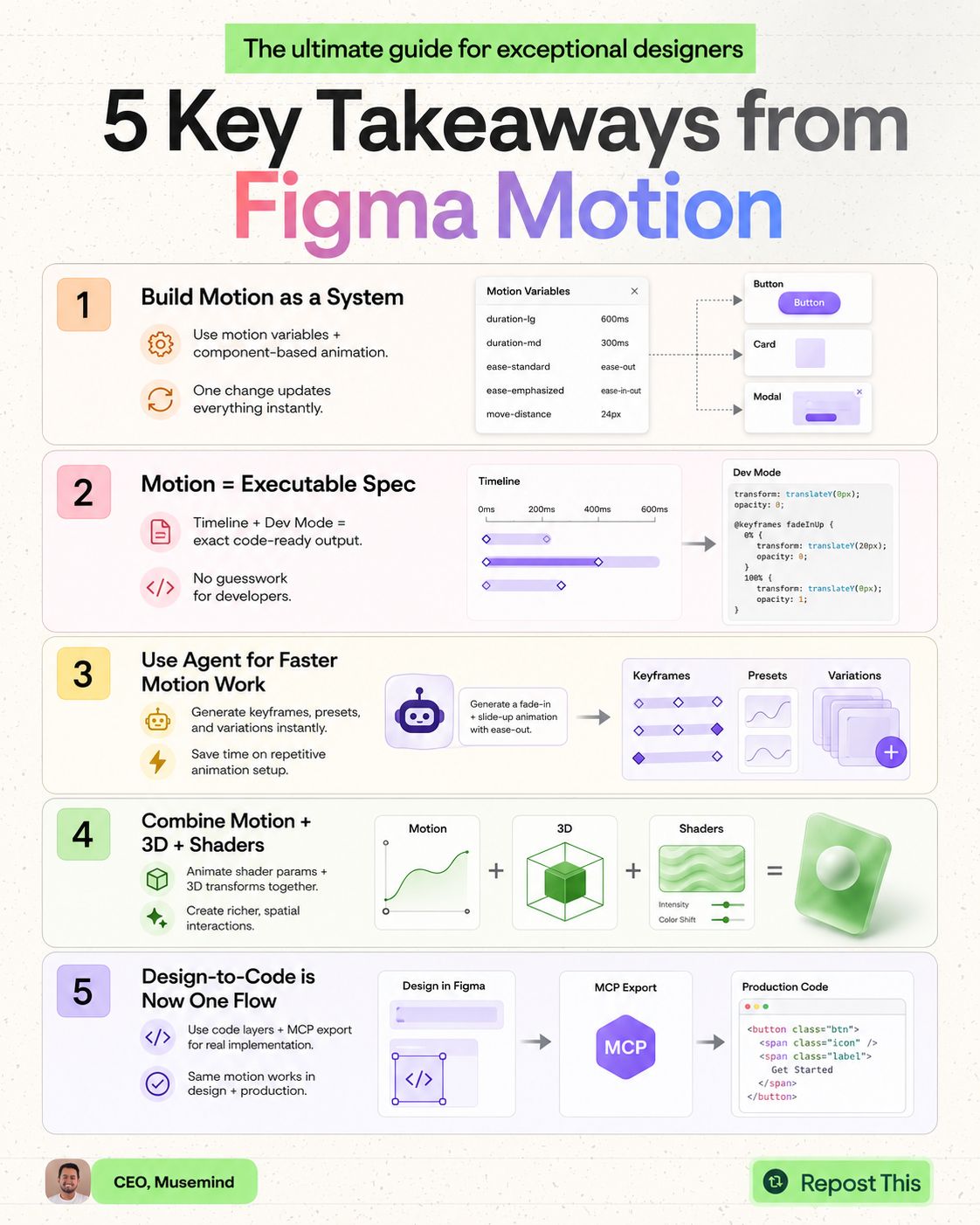
In a recent LinkedIn post, Nasir Uddin discusses a significant evolution in how motion is integrated into product design workflows, moving beyond individual animations to a more systematic approach. Uddin highlights that this shift is fundamentally changing the design, structuring, and shipping of motion within product teams.
According to Uddin, many designers still perceive motion as a collection of isolated animations. However, he emphasizes that the industry is transitioning towards treating motion as a “system-level workflow.” This change, Uddin posits, is crucial for teams aiming to maximize their output and efficiency.
“Most designers still think of motion as individual animations. But this shift is turning motion into a system-level workflow.”
The Systemic Nature of Modern Motion Design
Nasir Uddin breaks down five core changes that product designers need to understand about Figma Motion. A primary point of emphasis is that motion is now being treated as a system, rather than a series of disconnected elements. As Uddin explains:
“Changes in variables update everything across components. Consistency becomes automatic.”
This systemic approach, Uddin argues, brings inherent consistency and scalability, automating updates across various components and ensuring a unified user experience. This contrasts with traditional methods where individual animations required manual adjustments, often leading to inconsistencies.
From Design Timelines to Executable Specifications
Another key aspect highlighted by Uddin is the transformation of motion design into an “executable spec.” He notes that design timelines can now directly translate into developer-ready output, significantly reducing the interpretative gap between design and code. “Less interpretation between design and code,” Uddin states, underscores the increased fidelity and directness of this new workflow.
Accelerating Creation with Agent Workflows
Furthermore, Uddin points to the acceleration of creation through agent workflows. He suggests that keyframes, presets, and variations can now be generated rather than meticulously built from scratch. This advancement, in Uddin’s view, frees up designers to focus on higher-level creative decisions rather than repetitive manual tasks.
Expanding Horizons: Motion in 3D and Shaders
The evolution of motion design, as outlined by Uddin, also extends beyond traditional 2D interfaces. He observes that UI is increasingly becoming “spatial and interactive,” incorporating 3D elements and shaders. This expansion signifies a move towards richer, more immersive user experiences.
“UI is no longer only flat. It is becoming spatial and interactive.”
Bridging the Design-to-Code Gap
Ultimately, Uddin contends that the most significant impact of these changes is the establishment of a “single flow” from design to code. This integration means that what is designed is much closer to what is actually implemented in production. “If you work in product design, this matters because it reduces loss between design and development,” Uddin concludes. He reiterates that this approach makes motion scalable, moving away from manual, labor-intensive processes.
📝 About This Content
This article is based on insights shared by Nasir Uddin on LinkedIn.
📅 Originally posted on June 29, 2026 | View original post on LinkedIn →