
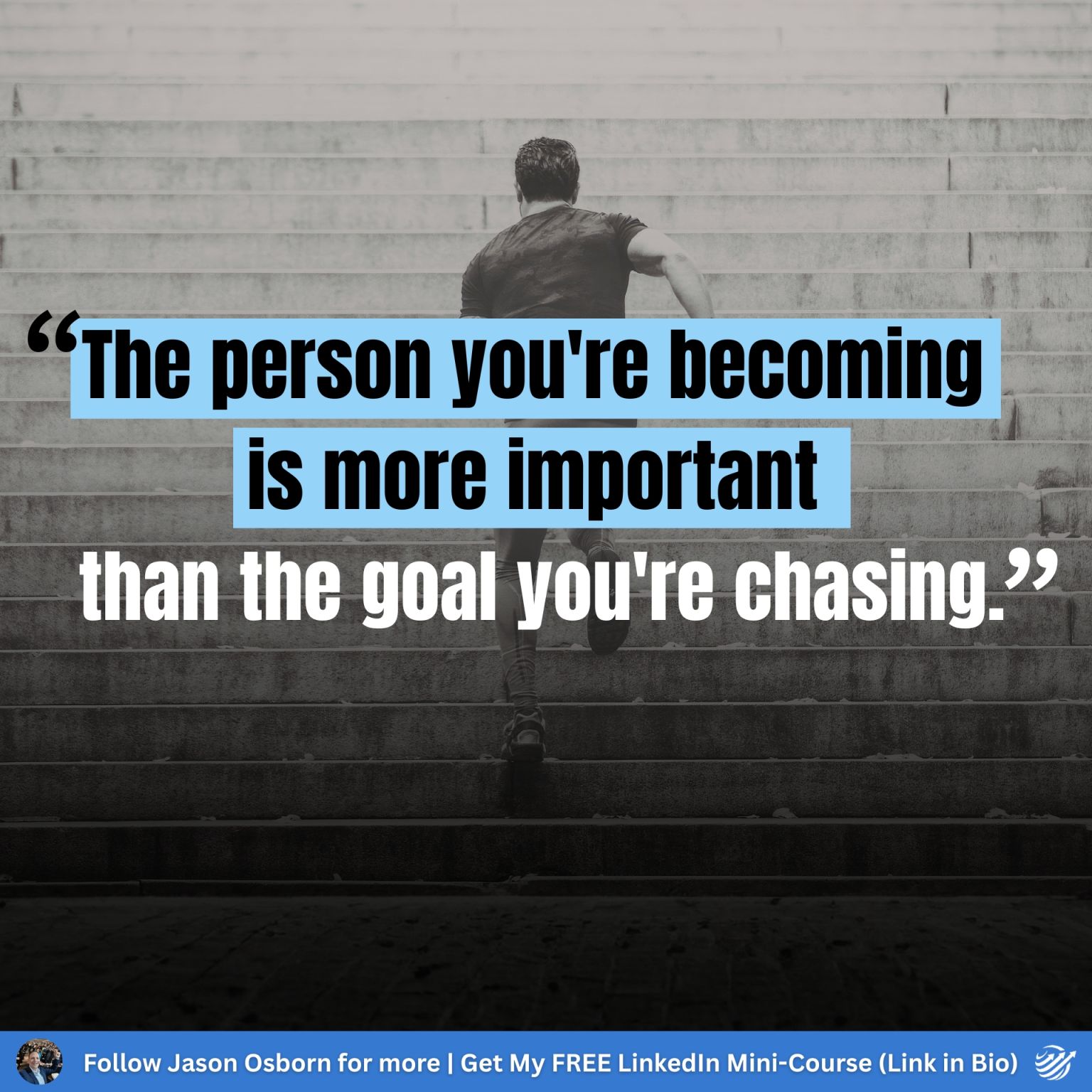
In a recent LinkedIn post, Jason Osborn explores a fundamental shift in mindset for achieving lasting success: prioritizing personal identity development over the mere pursuit of goals. Osborn argues that the common obsession with outcomes, such as hitting revenue targets or closing deals, often leads to temporary satisfaction but fails to create sustainable change because the underlying identity of the individual remains unaltered.
According to Osborn, the transient nature of goals stands in stark contrast to the permanence of identity. He points out that once a goal is achieved, the behaviors associated with it often cease, leading individuals to revert to their baseline. This happens because the focus was on an external achievement rather than an internal transformation.
“Goals End. Identity Lasts.
Most people obsess over the outcome. Hit the revenue target. Close the deal. Build the business. Then they hit it and nothing changes. Because they focused on the goal, not who they needed to become to sustain it.”
The Primacy of Identity Over Goals
Jason Osborn emphasizes that true, lasting behavior change stems from cultivating an identity that naturally aligns with desired actions. He uses the example of consistently posting on LinkedIn, contrasting the goal-oriented approach (“I want to post on LinkedIn consistently”) with an identity-focused one (“I’m someone who shows up and shares what I know”). Osborn posits that the latter is more powerful because it defines who you are, not just a task to be completed.
“Identity drives behavior longer than goals ever will,” Osborn writes. “Results come from who you are, not what you want. You don’t rise to your goals. You fall to your identity.” This highlights his central thesis: our inherent sense of self dictates our capabilities and our ultimate achievements, often more so than any specific objective.
Shifting the Question from ‘What’ to ‘Who’
To facilitate this crucial shift, Osborn suggests a change in the questions leaders ask themselves. Instead of focusing on external achievements, he urges a deeper inquiry into the kind of person one needs to become.
He advises moving away from questions like, “What do I want to achieve?” and instead asking:
- “Who do I need to become to make that inevitable?”
- “What does that person do daily?”
- “How do they make decisions?”
- “What do they say no to?”
- “How do they show up when it’s hard?”
By focusing on these identity-building questions, Osborn suggests that the goals themselves become a natural consequence of the person one is becoming. The business scales when you embody the identity of a scaled-business operator; the audience grows when you become a creator worth following; revenue increases when you become a consistent deliverer of value.
“Becoming comes first. Results follow.”
Building Identity for Sustainable Success
Osborn concludes by reiterating that chasing outcomes without evolving one’s identity is a flawed strategy. He directly addresses aspiring entrepreneurs, creators, and high-earners, stating that the desired results—a scalable business, a large audience, significant revenue—are contingent upon first embodying the identity of someone who already possesses those attributes.
“Stop chasing goals. Start building identity. The person you’re becoming determines what you achieve. Not the other way around.”
Ultimately, Jason Osborn’s message on LinkedIn is a call to action for business leaders to invest in their personal development and identity formation as the primary driver of long-term, sustainable success, rather than solely focusing on the transient nature of goals.
📝 About This Content
This article is based on insights shared by Jason Osborn on LinkedIn.
📅 Originally posted on February 1, 2026 | View original post on LinkedIn →