
In a recent LinkedIn post, Melina Panetta explores the critical difference in outcomes for two VPs who left corporate roles around the same time, highlighting how their chosen business models led to vastly different financial and professional trajectories.
Melina Panetta contrasts two scenarios: one executive who adopted a fractional model and another who built an advisory practice. The core of her analysis lies in how each approach fundamentally dictates the potential for growth, stability, and ultimately, freedom.
“The difference wasn’t talent. Both were brilliant. The difference was the business model.”
The Pitfalls of a Fractional Model
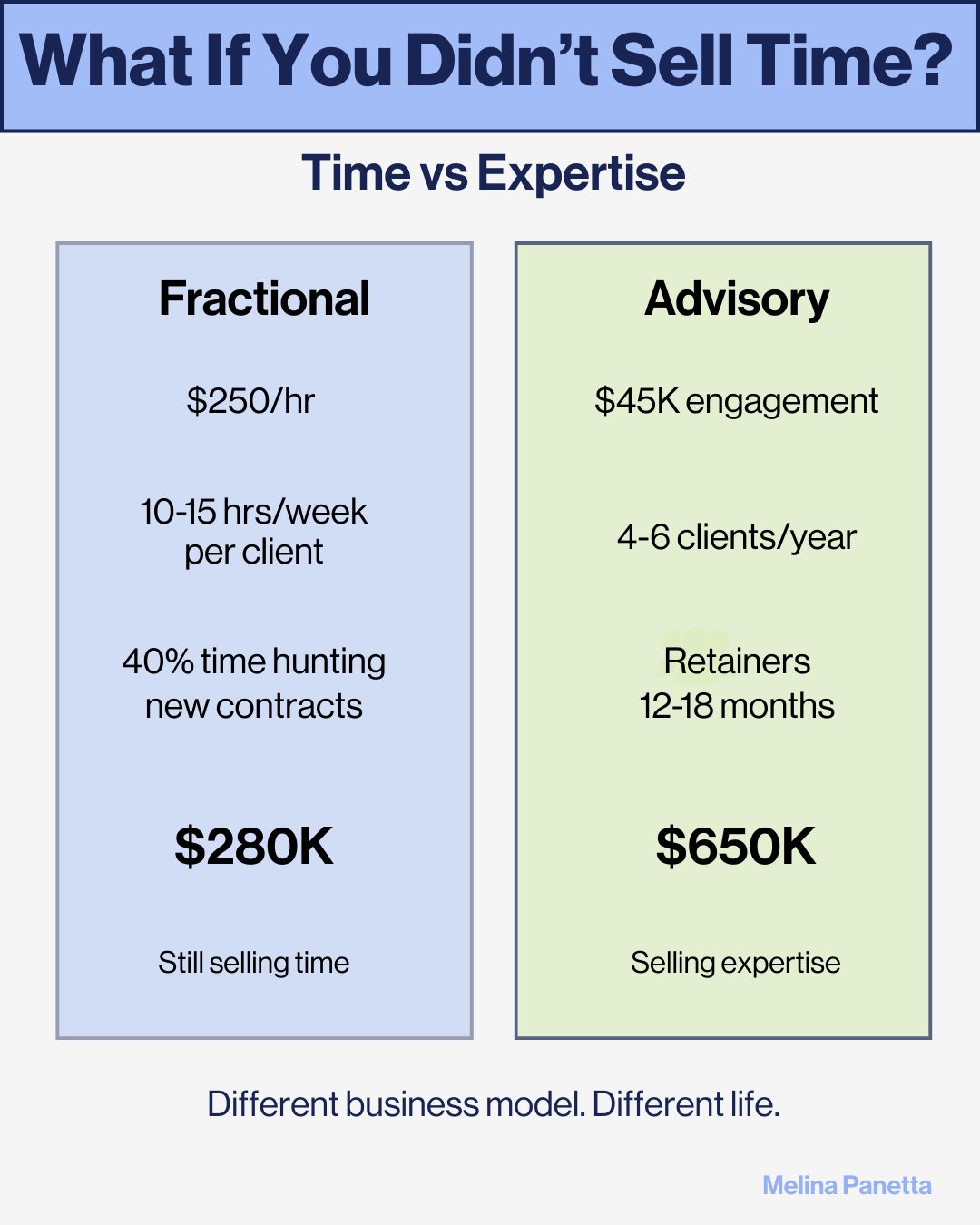
According to Melina Panetta, the first executive, who went fractional, sold her time by the hour at a seemingly impressive rate. However, this model, as outlined by Panetta, led to significant limitations.
Panetta details the realities of this approach:
- Income was capped by billable hours.
- A single budget cut could create immediate financial instability.
- A substantial portion of time was spent on hunting for the next contract.
- There was constant worry about a drying pipeline.
- Clients were often unwilling to commit to more than 10-15 hours per week.
Melina Panetta argues that this executive effectively traded a corporate salary for slightly better hourly rates, remaining tethered to the concept of trading time for money. “She traded a corporate salary for slightly better hourly rates. Still trading time for money,” Panetta writes.
Building an Advisory Practice for Transformation
In stark contrast, Melina Panetta describes the second executive who built an advisory practice, focusing not on selling hours, but on selling transformations and outcomes. This strategic shift, as Panetta explains, unlocked significantly higher earning potential and greater stability.
Panetta outlines the key actions taken by the successful advisor:
- Positioned expertise around a significant industry problem ($5M problem).
- Packaged expertise into defined 90-day engagements.
- Charged a fixed fee ($45K per client) rather than an hourly rate.
- Focused on building long-term retainers (12-18 months).
- Managed a limited client roster (4-6 per year).
The results, as shared by Melina Panetta, show a dramatic divergence. While the fractional executive faced income caps, the advisory model led to substantial growth, reaching $650K by year five through a stable retainer base and premium pricing.
“One sold availability. The other sold expertise. One was capped by hours in a day. The other compounded authority and outcomes.”
The Business Model as the Deciding Factor
Melina Panetta emphasizes that the difference in outcomes was not due to a disparity in talent or credentials, but solely the chosen business model. As she points out, one model was constrained by the finite hours in a day, while the other leveraged compounded authority and client results.
The core message from Panetta is clear: leaving corporate employment is not just about gaining independence; it’s about selecting a business model that either builds true freedom or merely creates a different form of employment.
“When you leave corporate, you’re not choosing independence. You’re choosing a business model. And that choice determines whether you build freedom or buy yourself a different job.”
Panetta concludes by urging professionals to consider which model they are actively building toward, underscoring that the same expertise and credentials can lead to completely different financial futures based on the underlying business strategy.
📝 About This Content
This article is based on insights shared by Melina Panetta on LinkedIn.
📅 Originally posted on February 3, 2026 | View original post on LinkedIn →