
In a recent LinkedIn post, Francisco Gaffney explores the critical distinction between business growth and true operational scale, arguing that many companies mistake expansion for sustainable progress. Gaffney highlights that simply increasing revenue and client numbers, while beneficial, does not equate to healthy scaling if the underlying operating model remains unchanged.
He elaborates on this common pitfall, stating:
“Your scale plan may not be working because the business grew, but the operating model did not.”
Gaffney contends that this scenario, which he terms “not clean scale,” leads to a larger version of existing weaknesses rather than genuine advancement. As revenue rises and the team expands, businesses often find their margins under pressure, decision-making processes slow down, and founders become increasingly bogged down in operational problems.
The Pitfalls of Unprepared Scaling
Francisco Gaffney identifies three key problems that expose weak scaling: revenue growth outpacing operational efficiency, new capital entering a model that can’t account for margin or capacity, and rising headcount without corresponding improvements in output or decision quality. He uses the analogy of fitting a bigger engine to a car with loose wheels, suggesting that growth without foundational readiness results in faster problems, not a better journey.
According to Gaffney, before chasing further growth, leaders must ask critical questions about their organization’s resilience:
- Can margin survive?
- Can service quality survive?
- Can leadership capacity survive?
- Can the control model survive?
He emphasizes that these internal capacities are paramount. As Gaffney points out, simply growing bigger without addressing these fundamental areas leads to a “faster problem.”
The Advisory Board Operating System for Scalability
To navigate these challenges, Gaffney introduces the concept of an “Advisory Board Operating System,” which focuses on four interconnected milestones: Scale, Predictability, Systems, and Edge. This framework aims to ensure that a business can grow without introducing avoidable strain, that its financial projections are trustworthy, that its internal controls and ownership structures can withstand pressure, and that it can innovate without disrupting existing successes.
Gaffney further suggests examining three key “scale assets” to gauge readiness:
Brand
Can the market consistently understand and value why the company wins?
People
Is judgment and decision-making authority placed in the right roles?
Partnerships
Do existing relationships provide reach, trust, or enhanced capability?
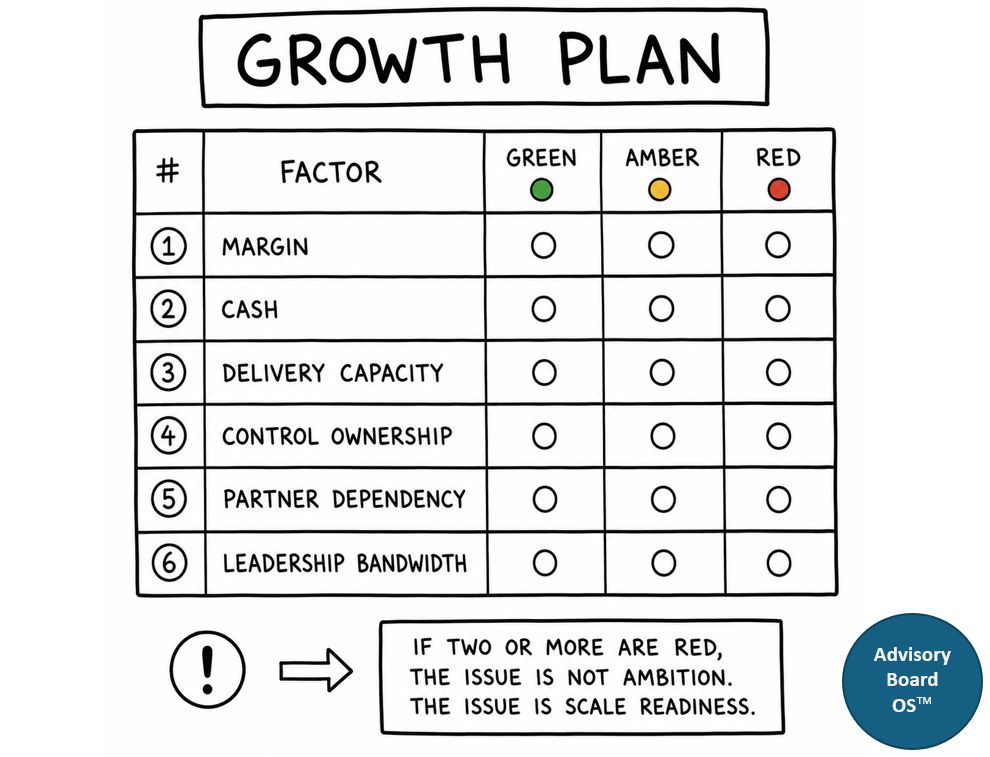
Gaffney’s core recommendation for assessing scale readiness is straightforward: visualize the growth plan on a single page and mark six critical areas in red, amber, or green. These areas include margin, cash, delivery capacity, control ownership, partner dependency, and leadership bandwidth. He concludes that if two or more of these areas are marked red, the fundamental issue is not a lack of ambition, but a lack of scale readiness.
“The issue is not ambition. The issue is scale readiness.”
In Francisco Gaffney’s view, true business success at scale hinges not just on aggressive growth targets, but on the robust health and preparedness of the underlying operational model.
📝 About This Content
This article is based on insights shared by Francisco Gaffney on LinkedIn.
📅 Originally posted on July 13, 2026 | View original post on LinkedIn →