
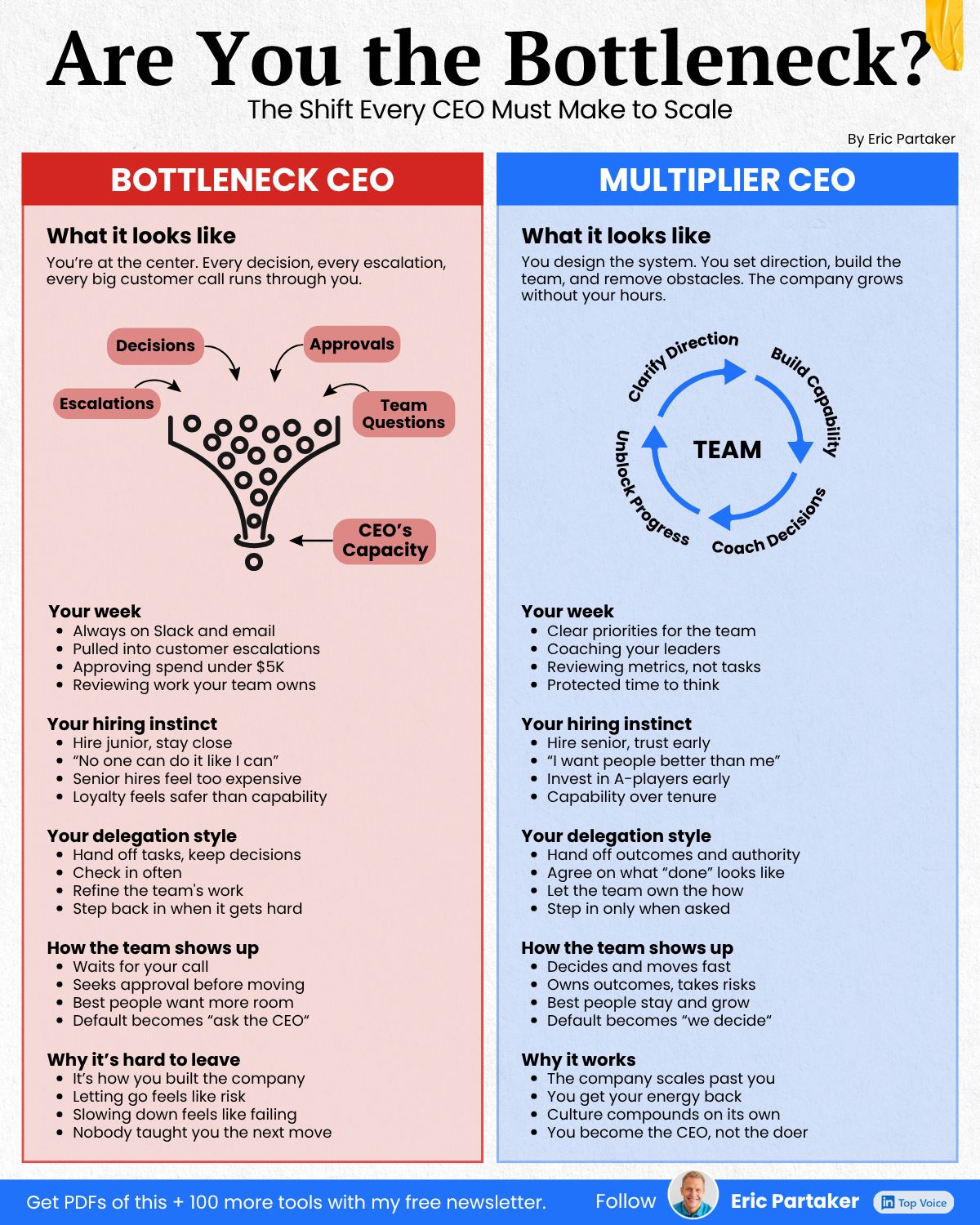
In a recent LinkedIn post, Eric Partaker, a seasoned CEO coach, highlights a common yet critical growth barrier faced by scaling businesses. He identifies a prevalent reason why many companies falter as they attempt to transition from the $3 million to $10 million revenue mark: the CEO themselves.
Partaker argues that the very leadership traits and operational approaches that enabled a company’s initial success can become significant impediments to further growth. The CEO, often at the epicenter of every decision and escalation, can inadvertently become a bottleneck, slowing down progress and hindering the team’s autonomy.
“70% of scale-ups stall between $3M and $10M. (Almost always for the same reason.) The CEO.”
The CEO as a Bottleneck
According to Partaker, many CEOs, even those who have successfully built their companies, fall into the trap of remaining the central hub for all activity. This can manifest in several ways. Partaker elaborates on this dynamic:
“The CEO is at the center. Of everything. Every decision. Every approval. Every escalation. The team waits. Growth plateaus. They work more hours and get less back.”
This centralizing tendency, while perhaps effective in earlier stages, creates a dependency that stifles the organization’s ability to operate and grow independently. The default mode becomes seeking the CEO’s input or approval for nearly every task, leading to delays and a sense of stagnation. Partaker refers to this leadership style as the “Bottleneck” CEO.
Shifting to a Multiplier Mindset
The critical shift for CEOs, as outlined by Partaker, is moving from being a bottleneck to becoming a “Multiplier.” This transition involves a fundamental change in how the CEO interacts with their team and delegates responsibilities. Instead of holding onto decisions, the Multiplier CEO focuses on empowering their team.
Key Characteristics of a Multiplier CEO
Partaker contrasts the two archetypes:
- The Bottleneck CEO: Hands off tasks but keeps decisions, hires junior and stays close, reviews work and jumps into escalations, with a default of “ask the CEO.”
- The Multiplier CEO: Hands off outcomes and authority, hires senior and trusts early, reviews metrics and coaches decisions, with a default of “we decide.”
The core difference lies in the questions they ask. The Bottleneck CEO asks, “How do I get this done?” while the Multiplier CEO asks, “Who owns this, and what do they need from me to get it done?” This shift redefines the CEO’s role from a doer to a system designer.
Designing the System for Scale
Partaker emphasizes that the CEO’s job evolves from executing tasks to architecting the operational framework that enables the company to scale effectively. He outlines the key responsibilities of a CEO operating as a multiplier:
“Clarify direction. Build capability. Coach decisions. Remove blockers. Do that, and the company scales past you.”
This strategic focus allows the organization to build its own momentum and capacity, moving beyond the direct involvement of the CEO in day-to-day operations. By empowering the team, fostering capability, and removing obstacles, the CEO enables sustainable growth that can outpace their individual capacity.
Partaker concludes by posing a question to his audience, seeking to understand the most challenging aspect of delegation for other CEOs, thereby fostering a community of shared learning and problem-solving among business leaders.
📝 About This Content
This article is based on insights shared by Eric Partaker on LinkedIn.
📅 Originally posted on April 20, 2026 | View original post on LinkedIn →