
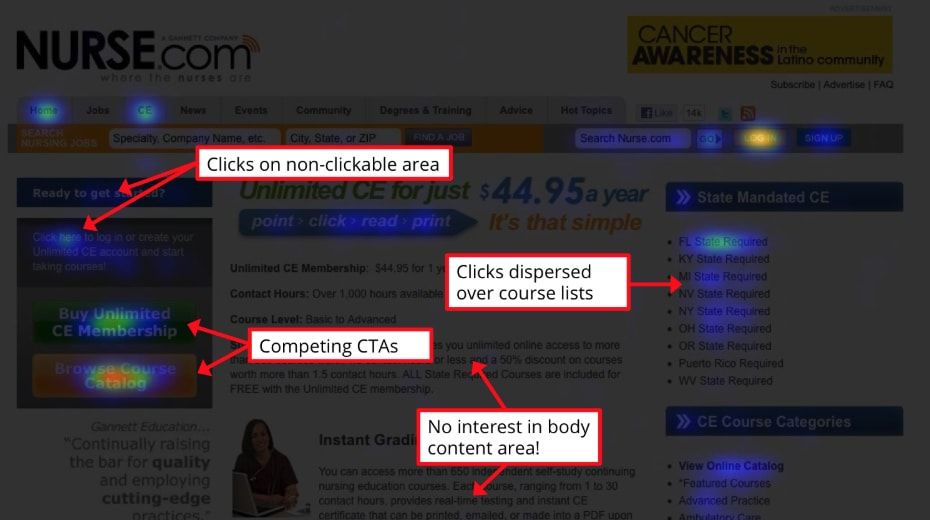
In the early days of the internet, understanding website visitor behavior was a complex and often frustrating task. Analytics tools provided raw numbers, but these figures lacked context, making it difficult to derive actionable insights. This data landscape, characterized by rows, charts, and dense log files, offered quantity but not quality.
Before the advent of tools like Crazy Egg, website analytics meant wading through endless tables and charts. While you could ascertain that a specific page received a certain number of clicks, the granular details of user interaction were lost. For instance, if two links pointed to the same destination – one positioned prominently at the top of a page and another discreetly at the bottom – their click data would be aggregated. Both might report ’15 clicks,’ obscuring the reality that the top link garnered 10 clicks and the bottom one only 5. This was the prevailing situation: businesses possessed data, but lacked true understanding.
The Genesis of Clarity: Crazy Egg’s Guiding Principle
Recognizing this critical gap, the team behind Crazy Egg established a fundamental rule that would shape their product and revolutionize the industry: No charts, no dashboards, no noise… just clarity.
The vision was straightforward: to empower users to visually comprehend their visitors’ actions rather than relying on guesswork or abstract numerical data. This singular principle had a profound impact:
- Designers shifted from debating subjective opinions to making evidence-based decisions.
- Marketers could articulate campaign performance without needing specialized analytical support.
- Teams gained a shared understanding of user behavior, leading to faster alignment and more cohesive strategies.
From Clicks to Decisions: The Evolving Impact of Visual Analytics
What began as an initiative to simply track and understand user clicks evolved into a powerful mechanism for informing critical business decisions. By meticulously stripping away any elements that hindered immediate comprehension, Crazy Egg focused on presenting the unvarnished truth directly on the screen.
The core philosophy was that when a problem is clearly visible, the path to its solution becomes significantly more apparent. This emphasis on direct visual feedback transformed how businesses approached website optimization and user experience. The pursuit of this kind of clarity remains a driving force, underscoring the enduring value of making complex data accessible and actionable for everyone.
This article is inspired by insights shared by Hiten Shah on LinkedIn.
📝 About This Content
This article is based on insights shared by Hiten Shah on LinkedIn.
📅 Originally posted on October 20, 2025 | View original post on LinkedIn →