
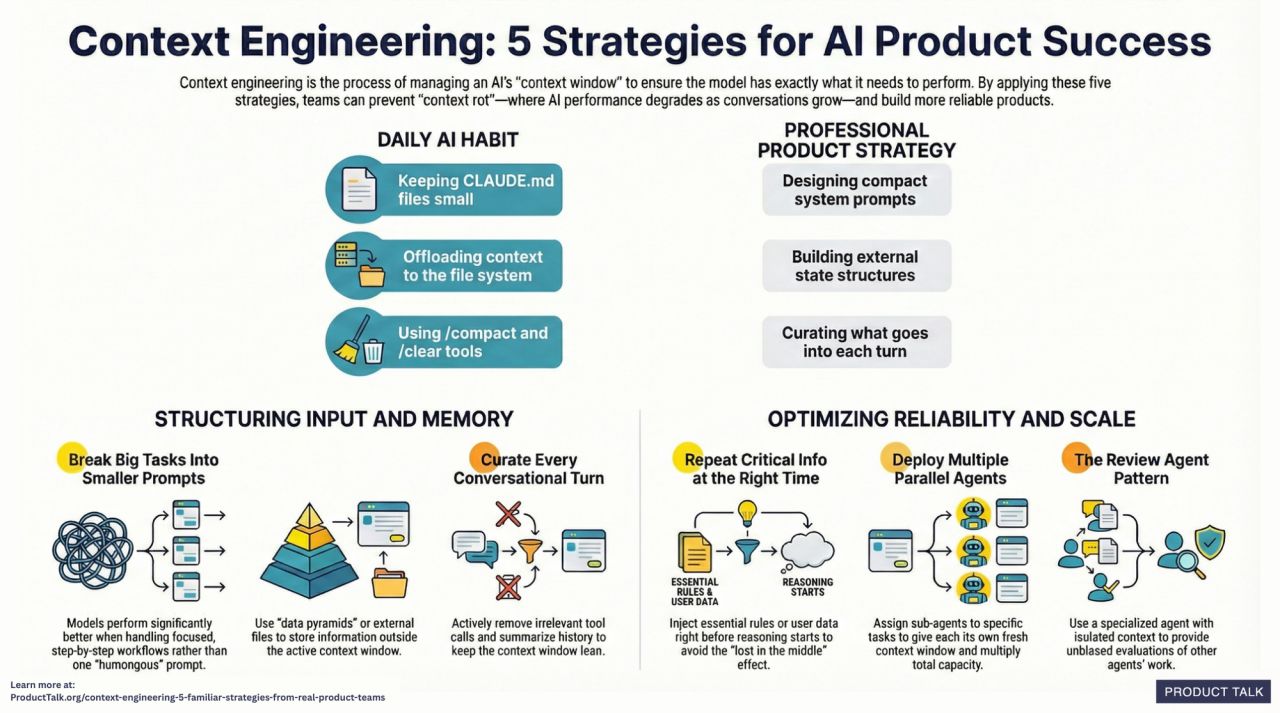
In a recent LinkedIn post, Teresa Torres explores the often-overlooked connection between everyday AI interactions and the sophisticated skills required for building production AI products. Torres highlights that personal productivity gains with tools like Claude Code are, in fact, a form of developing essential context engineering abilities.
As Teresa Torres notes, the realization dawned on her that personal use was also a learning ground:
“When I started using Claude Code, I thought I was just building personal productivity tools. I didn’t realize I was also learning context engineering—the same skills that product teams use to build production AI products.”
Torres argues that product teams are tackling similar challenges to those faced by individual users, albeit at a larger scale. The article she shared breaks down how these transferable skills are being applied in production environments.
Breaking Down Complexity for LLMs
One of the core principles discussed is the strategic decomposition of complex tasks into smaller, more manageable prompts. This mirrors the practice of keeping documentation, such as CLAUDE.md files, concise and focused.
Torres points out that this approach is not unique to personal use. In production AI, this translates to effective prompt design that prevents overwhelming the language model. According to Torres, a fundamental piece of advice is:
“If you’d break it down for a human, break it down for the LLM”
, a principle that holds true across various applications.
External Memory and Context Curation
Furthermore, Teresa Torres emphasizes the importance of building external memory systems. These systems are crucial for retaining context beyond the limitations of an AI’s immediate conversational window. This allows for more sustained and coherent interactions, essential for complex applications.
In production AI, this involves carefully curating the information that is fed into each conversational turn. Torres explains that this curation is vital to prevent information bloat and maintain the efficiency of the AI model. She highlights that repeating critical information ensures it remains fresh and accessible when key decisions need to be made.
Leveraging Multiple Agents for Extended Context
Torres also touches upon the sophisticated technique of using multiple agents to effectively multiply the available context windows. This advanced strategy allows production AI products to handle significantly larger amounts of information and more intricate tasks.
The article showcases real-world examples from companies like Incident.io, Rest, and Trainline, demonstrating how these organizations have refined these context management patterns through practical experience and iteration. As Teresa Torres observes, these companies have learned these valuable lessons through trial and error, validating the principles discussed.
Torres concludes by posing a question to her audience, inviting them to reflect on their own AI usage: “Which context management trick from your daily AI use do you think would be most valuable in a production AI product?” This encourages further engagement and highlights the practical applicability of the concepts she has outlined.
📝 About This Content
This article is based on insights shared by Teresa Torres on LinkedIn.
📅 Originally posted on February 11, 2026 | View original post on LinkedIn →