
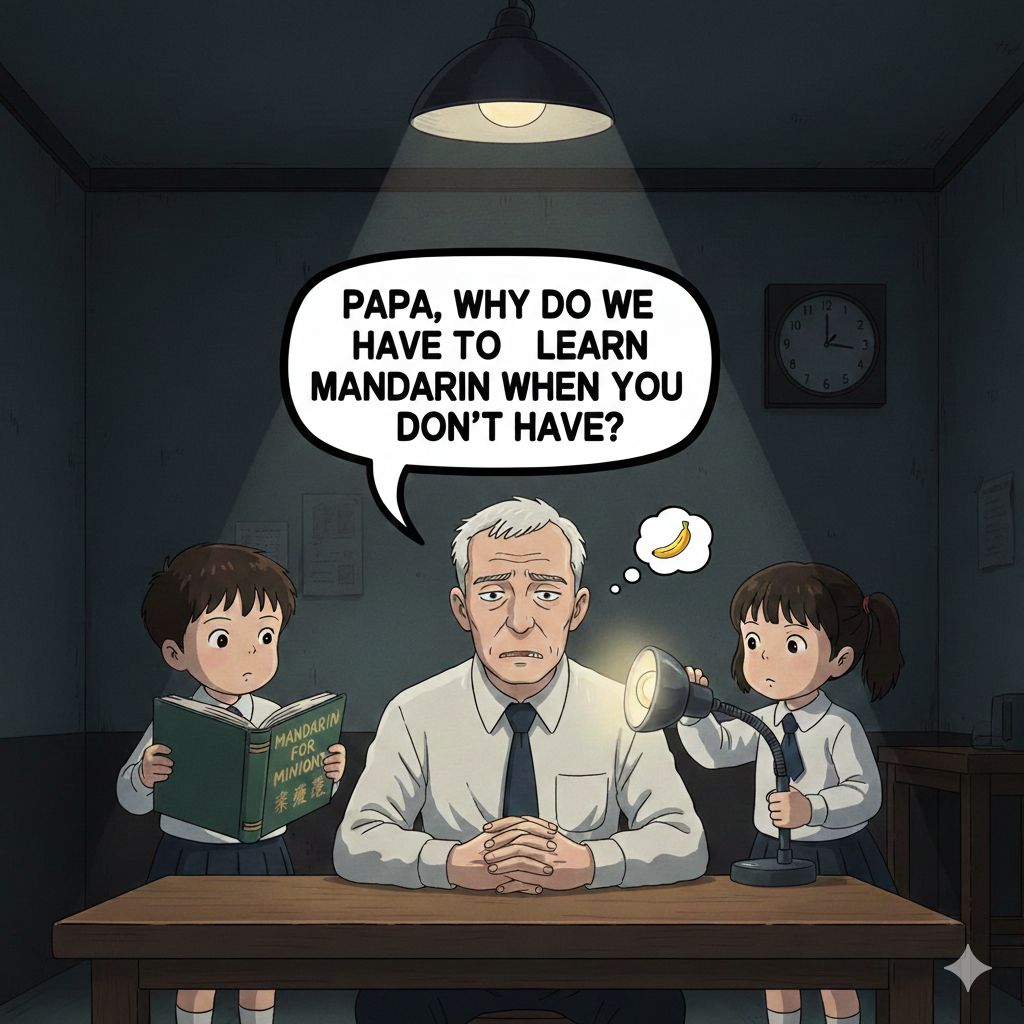
In a recent LinkedIn post, Choo Ann NGOH delves into the complexities of language acquisition, specifically questioning the necessity of learning Mandarin for his children when he himself did not face the same requirement. The post, framed as a dialogue with his “minions” (children), explores the apparent “double standard” and the perceived cruelty behind pushing them to master a language he describes as one of the world’s most difficult.
NGOH opens by recounting his children’s interrogation: “Papa, why do we have to learn Mandarin when you didn’t have to?” This sets the stage for his reflection on the evolving market landscape and the role of language in business and personal development. He contrasts his own educational experience, where Mandarin was not part of the curriculum, with the current reality for business owners.
“As a business owner today, I see the landscape shifting.”
The Evolving Business Landscape and Language as a Tool
NGOH argues that Mandarin is more than just a spoken language; it represents a different framework for problem-solving and requires a significant degree of persistence. He draws a parallel to the business world, stating that proficiency in any skill, whether it’s B2B marketing or corporate storytelling, demands continuous practice.
He elaborates on this by saying:
“The ‘Practice or Perish’ Principle: Just like in B2B marketing or corporate storytelling, if you stop practicing the craft, you fall behind.”
This principle, NGOH suggests, was learned by his children during the pandemic lockdown. He emphasizes that in Malaysia’s entrepreneurial ecosystem, multilingualism has transitioned from a mere advantage to a crucial necessity for regional trade and building trust with stakeholders.
Parenting and Leadership in a Complex World
The post touches upon the parental role in preparing children for future challenges. NGOH acknowledges his wife’s perspective, humorously referring to her as the “Finance Minister,” who rightly points out the difficulty of the Mandarin syllabus. However, he reframes this challenge not as an act of cruelty but as a form of future-proofing.
Equipping for Future Difficulty
According to NGOH, the role of parents and leaders is not to replicate the easier conditions of their own past but to equip the next generation for the current and future complexities of the world. He states:
“As parents and leaders, our job isn’t to make things ‘easy’ like they were in our time; it’s to ensure our team (and our minions) are equipped for the current, as well as future difficulty level.”
NGOH concludes by reflecting on the motivations behind pushing his children towards challenging pursuits. He questions whether such efforts are inherently “jahat” (cruel) or a necessary measure to prevent them from encountering the same “language roadblocks” he faced. His ultimate point is that in an increasingly interconnected and complex world, equipping individuals with diverse linguistic skills is a proactive strategy for their future success.
📝 About This Content
This article is based on insights shared by Choo Ann NGOH on LinkedIn.
📅 Originally posted on February 22, 2026 | View original post on LinkedIn →