
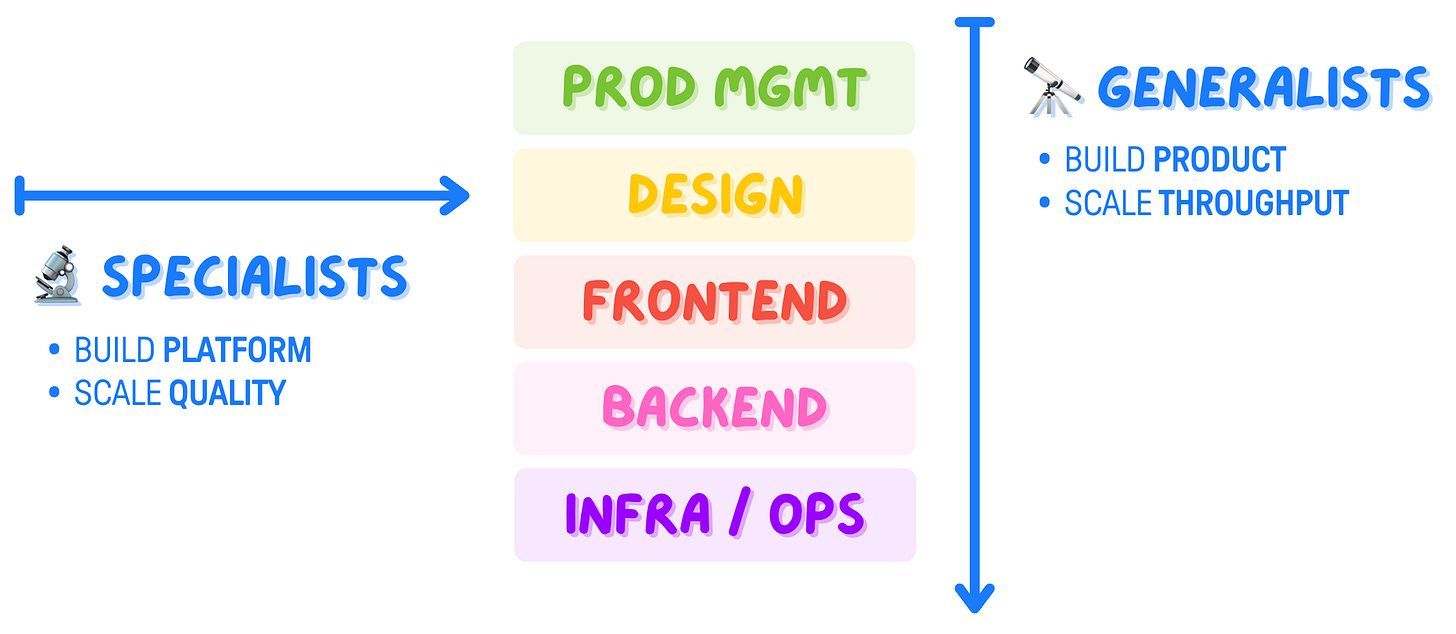
In a recent LinkedIn post, 🌀 Luca Rossi explores a strategic framework for structuring modern engineering teams, differentiating the roles of generalists and specialists to optimize both speed and quality. Rossi argues that a common pattern emerges in high-performing teams: generalists focus on product development, while specialists concentrate on platform engineering.
The Product vs. Platform Divide
Rossi posits that the most effective utilization of a senior engineer’s skills, particularly in frontend development, lies not in repetitive tasks but in building foundational systems. He suggests that assigning senior frontend engineers to construct component systems that empower other developers represents a higher-leverage application of their expertise. This approach, according to Rossi, is not only more efficient but also leads to more engaging and rewarding work for the engineers themselves.
“The best way to use e.g. a senior frontend engineer’s skills is not to build yet another form, but to build the component system that empowers others.”
This distinction leads to a core assertion from Rossi: generalists are key to scaling throughput, while specialists are crucial for scaling quality. This dual focus, he explains, enables teams to move quickly and at scale without sacrificing the integrity of their output, all while ensuring that the work remains challenging and fulfilling for team members.
Platform Engineering as Product Engineering
A significant point Rossi makes is the inherent similarity between product engineering and platform engineering, despite their distinct labels. He observes that good platform engineering often mirrors the practices of excellent product engineering, with the key difference being the target customer: other engineers.
The Engineer as Customer
According to 🌀 Luca Rossi, platform engineers engage in activities analogous to those of top product engineers. They design tools, build solutions that meet the needs of their internal users (engineers), rigorously test these tools through dogfooding, and manage the end-to-end delivery process.
“Platform engineers do pretty much the equivalent of what the best product engineers do: they design products (tools), build things that customers want, dogfood them, and ship things from top to bottom.”
Rossi emphasizes that this perspective reframes platform engineering not as a secondary or support function, but as a critical product development discipline. By treating internal engineering teams as customers, platform engineering can achieve the same goals of innovation, quality, and efficiency that drive successful product development.
Achieving Speed, Scale, and Quality
The overarching conclusion from Rossi’s analysis is that this structured approach—generalists on product, specialists on platform—is the pathway to achieving speed and scale without compromising quality. He believes this model fosters an environment where engineers are consistently engaged in high-impact, challenging work.
“So generalists scale throughput, while specialists scale quality.”
Rossi’s insights provide a valuable lens for engineering leaders seeking to optimize team structure and workflow. By clearly defining these roles and recognizing the product-centric nature of platform engineering, organizations can unlock greater potential for innovation and efficient delivery.
📝 About This Content
This article is based on insights shared by 🌀 Luca Rossi on LinkedIn.
📅 Originally posted on December 4, 2025 | View original post on LinkedIn →