
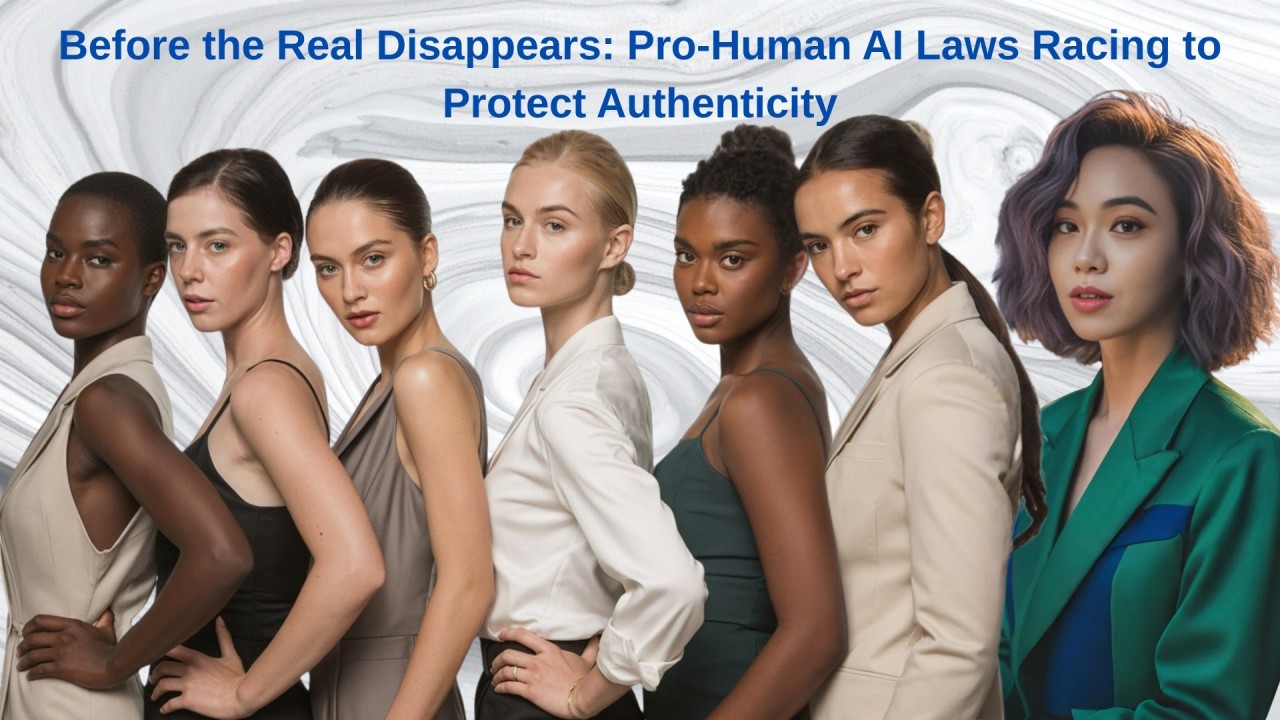
In a recent LinkedIn post, Jean Ng 🟢 highlights a significant global trend in Artificial Intelligence (AI) governance: the increasing focus on protecting and prioritizing human authenticity. Ng 🟢 observes that while many discussions revolve around broad risk frameworks or innovation, a distinct regulatory path is emerging, centered on a “pro-human” ethos.
“While much of the world debates broad AI risk frameworks or innovation-friendly guidelines, a distinct subset of regulations is coalescing around a “pro-human” ethos: prioritising transparency, disclosure, and the intrinsic value of real human performers, creators, and interactions over unchecked synthetic substitutes.”
The Rise of Pro-Human AI Regulations
Ng 🟢 points out that this emerging regulatory landscape is characterized by a push for transparency, disclosure, and the recognition of the value of human creators and performers. This contrasts with a less regulated approach that might favor unchecked synthetic alternatives. The core idea, as Ng 🟢 explains, is to safeguard what is genuinely human in an increasingly AI-driven world.
Key Global Regulatory Developments
The post details several recent legislative actions across different jurisdictions that underscore this trend. Ng 🟢 notes that New York’s December 2025 laws are particularly direct in their affirmation of human primacy within the United States.
New York’s Specific Mandates
According to Jean Ng 🟢, these laws include requirements for:
- Explicit disclaimers for synthetic performers in commercial content.
- Obtaining consent for the digital replication of deceased personalities.
- Implementing safety protocols for powerful AI models.
International Regulatory Alignment
Ng 🟢 also draws attention to similar legislative movements globally. These include:
- China’s Measures for Labeling AI-Generated and Synthetic Content (effective September 2025), which enforce dual explicit and implicit labeling across various media types.
- The EU AI Act’s mandate for machine-readable identification of synthetic outputs, with full transparency rules set for August 2026.
- South Korea’s Basic AI Act, introducing commercial disclosure obligations from January 2026.
- India’s updated intermediary rules, demanding visible labeling of synthetic uploads starting February 2026.
As Ng 🟢 articulates:
“These laws, though varying in scope and enforcement, collectively push back against the dilution of human authenticity in an AI-saturated world.”
Convergence on Human Value
Jean Ng 🟢 argues that despite differences in approach and implementation, these varied regulations signal a unified global direction. The common thread is the recognition that as AI capabilities expand, there is a growing imperative to protect human creativity, identity, and interaction from being overshadowed or misrepresented by synthetic creations.
Ng 🟢’s analysis suggests that the initial phase of AI governance is moving beyond abstract risk discussions to concrete measures that ensure accountability and maintain the distinct value of human contribution. This focus on protecting the “genuinely human” appears to be a surprising but significant point of convergence in the international effort to govern AI.
The post concludes by inviting readers to explore the topic further via a provided link, indicating that these regulatory developments are part of a larger, ongoing conversation about the future of AI and its impact on society.
📝 About This Content
This article is based on insights shared by Jean Ng 🟢 on LinkedIn.
📅 Originally posted on March 22, 2026 | View original post on LinkedIn →