
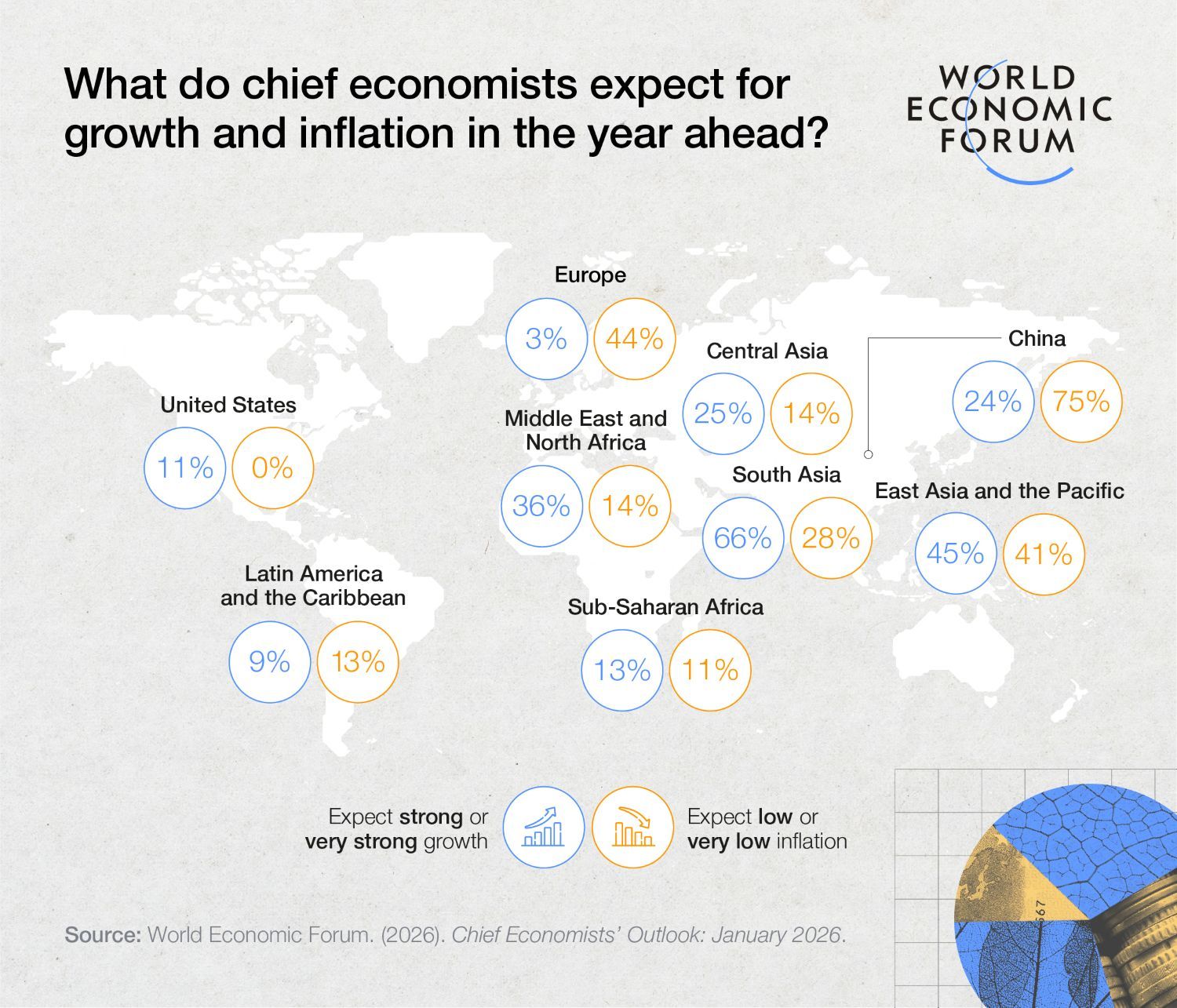
In a recent LinkedIn post, Nicki Allitt discusses the nuanced shifts in the global economy, moving beyond single indicators to examine evolving sentiment and leadership investment strategies. Allitt highlights the findings of the January 2026 Chief Economists’ Outlook, a report that offers a cautiously optimistic view compared to the latter half of 2025, while still maintaining a negative tilt.
Global Economic Sentiment and Key Regional Trends
Allitt draws attention to the report’s examination of near-term economic prospects alongside significant structural changes impacting growth, policy, and investment amidst a backdrop of considerable uncertainty. The analysis underscores that the global economic picture is far from uniform.
The global economy rarely turns on a single signal. More often, it shifts quietly — in sentiment, in expectations, in where leaders begin to place their bets.
According to Nicki Allitt, this sentiment shift is a critical, albeit subtle, indicator of broader economic movements. The post breaks down regional expectations, noting distinct patterns emerging across major economic blocs.
Regional Economic Divergences and Growth Drivers
Allitt points out specific regional trends detailed in the Chief Economists’ Outlook. Growth expectations in the United States are showing improvement, largely fueled by investments related to artificial intelligence.
US Growth Fueled by AI Investment
As Nicki Allitt highlights, the US economy is experiencing a positive outlook driven by technological advancements and related capital expenditure. This suggests AI is not just a future concept but a present driver of economic activity.
Challenges in Europe and China
Conversely, Europe is depicted as facing a challenging environment characterized by weak growth and significant geoeconomic pressures. Allitt also notes that China is grappling with deflationary pressures and undergoing a process of economic rebalancing.
China navigates deflationary pressures and rebalancing.
In contrast to these challenges, Allitt emphasizes a standout region:
South Asia stands out with the strongest growth outlook.
This divergence signals a complex global landscape where different regions are experiencing vastly different economic trajectories, influenced by a mix of technological adoption, geopolitical factors, and domestic policy challenges.
Broader Economic Pressures: Debt and AI Adoption
Beyond regional specifics, Nicki Allitt also brings attention to overarching economic concerns highlighted in the report. These include the escalating pressures of rising global debt levels and the uneven implementation of artificial intelligence technologies.
Allitt explains that the adoption of AI, while promising, has uneven implications for productivity and employment. This unevenness is a key area of focus for economists seeking to understand future labor market dynamics and productivity gains.
The report examines near-term prospects alongside deeper structural shifts shaping growth, policy and investment, amid elevated uncertainty.
The post concludes by posing a question to the audience, inviting reflection on the shifts shaping their own decision-making processes for the year. Nicki Allitt effectively synthesizes complex economic data into an accessible overview, positioning the Chief Economists’ Outlook as a vital resource for understanding the current global economic climate.
📝 About This Content
This article is based on insights shared by Nicki Allitt on LinkedIn.
📅 Originally posted on January 16, 2026 | View original post on LinkedIn →