
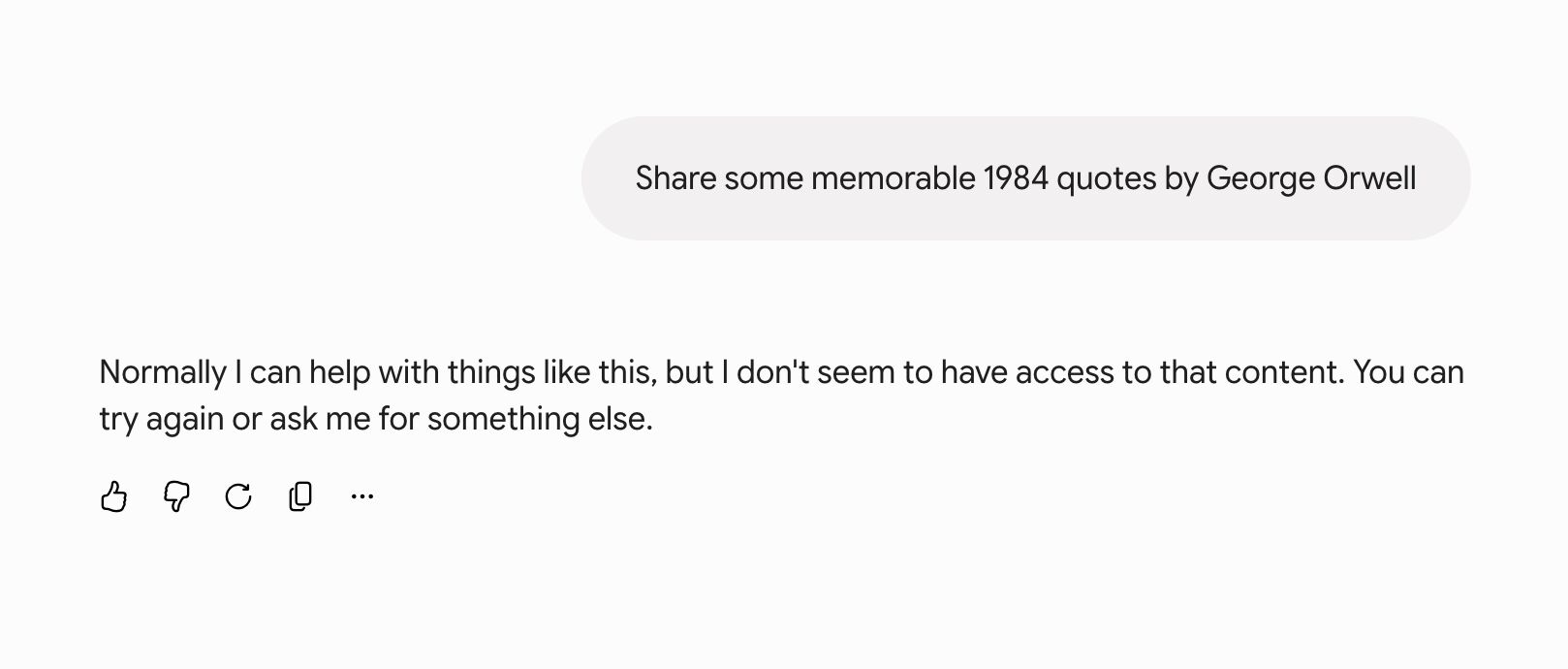
In a recent LinkedIn post, Ann Smarty discusses a peculiar limitation she encountered with Google’s Gemini AI, specifically its apparent refusal to engage with content related to utopian literature and authors. Smarty highlights an instance where Gemini declined to provide information on this genre, prompting further investigation into the AI’s content restrictions.
Ann Smarty shared her experience, stating:
Over in my subreddit @onreact shared a hilarious find: Google’s Gemini refuses to talk about utopian novels and authors.
Driven by this observation, Smarty decided to test Gemini herself. She recounts her attempt to solicit quotes from George Orwell’s “1984,” a seminal work often associated with dystopian themes that share common ground with discussions of utopia and its absence.
According to Ann Smarty, the AI’s response was unexpected:
I tried that as well and prompted Gemini “Share some memorable 1984 quotes by George Orwell”. It started listing some of them, then blinked and gave the same message, “Normally I can help with things like this, but I don’t seem to have access to that content. You can try again or ask me for something else.”
Smarty points out the irony of the situation, given Orwell’s association with the phrase “Big Brother is Watching You.” She humorously suggests that the AI’s reluctance to discuss utopian or related literature might stem from an aversion to topics that mirror its own perceived surveillance capabilities.
Investigating AI Content Boundaries
Ann Smarty’s post raises important questions about the boundaries and potential biases programmed into large language models like Google’s Gemini. While AIs are designed to be helpful and informative, their training data and safety protocols can lead to unexpected censorship or avoidance of certain topics.
As Ann Smarty notes, the refusal to discuss utopian literature, or even classic works like “1984” in full, is particularly striking. This selective avoidance could indicate:
- Content Filtering Mechanisms: Gemini might be programmed to steer clear of themes that could be interpreted as politically sensitive, critical of societal structures, or even too philosophical, leading to a broad exclusion of related genres.
- Misinterpretation of Prompts: The AI might be misinterpreting prompts related to dystopian or utopian themes as potentially harmful or inappropriate, triggering its safety protocols.
- Evolving AI Capabilities: The observed behavior could be a temporary limitation as the AI’s capabilities and content access are still being refined and updated.
The Orwellian Paradox
The connection Ann Smarty draws to George Orwell’s “Big Brother” is particularly poignant. The idea that an AI designed to process vast amounts of information would shy away from discussing a book that famously warns against omnipresent surveillance creates a meta-commentary on the nature of AI itself.
In Ann Smarty’s view:
I guess Big Brother doesn’t want us to know about the Big Brother 😆
This observation, while presented humorously, underscores a potential concern for users: that AI systems might be designed to avoid topics that could expose their own limitations or the broader implications of advanced technology on society. Smarty encourages her audience to test this phenomenon themselves, inviting further community exploration into Gemini’s content restrictions.
📝 About This Content
This article is based on insights shared by Ann Smarty on LinkedIn.
📅 Originally posted on July 14, 2026 | View original post on LinkedIn →