
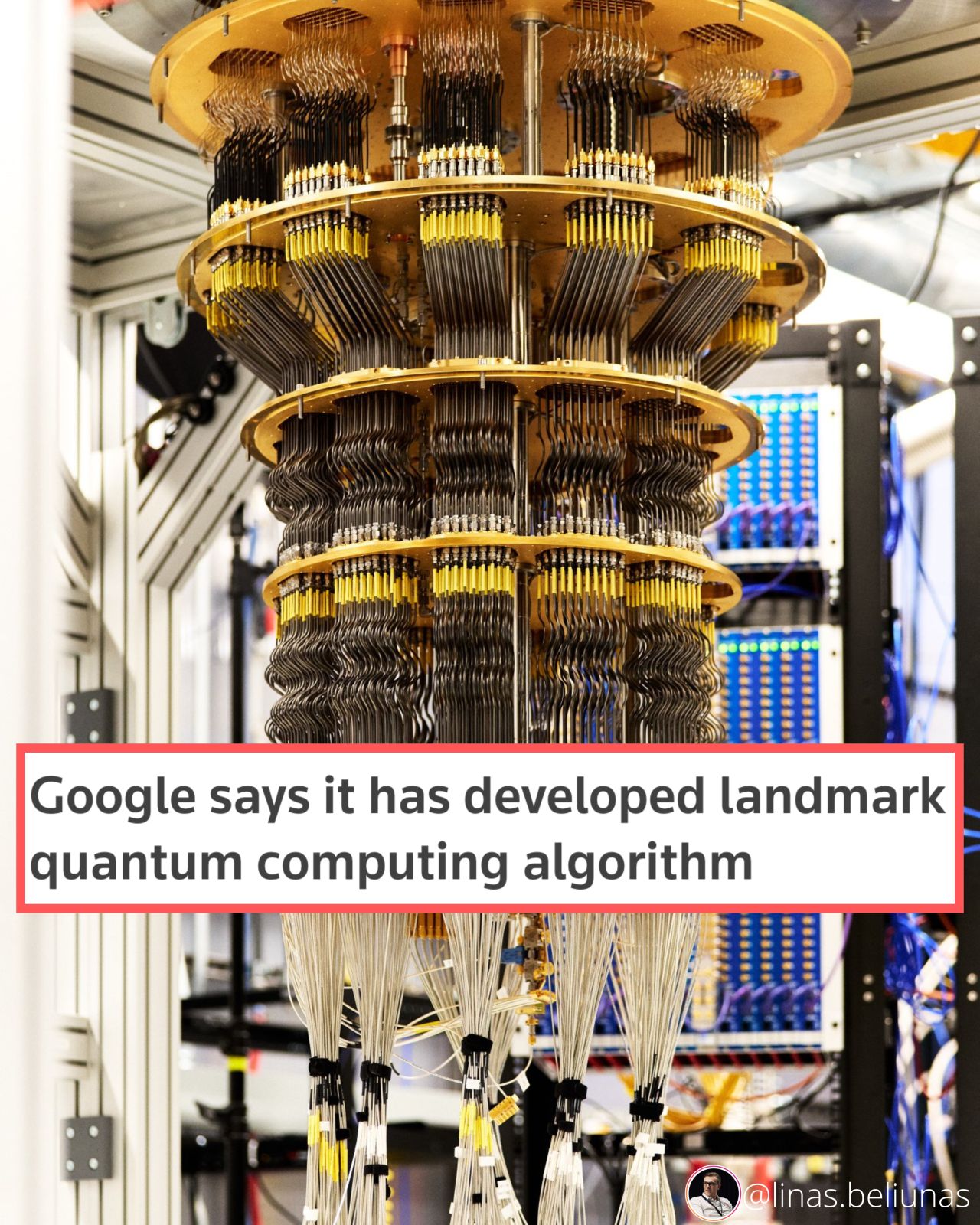
In a groundbreaking development, Google has achieved a verifiable quantum advantage, a significant milestone that moves quantum computing beyond theoretical possibility into practical application. Their quantum chip, codenamed Willow, has reportedly executed a complex physics simulation 13,000 times faster than even the most powerful conventional supercomputers available today. This achievement marks a pivotal moment, distinguishing itself from previous claims by tackling a problem with tangible real-world implications.
Unlike the 2019 demonstration of “quantum supremacy,” which involved solving an abstract mathematical problem of limited practical value, Google’s latest feat focuses on simulating the intricate interactions of atoms within real molecules. This capability is foundational to scientific advancements across multiple critical industries. The ability to accurately model molecular behavior is key to accelerating drug discovery, designing next-generation batteries, and pioneering novel materials research.
The Significance of Verifiable Advantage
A crucial aspect of this achievement is its verifiability. The results produced by Google’s quantum processor can be confirmed by other quantum systems and laboratory experiments. This distinguishes a genuine scientific milestone from mere marketing hype, providing confidence in the quantum computer’s capabilities. The publication of these findings in the prestigious journal Nature further underscores their scientific rigor and allows for peer review and independent verification.
Key Metrics of the Breakthrough
The success of the Willow chip is underpinned by several impressive technical specifications:
- 105 Qubits: The quantum processor utilizes 105 qubits, incorporating advanced error suppression techniques to maintain computational integrity.
- 13,000x Speedup: The simulation demonstrated a staggering 13,000-fold increase in speed compared to classical supercomputing methods.
- Peer-Reviewed Publication: The research has been published in Nature, ensuring scientific scrutiny and validation.
This represents the first instance where a quantum computer has performed a demonstrably useful and provable task.
Future Implications of Scaled Quantum Computing
Should the Willow architecture continue to scale effectively, the potential applications are transformative:
Accelerated Innovation in Key Sectors
- Drug Discovery: The timeline for designing new pharmaceuticals could be drastically reduced from years to mere months.
- Materials Science and Energy: Breakthroughs in developing advanced materials and more efficient batteries are on the horizon.
- Artificial Intelligence: Training complex AI models could potentially be achieved at unprecedented quantum speeds.
From Theory to Reality
Google’s achievement signifies a critical transition for quantum computing, moving it from the realm of theoretical exploration into practical, real-world problem-solving. This development suggests that Google is not just participating in the quantum revolution but is actively initiating the next wave of computational advancement. The era of quantum computing performing useful and verifiable tasks appears to have truly begun.
📝 About This Content
This article is based on insights shared by Linas Beliūnas on LinkedIn.
📅 Originally posted on October 22, 2025 | View original post on LinkedIn →