
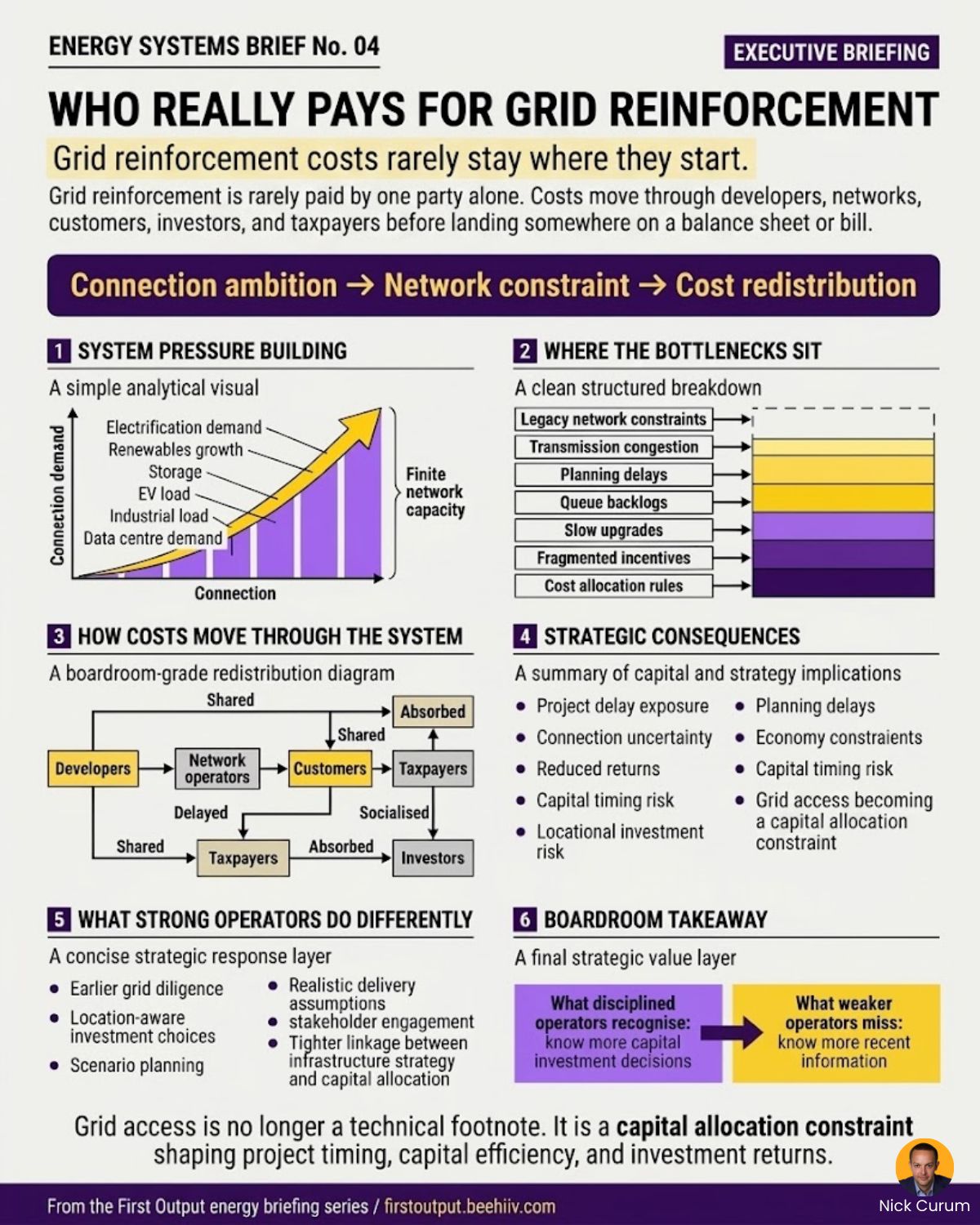
In a recent LinkedIn post, Nick Curum highlights a critical, often-overlooked challenge in the energy sector: grid access. Curum argues that grid access is frequently miscategorized as a purely technical or engineering problem, when in reality, it represents a significant capital allocation issue that boards are failing to adequately address.
The Misconception of Grid Access as a Secondary Concern
Curum begins by challenging the common perception that grid connection issues are someone else’s responsibility. He outlines a typical scenario where a developer initiates a project, encounters grid limitations, and triggers an upgrade. However, the crucial point Curum makes is that the associated costs are often not fully borne by the developer. Instead, these expenses can become shared, delayed, socialized, or absorbed, ultimately impacting balance sheets in ways that are not immediately apparent.
“The cost gets shared. Delayed. Socialised. Absorbed. By the time it lands on a balance sheet — it could be yours.”
This dynamic, according to Curum, shifts the problem from one of network engineering to one of capital allocation. He expresses concern that most corporate boards are treating this issue as a mere footnote in their strategic planning.
Strategic Shifts for Savvy Operators
The energy sector veteran points out that operators who are successfully navigating this challenge are adopting a more proactive and informed approach. Curum identifies three key differences in their strategies:
- Earlier Grid Diligence: These operators conduct grid assessments much earlier in the investment cycle, rather than as an afterthought.
- Location Decisions Based on Constraints: Site selection is increasingly influenced by grid constraint maps, moving beyond solely considering land costs.
- Stress-Testing Returns: Investment models are being stress-tested against potential connection delays to better understand financial risks.
Curum emphasizes that the widening gap in project success and financial performance is not driven by technological advancements but by disparities in information and strategic foresight.
“Grid access is now shaping project timing, capital efficiency, and investment returns.”
The Growing Risk of Unaccounted Grid Challenges
The core of Curum’s message is that grid access is fundamentally altering the landscape of project development, affecting timelines, capital efficiency, and overall investment returns. He warns that investment models that fail to incorporate these realities are inherently carrying unacknowledged risk.
“If your investment model doesn’t account for it, you are already carrying the risk. You just haven’t seen the bill yet.”
In his analysis, Curum suggests that understanding and integrating grid access considerations into capital allocation decisions is no longer optional but essential for financial prudence in the energy sector. He invites further discussion on where in the pipeline grid access is starting to impact financial numbers, indicating a call for greater industry awareness and adaptation.
📝 About This Content
This article is based on insights shared by Nick Curum on LinkedIn.
📅 Originally posted on March 9, 2026 | View original post on LinkedIn →