
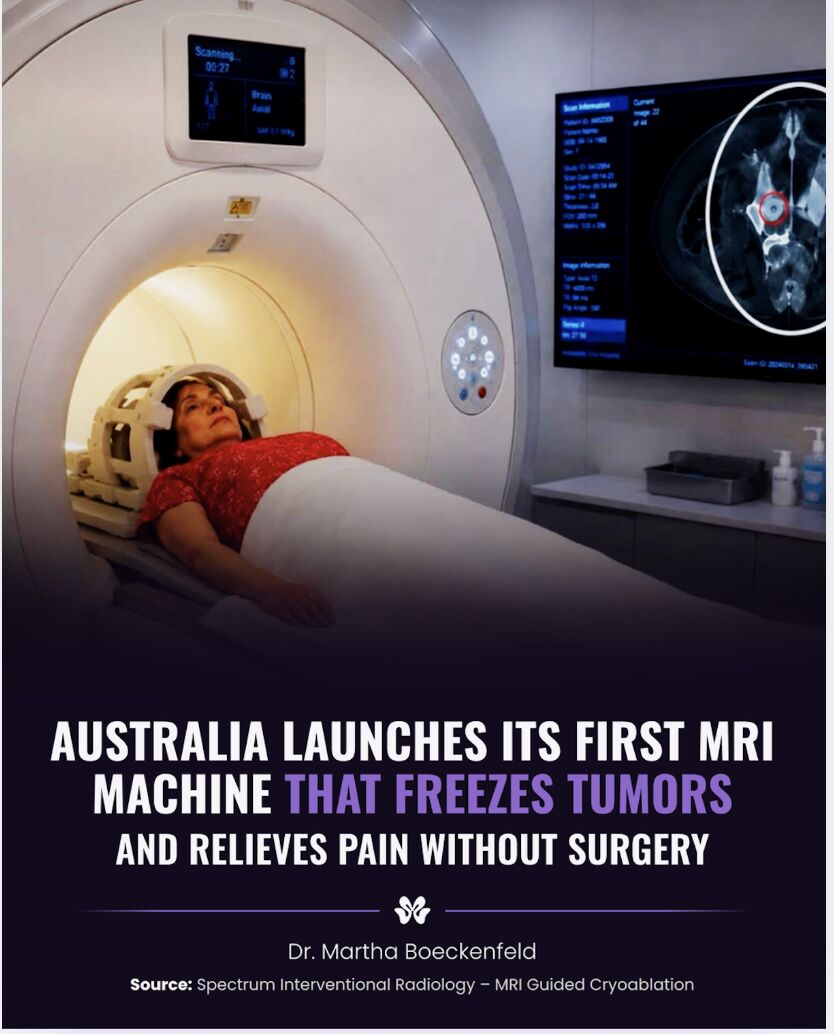
In a recent LinkedIn post, Dr. Martha Boeckenfeld highlights a revolutionary medical procedure that allowed a Sydney grandmother to return home pain-free on the same day of her treatment. Dr. Boeckenfeld shared the compelling case of Josephine, a 64-year-old who was suffering from a spinal tumor that caused debilitating pain, making even basic daily activities unbearable.
The traditional surgical approach for Josephine’s condition, an osteoid osteoma on her L3 pedicle, carried the risk of significant bone removal, the insertion of screws, and a lengthy recovery period spanning several months. However, Dr. Boeckenfeld detailed how Josephine became the first patient in Australia’s public health system to undergo MRI-guided in-bore cryoablation at Liverpool Hospital.
“A thin probe entered through a small puncture in her skin. Argon gas cooled its tip to about -160°C, creating an ice ball around the tumor. MRI let doctors watch its position in real time as the cold killed the tumor cells.”
Revolutionizing Spinal Tumor Treatment
Dr. Martha Boeckenfeld explained that the cryoablation technique involves inserting a small probe through a minimal skin puncture. This probe, utilizing argon gas, cools its tip to approximately -160°C, forming an ice ball around the tumor. The critical element, as noted by Dr. Boeckenfeld, is the real-time guidance provided by MRI, allowing clinicians to precisely monitor the probe’s position and the ice ball’s coverage as it destroys the tumor cells. This method is significantly more potent than the -40°C required for cell death.
The Power of Integrated Technology
The success of Josephine’s procedure was significantly attributed to the advanced capabilities of Liverpool Hospital’s IR-MACS suite. Dr. Boeckenfeld pointed out that this integrated suite combines MRI, CT, angiography, and ultrasound in a single room. This consolidation meant doctors could visualize the tumor, guide the cryoablation probe, and confirm the ice ball’s extent without needing to move the patient between different scanning machines.
“That room is the reason Josephine’s doctors could see the tumor, guide the probe, and confirm the ice ball’s reach without moving her to a different scanner.”
This state-of-the-art facility is part of a substantial redevelopment of the Liverpool Health and Academic Precinct. Dr. Boeckenfeld highlighted that this approach, first utilized for spinal tumors in Australia by Dr. Glen Schlaphoff in 2025, is already being applied to treat liver tumors, kidney tumors, and vascular malformations, underscoring its versatility and growing impact.
Accessibility and Future Potential
While acknowledging that cryoablation is not a universal solution and may not be suitable for all tumor types or patients, Dr. Boeckenfeld emphasized its transformative potential for the right cases. She stated:
“But for the right cases, a small puncture can replace open surgery, and patients can go home the same day instead of facing weeks of recovery.”
Dr. Boeckenfeld reflected on the seemingly simple combination of technologies—argon gas, extreme cold, and medical imaging—that, when integrated within a public hospital setting, can yield such remarkable patient outcomes. The ability to make such advanced treatments accessible to individuals like Josephine, who was expecting a major surgical intervention, represents a significant advancement in patient care.
“She woke up the next morning without the pain she’d been living with.”
The story, as presented by Dr. Boeckenfeld, invites reflection on how often medical experiences exceed patient expectations, offering hope and a swift return to normalcy through innovative application of existing technologies.
📝 About This Content
This article is based on insights shared by Dr. Martha Boeckenfeld on LinkedIn.
📅 Originally posted on August 12, 2026 | View original post on LinkedIn →