
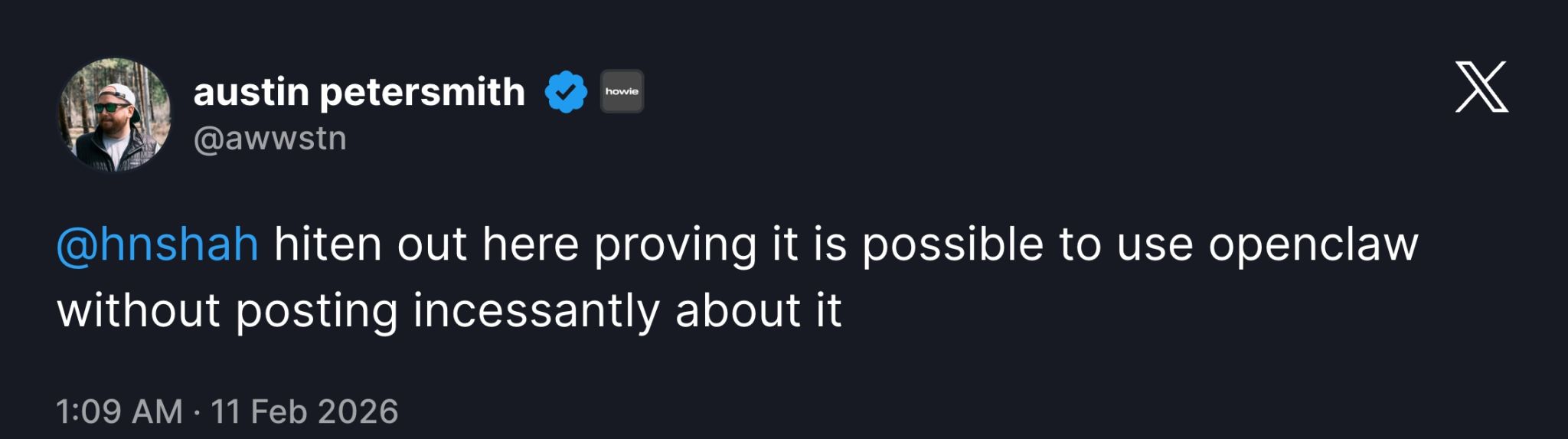
In a recent LinkedIn post, Hiten Shah discusses a profound rediscovery of the unbridled enthusiasm he experienced in the early days of computing, an emotion he attributes to his hands-on work with a new AI development, OpenClaw.
Shah, a long-time figure in the tech industry, described a feeling he hadn’t experienced since 1989, a time of early online communities like BBSs, IRC, and Prodigy. He contrasts this with the current landscape, noting a potential overemphasis on superficial engagement over deep understanding.
“I’ve had a computer since I was 8. Back then, it was BBSs, IRC, Prodigy, AOL. Small communities of people tinkering and building together. You know that feeling when you can’t stop because you’re learning too fast? I haven’t felt it in decades.”
This rekindled passion emerged last week as Shah began using OpenClaw for substantial work, moving beyond simple personal productivity. He intentionally refrained from public sharing, choosing instead to immerse himself in the learning process.
Deep Dive into AI Development
Shah recounts late nights spent engaged in DevOps tasks, some of which he hadn’t touched in thirty years. The driving force was not external pressure but an internal compulsion to learn and build.
“Multiple nights up till 2am doing DevOps work I haven’t touched in 30 years. There was no deadline. No customer waiting. I just couldn’t stop.”
He observed a prevailing trend where attention-seeking seems to overshadow the practical application and deep understanding of new technologies. Shah expressed a desire to avoid what he terms “documentation theater,” emphasizing the importance of first thoroughly understanding a tool before documenting it.
From Understanding to Application
Shah’s approach involved breaking the system, fixing it, and deploying it across multiple Slack workspaces. He even created a GitHub repository for his bot, named Bob, and observed colleagues using it in unexpected ways.
According to Shah, the current discourse around AI often moves too quickly, suggesting that genuine learning occurs in quieter, more focused environments.
“Everyone’s talking fast. You learn faster when you’re quiet.”
He detailed the setup of his bot, Bob, complete with its own GitHub repo and email address. The ability to deploy instances rapidly, reducing the setup time from initial struggles to mere minutes, highlighted a significant compression of the development cycle.
A Fundamental Shift in Capability
Shah clarifies that his renewed excitement isn’t tied to a specific tool, integration, or DevOps process. Instead, he identifies a fundamental shift where limitations of time and capability have given way to imagination as the primary constraint.
He shared an anecdote about a friend who integrated their own non-OpenClaw agent’s repository with Bob, enabling Bob to code solutions for their agent’s workflow problems. This illustrates a key distinction Shah makes: personal productivity tools save time, whereas this new wave of AI development offers entirely new capabilities.
“Personal productivity tools save you time. This gives you capabilities you never had.”
The journey, from wrestling with terminal commands and debugging complex integrations in the early chaotic stages (evidenced by the tool’s evolving names: Claudebot, Moltbot, and now OpenClaw) to frictionless deployment, represents a significant technological and personal milestone for Shah.
Looking ahead, Shah intends to share more about the work Bob and other bots are doing, particularly focusing on treating AI as a colleague rather than just a tool, and the implications of empowering non-engineers with capabilities previously reserved for engineering teams. However, he stresses the foundational importance of the hands-on building process itself.
📝 About This Content
This article is based on insights shared by Hiten Shah on LinkedIn.
📅 Originally posted on February 11, 2026 | View original post on LinkedIn →