
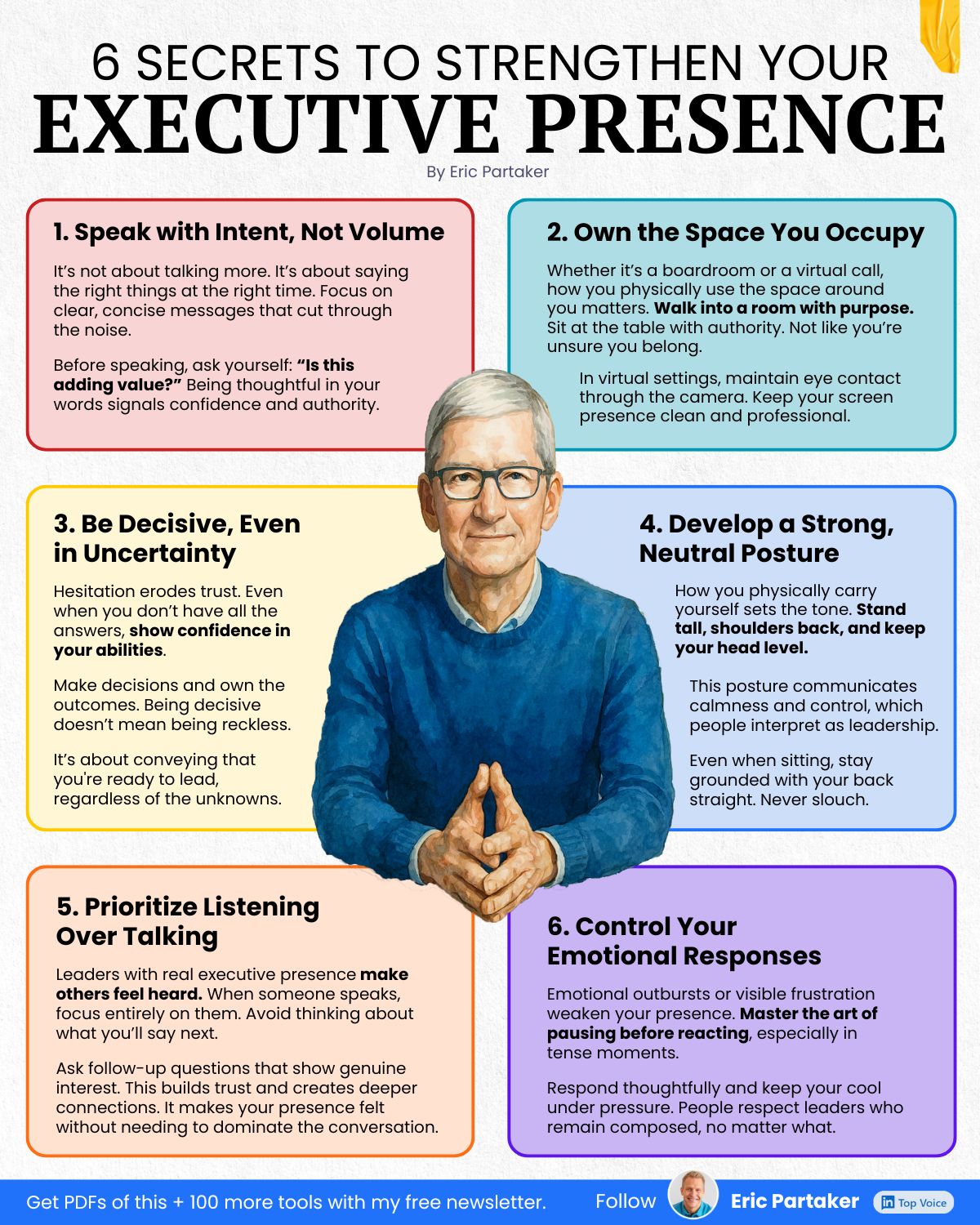
In a recent LinkedIn post, Eric Partaker explores the critical, often unspoken, elements of executive presence and how they impact leadership effectiveness. Partaker emphasizes that an individual’s presence communicates volumes before any words are spoken, particularly in scenarios involving team leadership, talent acquisition, investment pitches, and board presentations.
According to Partaker, executive presence serves as a “silent superpower” for leaders aiming to inspire trust and confidence. He outlines six key strategies for cultivating this essential leadership quality, focusing on impactful communication, confident demeanor, decisive action, effective listening, and emotional regulation under pressure.
“Your presence speaks before you do. But the real question is: What’s it saying?”
Partaker begins by challenging leaders to assess the message their non-verbal cues and overall bearing convey. He posits that in high-stakes professional situations, a strong executive presence is not merely beneficial but essential for establishing credibility and influence.
The Art of Speaking Less, Saying More
One of the core tenets highlighted by Eric Partaker is the principle of “Speak Less, Say More.” This doesn’t imply silence, but rather a deliberate and impactful use of language. Partaker advises leaders to ensure every word adds value and contributes to their core message, avoiding rambling or unnecessary discourse. This approach ensures that when a leader does speak, their words carry significant weight and clarity, making their message more memorable and persuasive.
“People with presence don’t ramble. They land their message. Ask: “Is this adding value?” Make your words do the heavy lifting.”
Cultivating Confidence Through Demeanor and Decision-Making
Partaker further breaks down executive presence into actionable physical and psychological components. He stresses the importance of posture and movement, suggesting that how one walks and sits can significantly influence perceptions of authority and self-assurance. This includes maintaining eye contact, having a clean background on video calls, and adopting a confident posture.
Furthermore, Partaker identifies decisive action as a cornerstone of leadership. He argues that in the face of uncertainty, leaders must be willing to make difficult decisions and own the outcomes, rather than getting paralyzed by indecision. According to Partaker, this ability to move forward, even without all the answers, is a key differentiator for trusted leaders.
Posture as a Communication Tool
Elaborating on physical presence, Partaker notes that posture is a direct reflection of internal confidence. “Slouching says: ‘I’m unsure.’ Straight back. Shoulders open. Chin up. Even seated, your body speaks volumes,” he writes. This emphasis on physical bearing underscores the idea that leadership communication begins long before verbal interaction.
The Power of Active Listening and Emotional Control
Beyond outward projection, Eric Partaker emphasizes the inward-facing skills of active listening and emotional regulation. He advocates for truly hearing what others are saying, rather than merely waiting for a turn to speak. By asking sharper questions and ensuring individuals feel genuinely heard and seen, leaders can rapidly build trust.
“Don’t just wait to talk. Actually hear them. Ask sharper questions. Trust builds fast when people feel seen.”
Partaker also addresses how leaders handle pressure. He suggests that pressure situations are opportunities to reveal leadership strength, not to falter. His advice is to pause, breathe, and respond calmly, asserting that “Calm earns confidence.” This ability to manage one’s internal state under duress is presented as a vital component of inspiring confidence.
Inspiring Confidence, Not Dominating
In conclusion, Partaker reframes executive presence not as an act of dominance, but as a means of inspiring confidence and trust. He reiterates that the most effective leaders often don’t need to be the loudest voice in the room; their inherent presence commands attention and respect. The insights shared by Partaker offer a practical guide for professionals seeking to enhance their leadership impact through a more deliberate and powerful executive presence.
📝 About This Content
This article is based on insights shared by Eric Partaker on LinkedIn.
📅 Originally posted on March 3, 2026 | View original post on LinkedIn →