
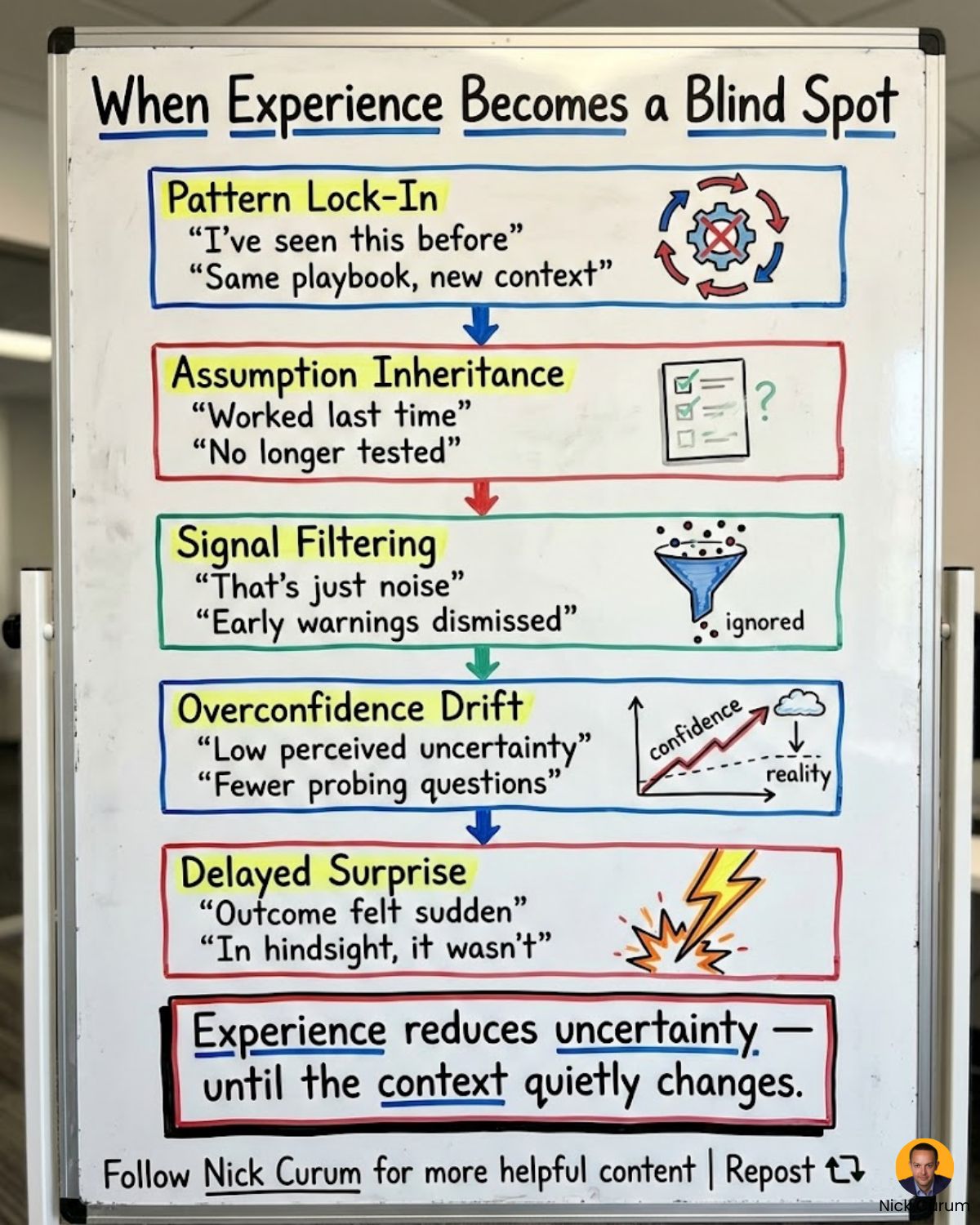
In a recent LinkedIn post, Nick Curum explores a critical paradox: how the very experience that should guide business leaders can, in fact, lead them astray. Curum, a prominent voice on strategic thinking, highlights how deep-seated experience can inadvertently create “blind spots” within boardrooms, preventing them from recognizing crucial shifts in their operating environment.
Curum argues that experience transitions from being a valuable tool to a detrimental filter. “Experience is meant to help us see more. In boardrooms, it often makes us see less,” he writes. This shift, according to Curum, is most dangerous at a stage he identifies as “Signal Filtering,” where genuine indicators of change are dismissed because they don’t align with pre-existing “mental models.”
The Cycle of Pattern Lock-In and Signal Filtering
Nick Curum outlines a five-step cycle that explains how even intelligent boards can miss significant market changes. He identifies the initial step as “Pattern Lock-In,” where familiar strategies are applied to new contexts without sufficient adaptation. This leads to “Assumption Inheritance,” where the efficacy of past successes is no longer critically examined.
The most critical phase, as highlighted by Curum, is “Signal Filtering.” He explains that genuine signals, such as emerging competitors, recurring customer dissatisfaction, or unusual metrics, are often mislabeled as “noise.” This happens because these signals do not conform to the established understanding or “mental model” prevalent in the room.
“Real signals arrive early: a new competitor, recurring customer complaints, or an odd metric that won’t settle. But because they don’t fit the ‘mental model’ in the room, they get labelled as ‘noise.'”
Curum contends that this filtering mechanism is precisely why well-meaning, experienced boards can overlook obvious threats or opportunities. The cycle continues with “Overconfidence Drift,” where rising confidence correlates with diminishing curiosity, and culminates in “Delayed Surprise” – a phenomenon where a significant event feels abrupt to those experiencing it, but was, in hindsight, entirely predictable.
The Deceptive Nature of Experience
The core of Nick Curum’s argument rests on the subtle way experience can erode perceptual abilities. “Experience reduces uncertainty until the context quietly changes. Then it reduces your ability to notice,” he states. This implies that while experience is invaluable for navigating known challenges, it can become a liability when the underlying conditions transform.
Identifying and Countering Blind Spots
To combat this insidious effect, Curum proposes a proactive question for board members to ask in their next meeting: “What are we currently dismissing as noise that could be a signal?” This simple yet profound question is designed to challenge the status quo and encourage a more open examination of incoming information, regardless of whether it fits current assumptions.
Curum concludes by prompting reflection on which stage of this cycle is most frequently observed. By raising awareness of how experience can become a filter, Nick Curum provides a valuable framework for leaders to foster greater curiosity and adaptability within their organizations, ensuring that they remain attuned to the evolving landscape rather than being blindsided by it.
📝 About This Content
This article is based on insights shared by Nick Curum on LinkedIn.
📅 Originally posted on February 3, 2026 | View original post on LinkedIn →