
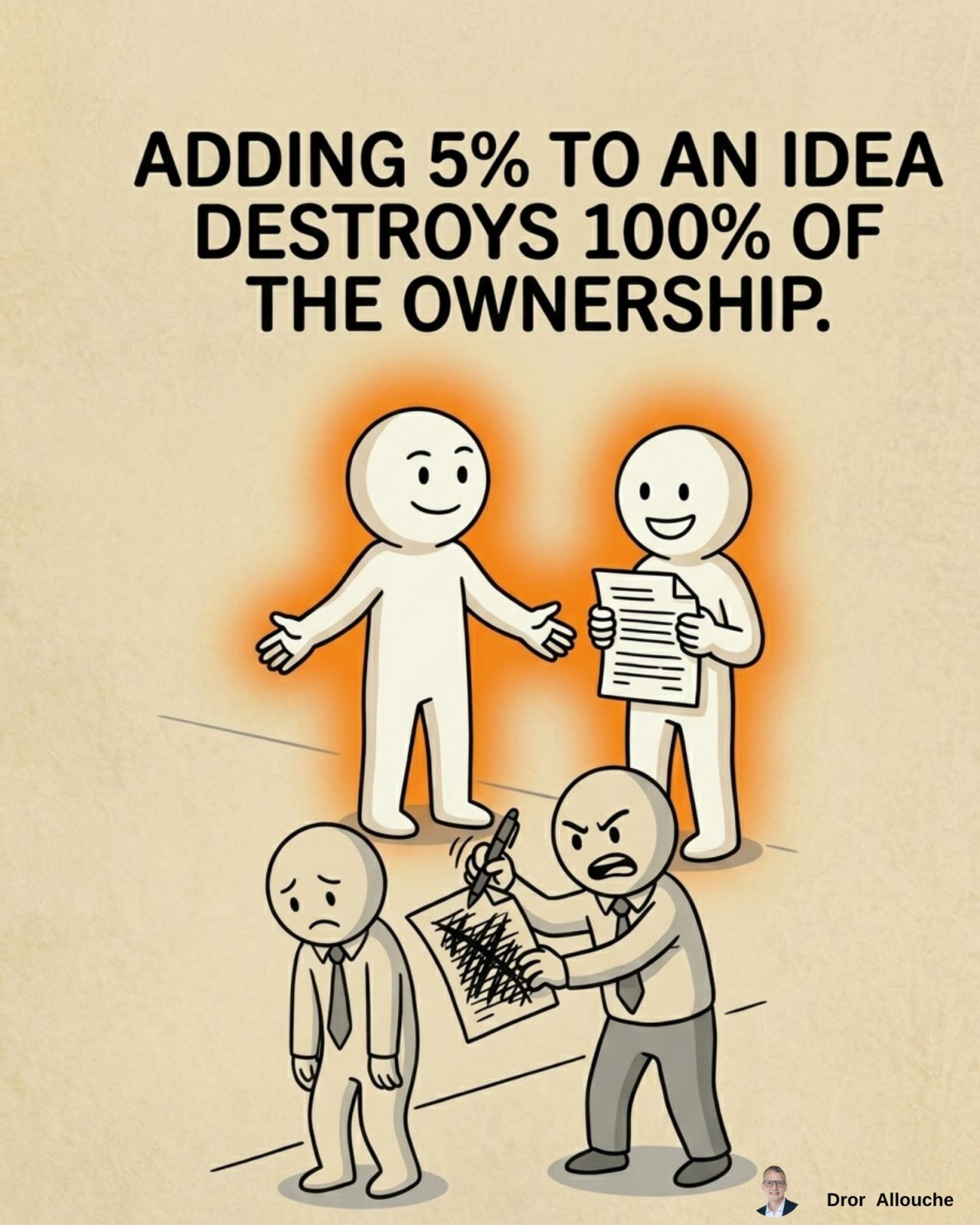
In a recent LinkedIn post, Drorallouche discusses a common workplace pitfall: the urge to ‘help’ that, paradoxically, can destroy an employee’s sense of ownership over their work. Drorallouche argues that while the intention might be to add value, unsolicited contributions can undermine a team member’s commitment and hinder their development.
The core of Drorallouche’s argument centers on the psychological impact of external interference. “We possess an urge to contribute,” the post begins, immediately setting the stage for an exploration of this innate human tendency within a professional context. The author observes that when a colleague presents a project, even with good intentions, adding “a little something extra” can satisfy the helper’s ego rather than genuinely benefit the project owner.
“In reality, we are destroying their ownership.”
Drorallouche emphasizes that this act, though often perceived as helpful, can lead to a significant reduction in the creator’s commitment to their own strategy and vision. The post poses a critical question for leaders: “Does it mean that I shouldn’t share my ideas?” The answer, according to Drorallouche, is nuanced: share, but do so in a way that fosters, rather than erodes, ownership.
Rethinking the ‘Execution Equation’
To address this challenge, Drorallouche outlines three practical steps for leaders to adopt. The first is framed as the “Execution Equation.” This principle highlights that true results stem from commitment, and altering a strategy inherently reduces the creator’s buy-in. Drorallouche advises leaders to approve plans that meet a certain standard and to resist the urge to insert their own additions, allowing the original creator to execute their vision.
“Results require commitment. Altering a strategy reduces the creator’s commitment.”
The author encourages leaders to reflect on their own practices with a coaching question: “Where do you sacrifice team commitment to satisfy your urge to contribute?” This prompts introspection into how leaders’ actions might inadvertently disempower their teams.
Understanding the ‘Intervention Threshold’
The second step, the “Intervention Threshold,” suggests that interventions should only occur when they have a significant impact. Drorallouche proposes a “30% rule,” meaning leaders should only intervene when their contribution is likely to alter the outcome by 30% or more. This metric aims to prevent minor, ego-driven adjustments that chip away at an individual’s sense of ownership.
“Interventions require a standard. Adjustments of 5% damage ownership.”
This approach, as Drorallouche explains, encourages leaders to critically assess the necessity and potential impact of their input, ensuring that interventions are strategic and substantial, rather than reactive or superficial.
Applying the ‘Boardroom Approach’
Finally, Drorallouche introduces the “Boardroom Application,” distinguishing between the roles of directors and operators. Directors, in this model, advise and guide, while operators execute. The actionable advice here is to address perceived gaps by asking questions rather than dictating solutions.
Governance Over Execution
Instead of directly intervening, leaders are encouraged to prompt the team member to explain their plan for closing any identified gaps. An example provided is: “I see a gap in the timeline. Walk me through your plan to close it.” This method empowers the team member to problem-solve, thereby reinforcing their ownership and building their capacity.
Drorallouche concludes by urging leaders to “Build capacity in your team” and “Protect their ideas.” By adopting these principles, leaders can foster an environment where team members feel a strong sense of ownership, leading to greater commitment and ultimately, better results.
📝 About This Content
This article is based on insights shared by Drorallouche on LinkedIn.
📅 Originally posted on May 27, 2026 | View original post on LinkedIn →