
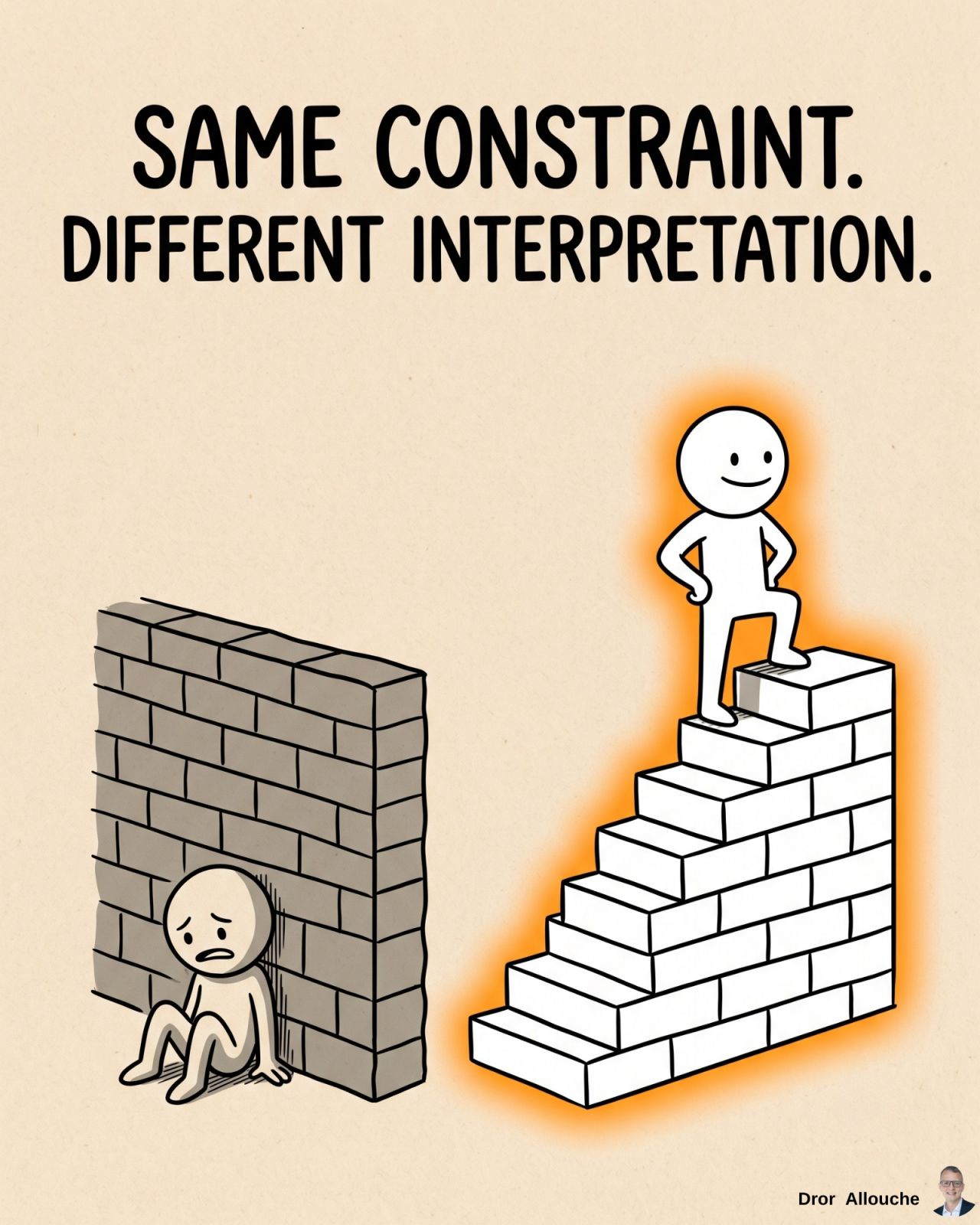
In a recent LinkedIn post, Dror Allouche explores the profound impact of personal interpretation on one’s life trajectory, particularly in the context of career advancement. Allouche uses a compelling analogy of two brothers with a shared difficult upbringing to illustrate how individual perspectives on constraints can lead to vastly different outcomes.
Allouche presents a core thesis: while individuals cannot choose all their life’s constraints, their interpretation of these limitations is the key determinant of their destiny. He writes:
“You cannot choose all your constraints in life. But your interpretation of those constraints will dictate your destiny.”
The post then outlines four practical strategies Allouche suggests for mastering these interpretations and, by extension, accelerating career growth.
The Power of Fact Separation
Allouche’s first strategy, ‘The Fact Separation,’ emphasizes distinguishing objective reality from emotional projection. He likens the mind to a projector rather than a camera, suggesting that we often overlay our experiences with emotions and opinions. To combat this, Allouche advises writing down a current obstacle, crossing out all emotionally charged words, and focusing solely on the remaining factual elements to find a solution.
“Your mind works like a projector, not a camera. You project emotions onto experiences.”
According to Allouche, this method allows individuals to address challenges from a more rational and actionable standpoint.
Leveraging the Opportunity Filter
The second technique, ‘The Opportunity Filter,’ addresses how our focus narrows our perception. Allouche explains that the brain actively filters information to align with what we are looking for. He proposes a simple yet powerful exercise: before entering important meetings, consciously decide to seek out solutions. By training the brain to actively look for opportunities, individuals can shift their focus from roadblocks to potential pathways forward.
The Art of the Lens Swap
In his third strategy, ‘The Lens Swap,’ Allouche delves into empathy and perspective-taking. He notes that people view the world through the lens of their unique past experiences. When faced with strong disagreement, Allouche suggests pausing the argument and instead asking the other person to explain their viewpoint.
“Ask them: ‘Can you help me see this situation through your eyes?'”
This approach, as Dror Allouche argues, can foster understanding and unlock collaborative solutions by acknowledging diverse perspectives.
Crafting a Better Story
Finally, Allouche introduces ‘The Better Story’ as a means to reframe constraints as advantages. He asserts that individuals possess the ultimate freedom to choose their attitude and narrative. The exercise involves identifying a significant career constraint and then writing a new story where this very constraint becomes a source of competitive strength.
“Write down a new story where this specific constraint becomes your competitive advantage.”
Dror Allouche concludes by reiterating that constraints do not predetermine the future; interpretations do. By consciously changing the narrative we tell ourselves about our obstacles, we can fundamentally alter our life’s course and unlock new possibilities.
📝 About This Content
This article is based on insights shared by Dror Allouche on LinkedIn.
📅 Originally posted on July 10, 2026 | View original post on LinkedIn →