
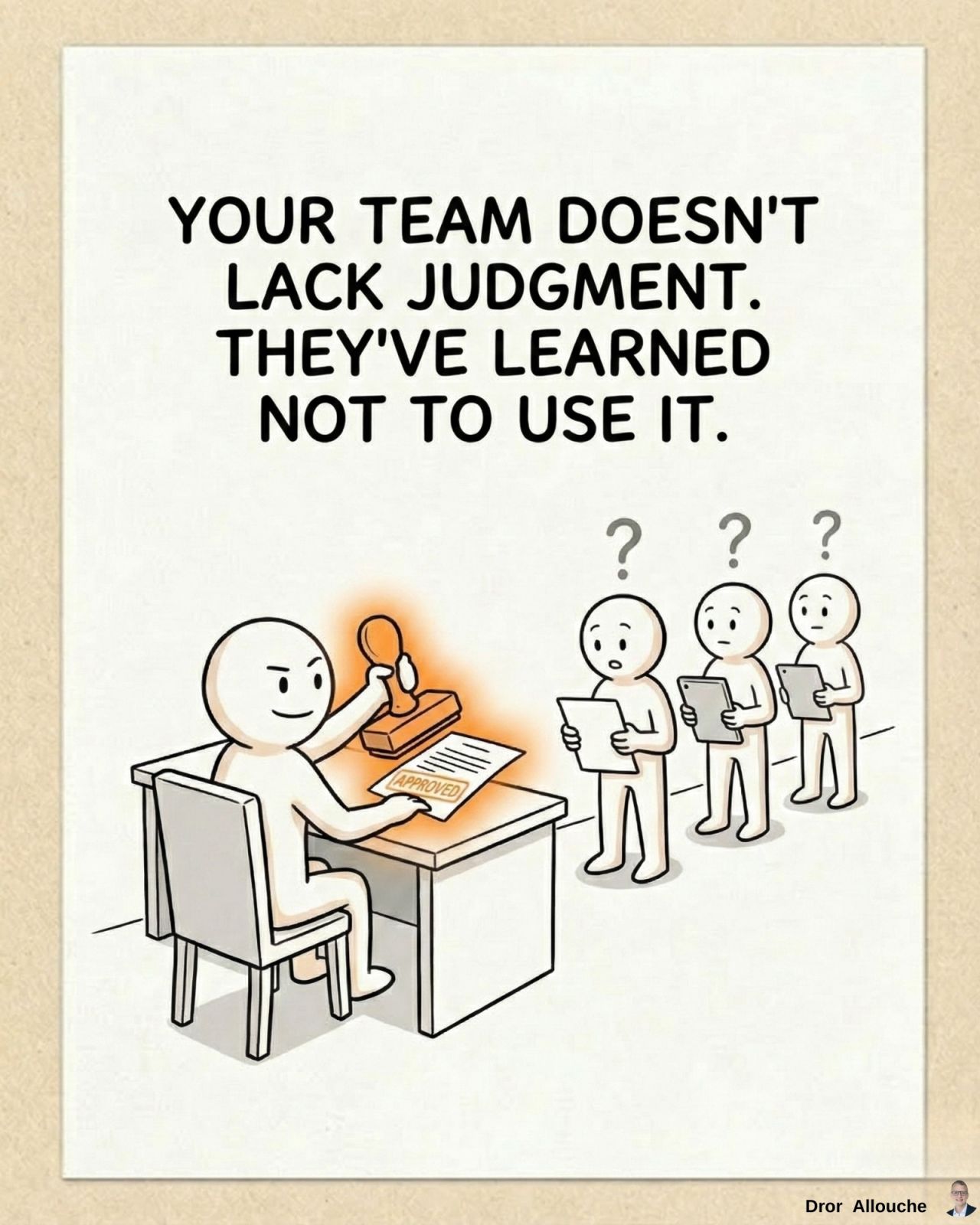
In a recent LinkedIn post, Dror Allouche addresses a common leadership pitfall: inadvertently creating dependency within teams. Allouche argues that many capable professionals, despite having a history of making significant decisions, often escalate even minor issues. This behavior, he suggests, is not due to a lack of judgment but rather a learned disinclination to use it, a consequence of how leaders respond to their team’s inquiries.
Allouche highlights several patterns where leaders unintentionally foster this dependency. He points out that the immediate provision of answers, rather than guiding the employee through their own decision-making process, teaches them to bypass their own thinking.
“Every time you answer ‘Should I do this?’, you teach them not to think.”
According to Allouche, this pattern can manifest in various ways. He identifies five common scenarios:
The Pitfalls of Leadership Responses
Dror Allouche outlines specific leadership behaviors that can stifle employee autonomy:
1. The Instant Answer
When an employee asks for a go-ahead on a task, a leader who immediately says “Yes, do it” inadvertently teaches the employee that seeking external validation is easier than independent thought. As Allouche puts it, the lesson taught is, “Why think when I can just ask?”
2. The Quality Takeover
Another common issue arises when employees present drafts or work for review, and the leader opts to rewrite it themselves. Allouche argues that this sends a clear message: “My judgment isn’t good enough.” This can erode an employee’s confidence in their own decision-making abilities.
3. The Second-Guess
Questioning an employee’s decision, especially in front of others, can create a lasting negative impression. Allouche notes that the resulting lesson is, “Better to ask first than apologize later,” discouraging proactive decision-making.
4. The Credit Grab
When employees solve a problem or achieve a win, and the leader presents it as their own accomplishment, it teaches the team that initiative is not truly rewarded. This can lead to a sense of disillusionment and a reluctance to go above and beyond.
5. The Inconsistent Override
Leaders who frequently disregard established processes or their own priorities can teach their teams that rules are flexible and ultimately unimportant. Allouche states the lesson learned here is, “The rules don’t actually matter.”
Cultivating Autonomous Teams
To counter these effects and build self-sufficient teams capable of reaching the C-suite, Allouche advocates for a shift in leadership approach. Instead of providing immediate answers, leaders should foster critical thinking by asking guiding questions.
“Stop answering. Start asking: ‘What do you think we should do?'”
Allouche emphasizes the importance of coaching over simply correcting or rewriting. When a team member presents work, he suggests leaders ask, “This works. What would make it stronger?” or “You’re 80% there. What’s the gap?” This approach encourages employees to refine their own work and thinking.
“The teams that reach the C-Suite aren’t the smartest. They’re the most autonomous.”
Furthermore, Allouche advises leaders to seek to understand the decision-making process rather than immediately questioning it. Phrases like “Walk me through your thinking” or “What led you here?” can encourage transparency and build trust. Ultimately, Dror Allouche concludes that autonomy is not an innate trait but a skill that is actively taught, one interaction at a time.
📝 About This Content
This article is based on insights shared by Dror Allouche on LinkedIn.
📅 Originally posted on February 26, 2026 | View original post on LinkedIn →