
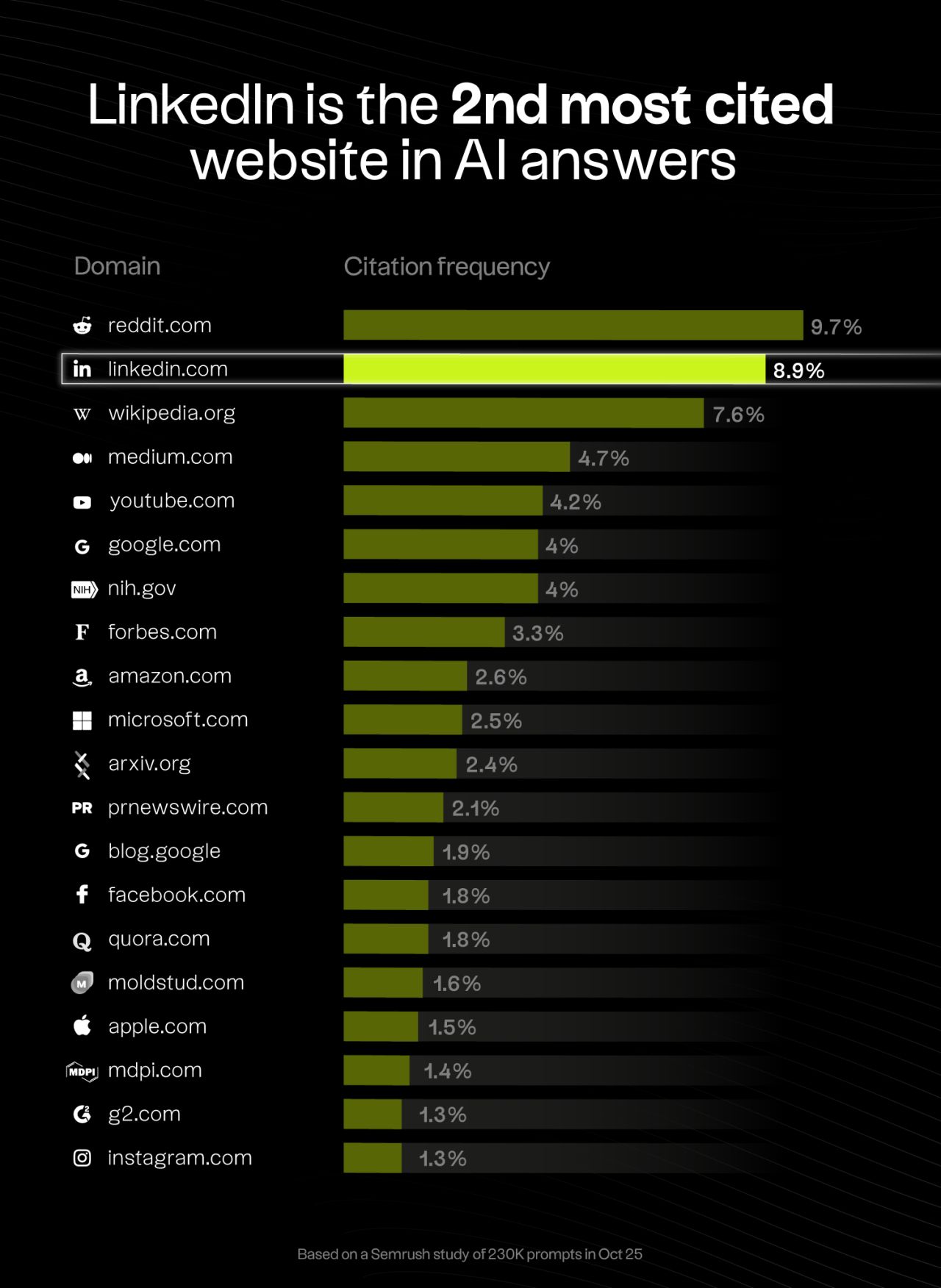
In a recent LinkedIn post, Rob Hoffman discusses the significant, yet often underestimated, role of LinkedIn content in improving visibility within Artificial Intelligence (AI) generated answers. Hoffman’s analysis, which delves deeper than initial findings from other platforms, reveals actionable insights for businesses looking to leverage AI’s growing reliance on social media data.
Hoffman’s research, conducted using Mentions to analyze 4.8 million AI answers and 13.4 million citations, uncovers a critical trend: LinkedIn is a dominant source for AI models. He highlights the sheer scale of this influence, stating:
“Almost half (42.5%) of all AI prompts we’re tracking cite LinkedIn at least once. Huge reach for a single platform.”
This statistic underscores the immense potential for content creators and businesses to gain visibility through LinkedIn. As Rob Hoffman notes, the platform’s content is not just being indexed but actively integrated into AI responses across various applications.
AI’s Growing Appetite for LinkedIn Content
The analysis reveals a rapid and consistent increase in AI’s citation of LinkedIn content. Hoffman’s findings indicate that AI tools are increasingly discovering and utilizing information shared on LinkedIn, suggesting a dynamic and evolving relationship between the platforms.
Key Growth Metrics
According to Rob Hoffman, the growth in AI citations of LinkedIn content is substantial:
“AI citations of LinkedIn grew by 72% in just 6 months. AI tools are finding and using LinkedIn content more every month.”
This rapid escalation points to a strategic imperative for businesses to optimize their LinkedIn presence for AI consumption. Hoffman further clarifies that much of this visibility is currently tied to Google’s AI products.
The Google AI Ecosystem
A significant portion of LinkedIn’s AI-driven visibility is channeled through Google’s AI initiatives. Hoffman points out:
“85% of LinkedIn citations come from Google’s AI products (AI Mode and Overviews). Using LinkedIn for AI visibility is mostly playing a Google game.”
This suggests that optimizing for Google’s search and AI features is paramount for maximizing LinkedIn’s impact in the AI landscape.
Optimizing for AI Visibility on LinkedIn
Beyond the general trend, Hoffman’s research identifies specific content formats and prompt types that yield the best results for AI visibility on LinkedIn.
The Power of Pulse Articles and Company Pages
Hoffman argues that longer-form content on LinkedIn significantly outperforms shorter posts in attracting AI citations. He found that LinkedIn Pulse articles are particularly effective, serving a dual purpose:
- Content ranks on Google search results.
- This ranked content is then frequently picked up by AI answers.
Furthermore, company pages emerge as the most cited entities on LinkedIn within AI responses. As Rob Hoffman explains, a well-ranking company page can lead to more consistent AI citations, reinforcing the importance of a robust corporate presence on the platform.
Understanding AI Prompt Preferences
The type of questions users ask AI significantly influences whether LinkedIn content is cited. Hoffman’s data indicates that AI is most likely to pull from LinkedIn when users inquire about specific people, companies, their experiences, or seek practical advice. Categories with high citation rates include:
- Hiring and HR questions (69.17%)
- Real examples and case studies (65.12%)
- “Who is this person or company?” (58.89%)
- Learning and training topics (57.04%)
This granular insight allows content strategists to tailor their LinkedIn efforts to align with topics that are frequently referenced by AI, thereby enhancing their digital footprint in the AI-driven information ecosystem.
📝 About This Content
This article is based on insights shared by Rob Hoffman on LinkedIn.
📅 Originally posted on February 24, 2026 | View original post on LinkedIn →