
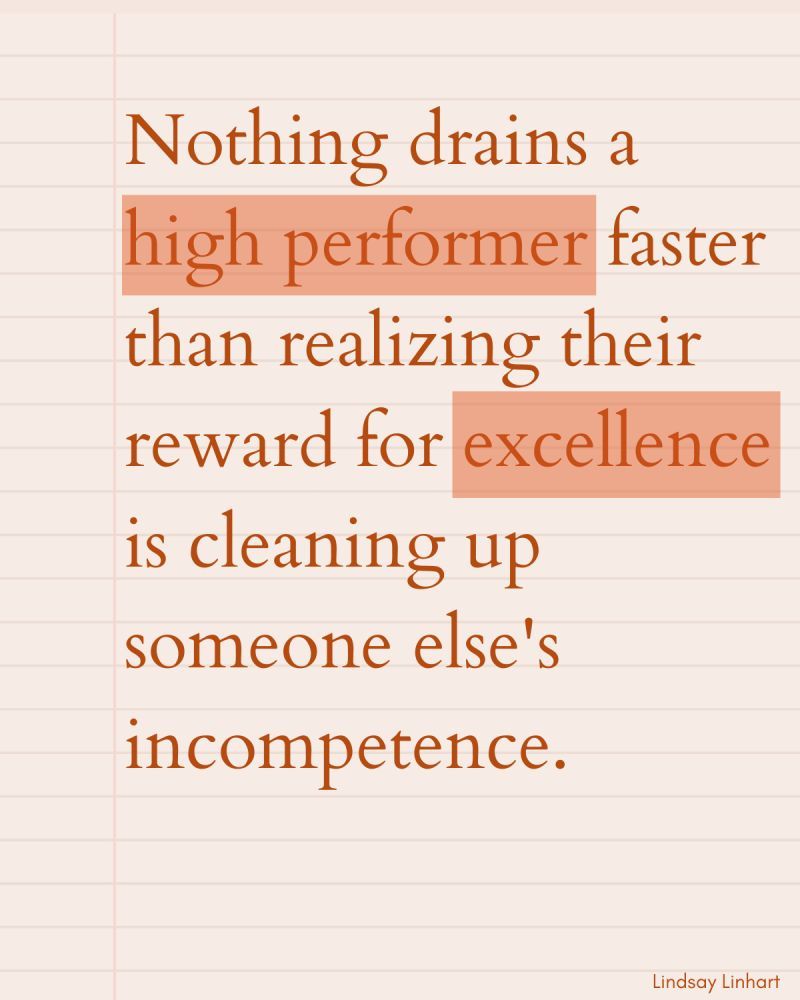
In a recent LinkedIn post, Lindsay Linhart discusses the insidious way that being perceived as highly capable can lead to burnout, as individuals become the default ‘cleanup crew’ for others’ shortcomings. Linhart highlights how the transition from being a valued team member to an organizational safety net can happen subtly, often starting with seemingly small requests.
The Slippery Slope of ‘Quick Favors’
Linhart points out the predictable pattern that often emerges: an individual excels, is noticed for their ability to ‘fix things,’ and subsequently receives more tasks that fall outside their core responsibilities. This can escalate from simple requests to inheriting projects that others have failed to manage effectively. As Linhart puts it:
“It starts innocently enough. You deliver. They notice. You get the sidebar. ‘Can you just take a look at this?’ ‘You’re so good at fixing things.’ ‘We need your magic touch on this project.’ Translation: Someone else dropped the ball and now it’s yours.”
This cycle, according to Linhart, leads to a situation where high performers are bogged down by the ‘broken pieces’ of the organization, often at the expense of their own critical work. The constant need to ‘rescue’ others’ mediocrity, while earning a reputation for being ‘reliable,’ can paradoxically undermine their actual job performance and career progression.
Protecting Excellence from Inherited Mediocrity
A core argument presented by Linhart is that an individual’s excellence should not be mistaken as an invitation to absorb the organization’s failures. Linhart stresses that being capable, skilled, or reliable does not equate to being responsible for everyone else’s deficits. The post argues that repeatedly stepping in to fix problems not only stretches an individual too thin but also sends a dangerous message to the organization.
Consequences of Constant Intervention
Linhart warns that this pattern teaches the organization that excellence involves doing one’s own job plus others’, that accountability is negotiable if a high performer is available to compensate, and that high performers are essentially there to cover for lower standards. This can create a culture where mediocrity is tolerated because there is always someone to clean up the resulting mess.
The author emphasizes the importance of setting boundaries to protect one’s energy and focus. As Linhart advises:
“Your excellence isn’t an invitation to inherit mediocrity. Being capable doesn’t mean being available. Being skilled doesn’t mean being responsible for everyone else’s gaps. Being reliable doesn’t mean being the default fixer.”
The post concludes with a strong call to action for high performers to safeguard their own contributions and energy. Linhart advocates for letting the organization learn from the natural consequences of its own standards, rather than consistently acting as a safety net. The ultimate message is that an individual’s primary role should be to excel at their designated responsibilities, not to constantly compensate for others.
“Because every time you rescue someone else’s mediocrity, you’re teaching the organization something dangerous: That excellence means doing your job AND theirs. That accountability is optional if someone will catch it. That high performers exist to compensate for low standards.”
Linhart encourages professionals to protect their energy and focus on their core duties, asserting that this self-preservation is crucial for sustained high performance and preventing burnout.
📝 About This Content
This article is based on insights shared by Lindsay Linhart on LinkedIn.
📅 Originally posted on March 30, 2026 | View original post on LinkedIn →