
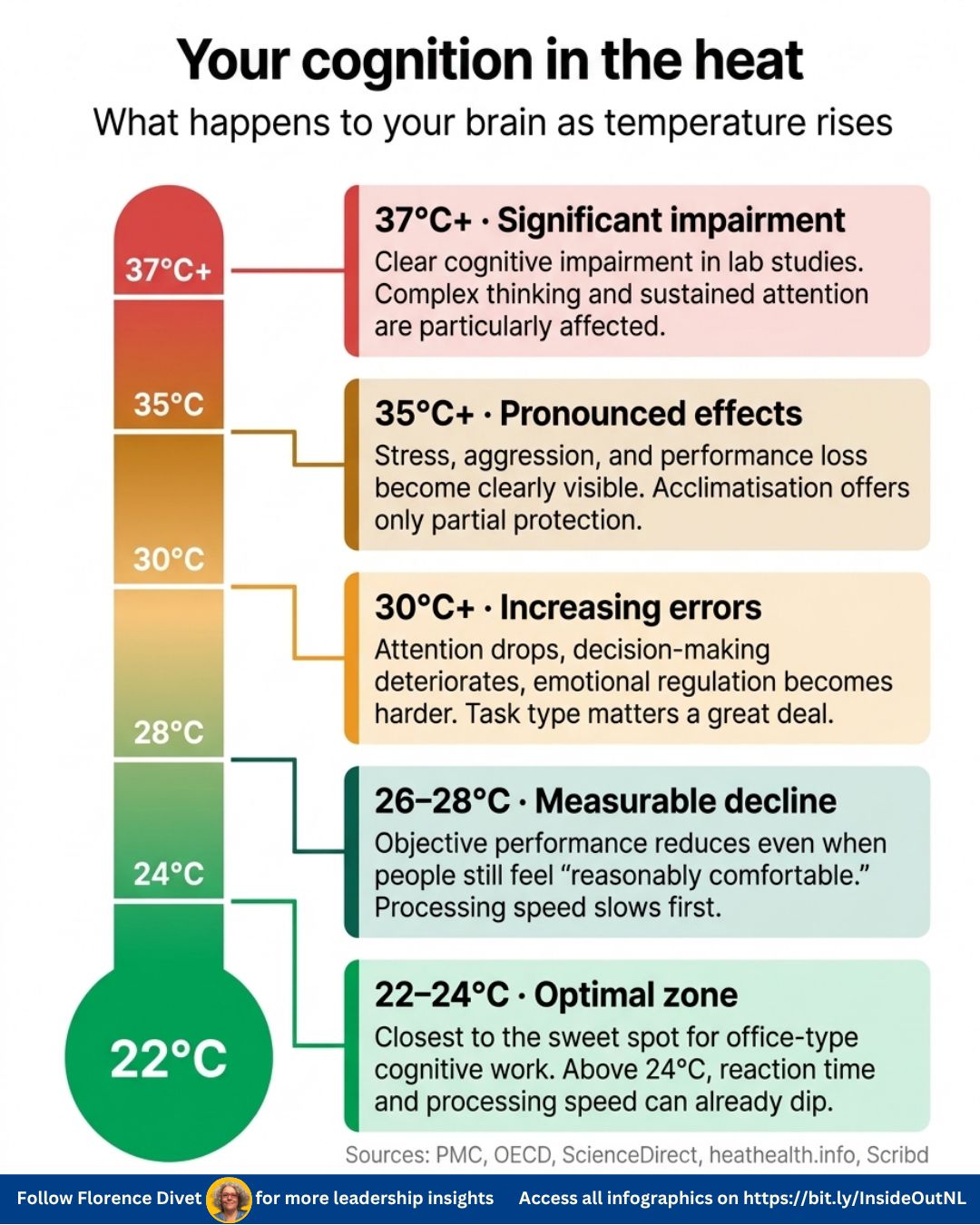
In a recent LinkedIn post, Florence Divet ☀️ discusses the significant, yet often overlooked, impact of rising temperatures on workplace cognition, productivity, and interpersonal dynamics. The post highlights how common workplace annoyances can escalate into serious conflicts when the ambient temperature becomes uncomfortable.
Florence Divet ☀️ points out that the human brain’s performance is intrinsically linked to environmental conditions, particularly temperature. As the author notes:
“Research shows cognitive performance starts declining above 23–24°C. By the low 30s, attention, memory, and decision-making drop significantly.”
This scientific observation, according to Florence Divet ☀️, explains the common experience of increased irritability, distraction, and exhaustion during heatwaves. The post elaborates on how normal workplace interactions can be negatively affected:
- The email that normally feels slightly annoying suddenly feels personal.
- The meeting that would usually spark healthy debate turns into friction.
- The colleague who is normally patient becomes reactive.
Florence Divet ☀️ argues that this phenomenon is not a matter of personal failing but a physiological response to heat. The brain is forced to work harder to maintain normal functions, leading to heightened stress, reduced self-control, increased aggression, and impaired judgment.
The Compounding Effect of Poor Sleep
Beyond the immediate effects of heat during working hours, Florence Divet ☀️ emphasizes the critical role of sleep quality, which is often compromised during warmer nights. The post explains:
“Warmer nights make it harder to fall asleep, to stay asleep, and for the brain to recover. So people arrive at work already depleted, then spend the day in a hot environment surrounded by other depleted people. A team running on fumes in a pressure cooker.”
This combination of sleep deprivation and a hot working environment creates a perfect storm for reduced cognitive function and increased emotional volatility, Florence Divet ☀️ suggests.
Strategies for Navigating Heat-Induced Cognitive Shifts
To mitigate these effects, Florence Divet ☀️ offers several practical strategies for individuals and leaders:
Prioritize High-Cognition Tasks
Florence Divet ☀️ advises scheduling demanding thinking tasks, complex decision-making, and creative work for the cooler parts of the day, typically before 11 a.m., as cognitive abilities wane as temperatures rise.
Manage High-Stakes Interactions
The post recommends delaying high-stakes conversations if the temperature exceeds 28°C, as hot environments can exacerbate tension. Florence Divet ☀️ suggests rescheduling such discussions if possible to avoid potential conflict.
Proactive Hydration and Cooling
Staying ahead of thirst is crucial, as Florence Divet ☀️ points out that thirst is a late indicator of dehydration, which contributes to cognitive fatigue. Additionally, the post highlights the importance of cooling the body, not just the immediate workspace, to facilitate deep sleep. Simple measures like a cool shower or a damp towel can significantly aid sleep recovery.
Allowing for Reaction Time
Florence Divet ☀️ stresses the need to build in buffer time for thinking and responding, noting that heat can increase impulsivity and slow down processing speed. This buffer allows individuals to counteract the effects of heat on their judgment and reactions.
Acknowledging the Environmental Factor
A key leadership skill, according to Florence Divet ☀️, is recognizing and naming the impact of the heat. Simply acknowledging, “It’s very hot in here, we might be more reactive than usual,” can increase collective awareness and help de-escalate potential conflicts. The post concludes by framing the issue not as a personal flaw but as an environmental challenge that great leaders can identify and manage effectively.
“The problem is the temperature in the room, not the person in it. Great leaders can tell the difference.”
Florence Divet ☀️’s insights provide a valuable framework for understanding and addressing the cognitive and emotional challenges posed by workplace heat, encouraging a more empathetic and effective approach to management and collaboration.
📝 About This Content
This article is based on insights shared by Florence Divet ☀️ on LinkedIn.
📅 Originally posted on June 22, 2026 | View original post on LinkedIn →