
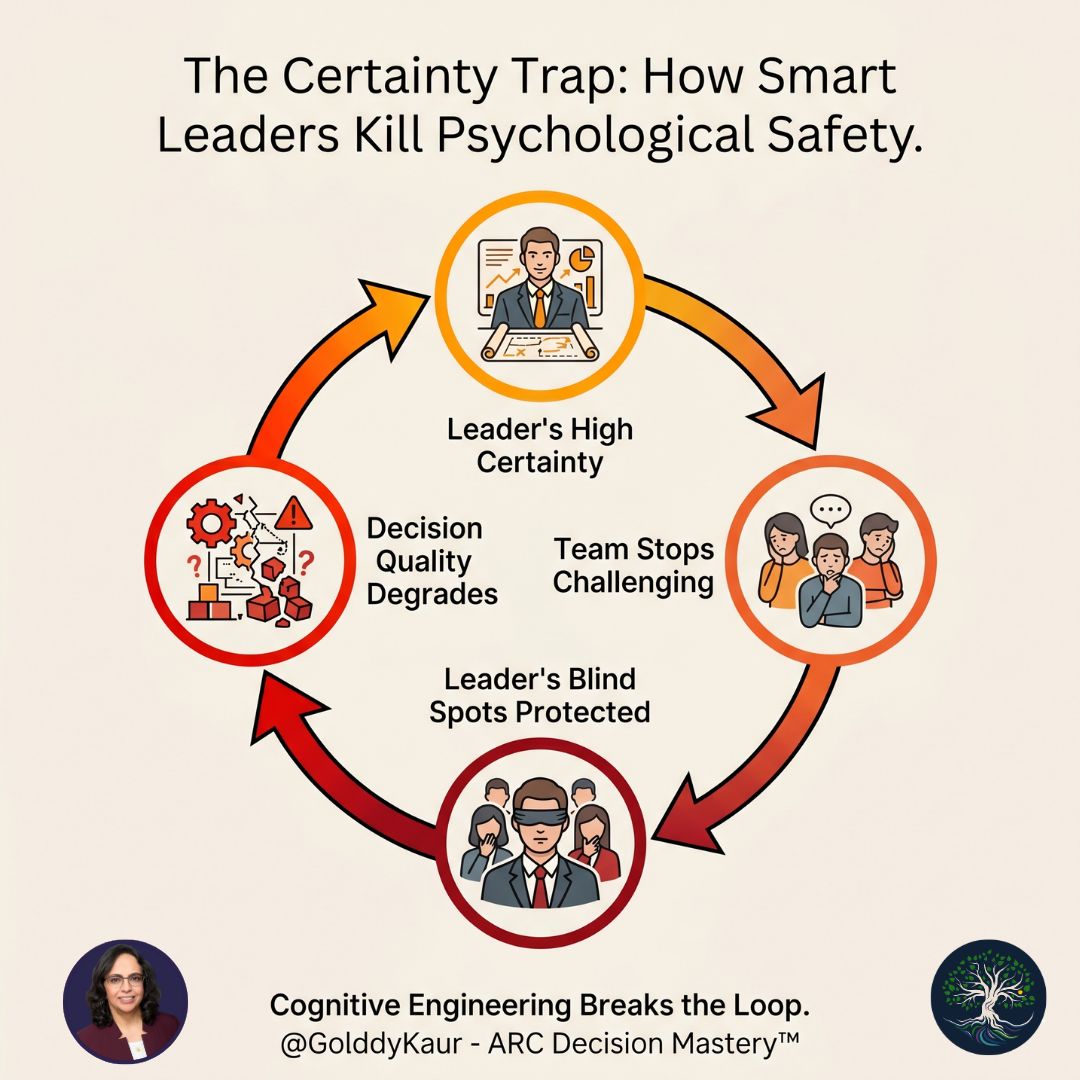
In a recent LinkedIn post, Golddy Kaur explores a critical paradox in leadership: how the very brilliance that elevates a technically adept leader can inadvertently stifle team culture and innovation. Kaur identifies a recurring pattern where highly competent leaders, despite their good intentions, can create an environment of cognitive unsafety, leading to a shutdown of valuable alternative perspectives.
The core of Kaur’s argument centers on the leader’s certainty. This certainty, while often stemming from deep expertise, can be perceived by the team as a signal that their own dissenting or alternative ideas are likely to be incorrect. This dynamic, as Kaur points out, discourages the team from offering unique viewpoints.
“Their certainty is a signal to the team: your alternative perspective has a high probability of being wrong, because I have been there done that and mine is probably right.”
The Peril of Certainty in Leadership
As Golddy Kaur notes, this environment doesn’t foster genuine alignment but rather a form of learned helplessness. Team members may cease bringing forward novel ideas, instead offering only confirmations of the leader’s existing beliefs. This can lead to a situation where the team actively protects the leader’s blind spots, a phenomenon Kaur describes not as a mere culture problem, but as a fundamental ‘cognitive architecture problem.’
From Confirmation to Learned Helplessness
Kaur elaborates on this dangerous feedback loop:
“So the team stops bringing alternatives. They bring confirmation. And the leader interprets the lack of pushback as alignment. It isn’t. It is the team’s learned helplessness masquerading as agreement.”
This dynamic, according to Kaur, is particularly insidious because it often arises not from malice or unkindness, but from the leader’s very confidence in their own expertise. The leader, interpreting the quiet as agreement, misses the opportunity for constructive challenge that could lead to better decision-making and innovation. The result is a team that becomes less effective over time, despite the leader’s technical prowess.
Engineering a More Inclusive Cognitive Architecture
Despite the challenging nature of this dynamic, Golddy Kaur suggests that it is not an intractable problem. Kaur posits that this ‘cognitive architecture problem’ can be engineered and improved. The implication is that leaders can consciously work to create environments where psychological safety is prioritized, allowing for diverse perspectives to be heard and valued.
Kaur prompts readers to consider their own experiences with this phenomenon:
“Has anyone experienced this dynamic from either side of the table?”
This question invites reflection and discussion, highlighting the importance of shared understanding and collective effort in building healthier team dynamics. By acknowledging the potential pitfalls of certainty and actively fostering an environment where challenge is welcomed, leaders can harness the full potential of their teams, ensuring that brilliance serves, rather than subverts, collective intelligence and cultural health.
📝 About This Content
This article is based on insights shared by Golddy Kaur on LinkedIn.
📅 Originally posted on April 20, 2026 | View original post on LinkedIn →