
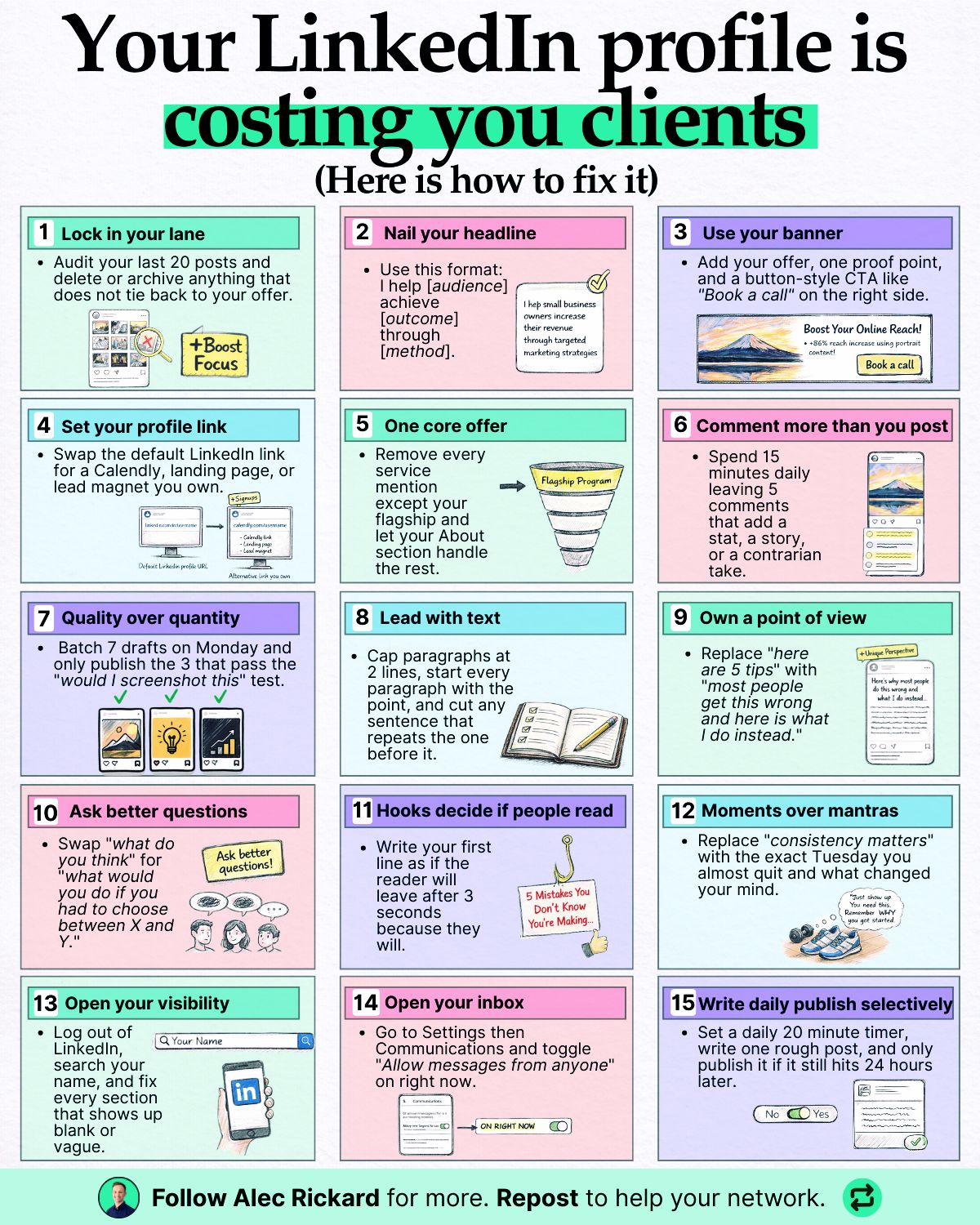
In a recent LinkedIn post, Alec Rickard explores strategies for aligning a user’s content with their personal brand to enhance authority and engagement on the platform. Rickard emphasizes that inconsistent or off-brand content can hinder growth, leading to missed opportunities for clicks, direct messages, and ultimately, deals. He argues that in today’s fast-paced digital environment, clarity is paramount for capturing audience attention.
Rickard’s core message is that a well-aligned profile and content strategy can convert attention into authority, allowing individuals to achieve their goals without needing to constantly inhabit the platform. He states:
“The algo does not reward off-brand tips. If your story is messy, you lose clicks, DMs, and deals.”
This highlights the critical need for a cohesive brand message across all LinkedIn activities. According to Rickard, buyers scan quickly and require immediate clarity to engage with content.
Strategic Profile Optimization for Business Growth
Rickard outlines 15 actionable steps designed to make a LinkedIn profile more effective. A key recommendation is to “lock in your lane” by auditing past content and removing anything that doesn’t directly relate to one’s core offer. This focus is crucial for establishing a clear identity and attracting the right audience.
Another significant point Rickard makes is the importance of a compelling headline and banner. He suggests a specific format for headlines: “I help [audience] achieve [outcome] through [method].” For the banner, he advises including the core offer, a proof point, and a clear call to action (CTA) such as “Book a call.” As Rickard notes, a strategic banner can immediately communicate value and guide visitors toward a desired action.
“Use your banner. Add your offer, one proof point, and a button-style CTA like ‘Book a call’ on the right side.”
Enhancing Engagement Through Content and Interaction
Beyond profile elements, Rickard delves into content creation and engagement tactics. He advocates for “quality over quantity,” suggesting batching content creation and then selectively publishing only the posts that meet a high standard. This approach ensures that each piece of content contributes meaningfully to the user’s brand authority.
Rickard also emphasizes the impact of how content is presented. He recommends leading with text, keeping paragraphs concise, and starting each paragraph with the main point. This writing style, he argues, respects the reader’s time and improves comprehension. He further advises users to:
“Own a point of view. Replace ‘here are 5 tips’ with ‘most people get this wrong and here is what I do instead.'”
This strategy encourages the development of a distinct voice and perspective, differentiating the user from generic advice-givers. Rickard also suggests asking more specific questions to foster deeper engagement, moving beyond generic prompts like “what do you think?” to more thought-provoking inquiries.
Consistency and Selectivity in Publishing
A nuanced approach to publishing is also central to Rickard’s advice. He suggests writing daily but publishing selectively, using a timer to create drafts and only sharing those that hold up under scrutiny. This method balances consistent content generation with the need for high-quality output.
Rickard concludes by stressing that authority is built on clarity and standards, not just sheer effort. He encourages users to tackle the recommendations that feel most uncomfortable, as these often represent the greatest areas for improvement.
📝 About This Content
This article is based on insights shared by Alec Rickard on LinkedIn.
📅 Originally posted on March 24, 2026 | View original post on LinkedIn →