
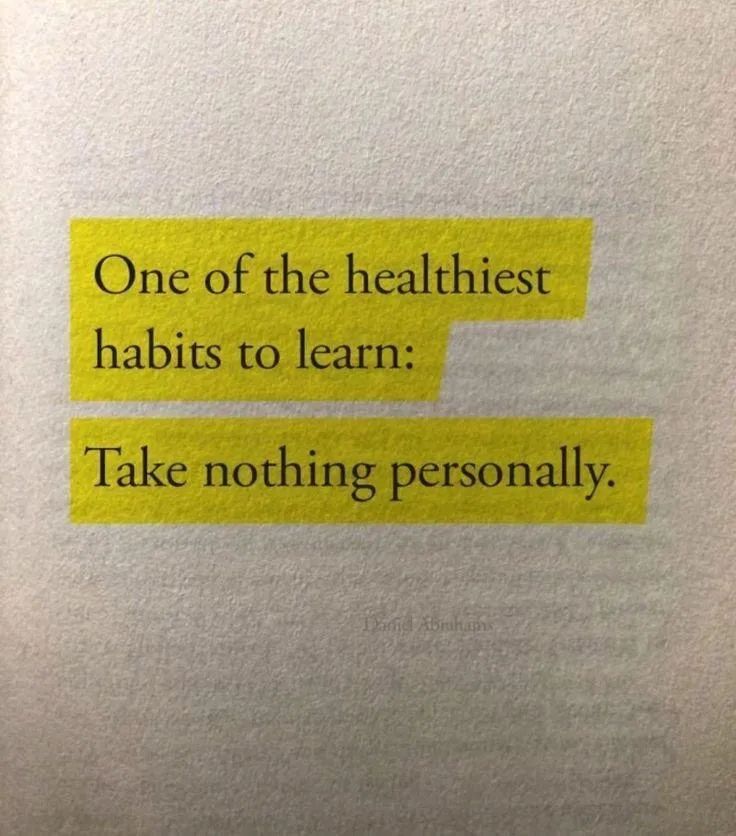
In a recent LinkedIn post, Noemi Kis✨ discusses the exhausting nature of taking professional and personal interactions too personally, offering practical strategies to break this common cognitive pattern. The post highlights how our internal narratives can often distort reality, leading to unnecessary emotional distress.
Noemi Kis✨ begins by acknowledging the prevalence of this issue, stating,
Taking things personally is exhausting. For years, I did it constantly.
This personal reflection sets the stage for an exploration of cognitive distortions – instances where the brain convinces an individual of untruths.
Understanding Cognitive Distortions
The core of Noemi Kis✨’s message revolves around identifying and reframing the stories we tell ourselves. As Noemi Kis✨ explains, the emotional impact often stems not from the event itself, but from the interpretation applied to it.
It’s not the event that upsets you. It’s the story you tell yourself about it.
This distinction is crucial, as it empowers individuals to recognize that their emotional responses are malleable and can be influenced by changing their internal dialogue.
Strategies for Breaking the Pattern
Noemi Kis✨ outlines several actionable steps to help individuals detach from personal interpretations and foster a healthier perspective:
1. Label Your Story
The first step involves consciously identifying the narrative being constructed around an event. By labeling the story, one can begin to separate objective reality from subjective interpretation.
2. Reframe Questioning as a Learning Opportunity
Noemi Kis✨ addresses the common tendency to perceive challenges or questions as personal attacks. The advice here is to reframe such instances not as rejection, but as opportunities for growth or clarification. As Noemi Kis✨ notes, when someone challenges you, your ego may translate it as an attack, but a shift in perspective can be beneficial.
3. Implement the ‘2-Second Buffer’
A key technique offered is the ‘2-second buffer.’ This simple yet effective strategy involves creating a small pause between receiving a reaction from someone and formulating a response. This space allows for a more considered and less reactive approach.
Give yourself space between someone’s reaction and your response.
This buffer can prevent impulsive reactions driven by perceived slights.
4. Focus on Controllables
Finally, Noemi Kis✨ emphasizes the importance of directing energy toward what is within one’s control. While external reactions are unpredictable, individual actions and responses are entirely manageable.
You can’t control if someone replies. You can control your next move.
This principle helps to mitigate anxiety associated with the actions or inactions of others, reinforcing that their behavior is a reflection of their own circumstances, not necessarily a commentary on you.
Noemi Kis✨ concludes by reinforcing that external reactions are often a reflection of the other person’s world, not yours. This perspective shift is fundamental to reducing the burden of taking things too personally.
📝 About This Content
This article is based on insights shared by Noemi Kis✨ on LinkedIn.
📅 Originally posted on January 10, 2026 | View original post on LinkedIn →