
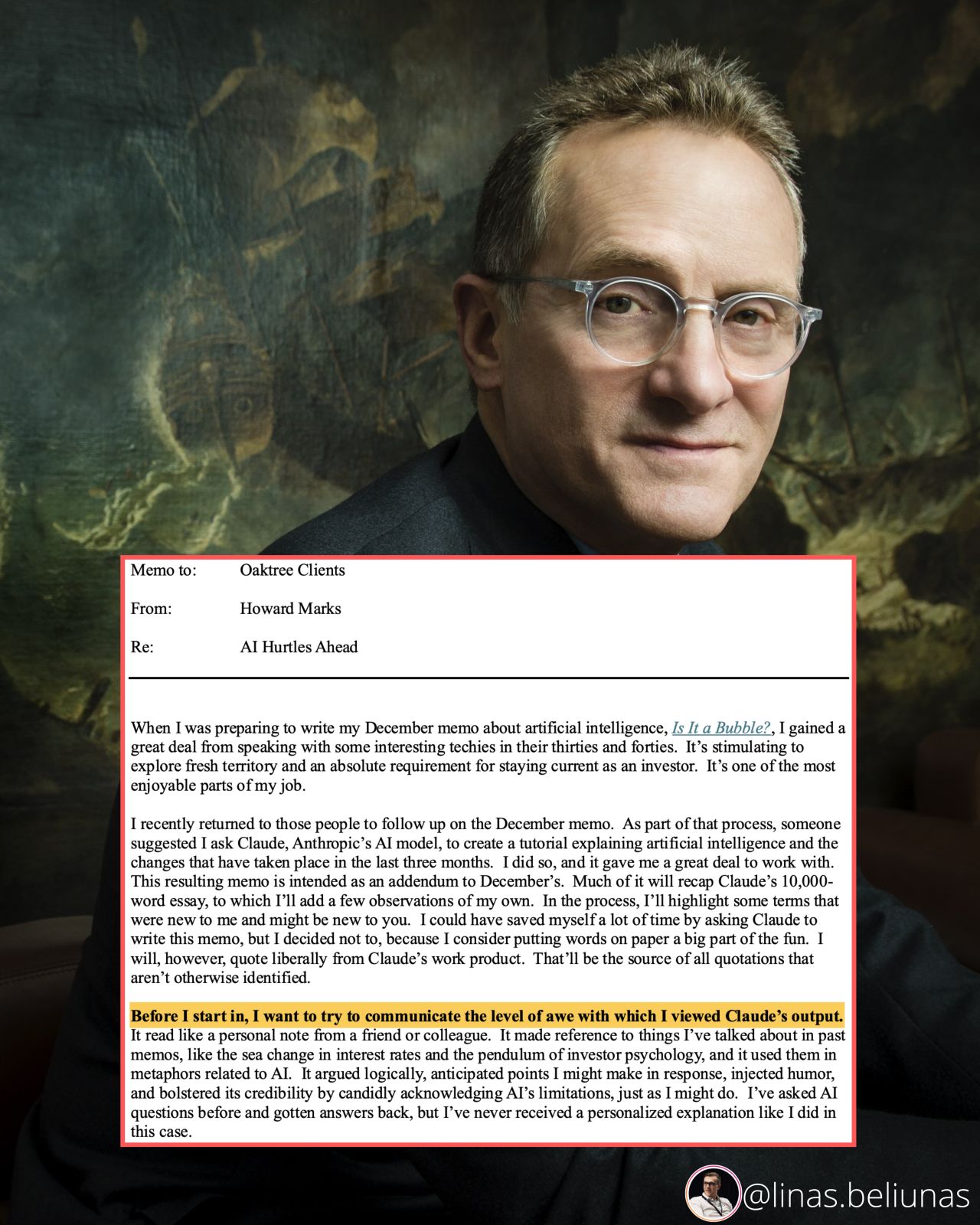
In a recent LinkedIn post, Linas Beliūnas highlights key takeaways from a new memo by investor Howard Marks, which delves into the profound implications of Artificial Intelligence. Beliūnas frames Marks’ inquiry as the central question of our time: whether AI will primarily serve as a productivity enhancer or a direct substitute for human labor. This distinction, as Beliūnas points out, has the potential to shift AI from a mere technological trend to a force that could fundamentally reshape the economy.
Linas Beliūnas shares that Marks, in his latest analysis, utilized Claude AI as a co-author, engaging with the technology to refine his thinking. This collaborative approach led to a comprehensive curriculum generated by Claude, tailored to Marks’ established frameworks and past writings. Beliūnas emphasizes the sophisticated interaction, noting how AI tutored Marks on the nuances of AI itself.
“Marks went back to the same tech people he interviewed for his December memo. This time, they gave him a different move: Ask Claude to teach you AI, as if it was tutoring you.”
The Evolving Capabilities of AI
Beliūnas elaborates on the progression of AI capabilities as outlined by Marks, which he categorizes into three distinct levels. The initial level involves basic conversational AI, providing answers. The second level sees AI acting as tools, executing specific steps in a process. The most transformative level, however, is Level 3, where AI can be given a goal and is expected to deliver the complete, finished work. This, as Beliūnas relays from Marks’ perspective, signifies AI not just assisting a human worker but potentially performing the role entirely.
AI’s Economic Impact Beyond ‘Thinking’
A particularly striking point shared by Beliūnas from Marks’ memo is the pragmatic economic perspective on AI’s value. As Linas Beliūnas quotes the sentiment:
“If AI can produce the output of a $200k/year associate, the bill payer doesn’t care whether it’s ‘thinking’ 🤖 They care if it’s reliable enough.”
This perspective underscores that for businesses, the ultimate measure of AI’s worth lies in its reliable output and economic efficiency, rather than its perceived level of consciousness or intelligence. Beliūnas also points to the rapid adoption rates, citing that AI already boasts around 400 million users, with 75-80% of companies incorporating it. Furthermore, the current demand for AI capabilities is so high that it is leading to supply constraints in inference capacity, a testament to its immediate economic relevance.
Navigating the Uncertainty of AI Investments
Despite the compelling evidence of AI’s impact, Linas Beliūnas conveys Marks’ cautious approach to investment. While acknowledging AI’s potential and the real demand for its services, Marks remains circumspect about determining definitive valuations and Return on Investment (ROI) at this stage. Beliūnas highlights Marks’ advice for a balanced strategy:
“Don’t go all-in and risk ruin. Don’t stay all-out and miss the shift. Moderate. Selective. Prudent”
As Beliūnas explains, Marks stresses that significant market consequences do not necessitate machine consciousness. The economic realities and the ability of AI to perform tasks are sufficient drivers of change. Marks also acknowledges the inherent limitations of current AI, noting its propensity to hallucinate and its struggles with truly novel situations, alongside its lack of inherent risk intuition or lived judgment. Therefore, his conclusion, as presented by Beliūnas, is one of measured engagement rather than aggressive speculation.
📝 About This Content
This article is based on insights shared by Linas Beliūnas on LinkedIn.
📅 Originally posted on February 26, 2026 | View original post on LinkedIn →