
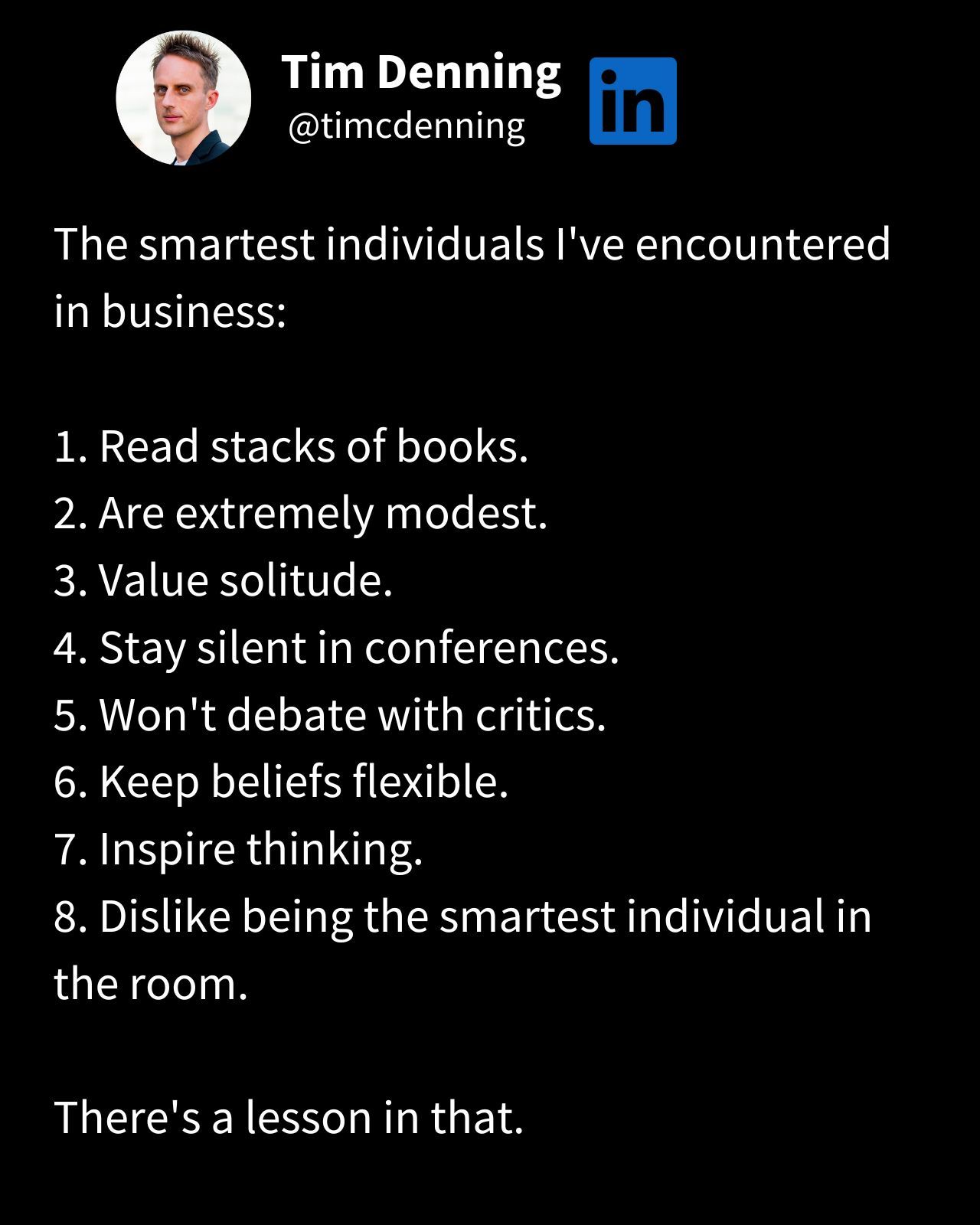
In a recent LinkedIn post, Tim Denning explores a counterintuitive perspective on intelligence and success, arguing that the loudest voices are often not the most insightful. Drawing on over a decade of experience in banking, Denning shares observations from thousands of meetings, highlighting a key trait shared by the most intelligent individuals he encountered.
According to Denning, the smartest people possess a unique ability to make others feel intelligent. He writes:
The smartest people I’ve worked with share a weird trait: they make you feel like the smartest person in the room. They don’t dominate conversations. They ask questions. They listen more than they talk. They’re genuinely curious about what you think.
This contrasts sharply with what Denning identifies as the behavior of “mediocre performers,” who, in his view, are preoccupied with proving their own intelligence. He observes that these individuals often turn every interaction into a competition and every meeting into a personal showcase.
The Ego Barrier to Growth
Denning challenges the conventional notion that confidence equates to possessing all the answers. Instead, he posits that true success, particularly for business owners he coaches, is rooted in an insatiable appetite for learning. These individuals, as Denning describes, are committed to continuous learning, actively seek out those with greater expertise, and are willing to change their minds when presented with superior information.
His analysis emphasizes a critical distinction:
They’re not attached to being right. They’re attached to getting it right.
This mindset, Denning argues, directly confronts the detrimental impact of ego on personal and professional development. He states that the moment one believes they have all the answers marks the cessation of improvement. Consequently, the individuals Denning admires remain humble, curious, and maintain flexible beliefs, prioritizing learning over the need to always be correct.
Detachment from External Validation
Further elaborating on the characteristics of intelligent individuals, Denning suggests they are largely unbothered by critics or detractors. They avoid engaging in unproductive debates, recognizing the futility of seeking external validation. Their focus remains on their work and building, rather than on what others might think.
Denning illustrates this point by noting:
I’ve watched brilliant people get dragged into pointless debates online. It never ends well. The truly smart ones just keep working.
This selective engagement allows them to conserve energy and direct it towards more productive endeavors.
The Power of Solitude and Continuous Learning
Contrary to the popular emphasis on networking and collaborative sessions, Denning champions the importance of solitude for deep thinking. He suggests that genuine insights are often cultivated in quiet environments, surrounded by books and opportunities for reflection, rather than in crowded conferences or brainstorming sessions.
He shares:
Solitude is where the real thinking happens. Not in brainstorming sessions. Not in crowded conferences. In quiet rooms with books and blank pages.
Denning concludes by offering advice for those aspiring to enhance their careers. He encourages seeking environments where one is not the most knowledgeable, suggesting that being the “dumbest” person in a room, where continuous learning is fostered and ego is challenged, is the true path to significant growth and advancement.
📝 About This Content
This article is based on insights shared by Tim Denning on LinkedIn.
📅 Originally posted on February 4, 2026 | View original post on LinkedIn →