
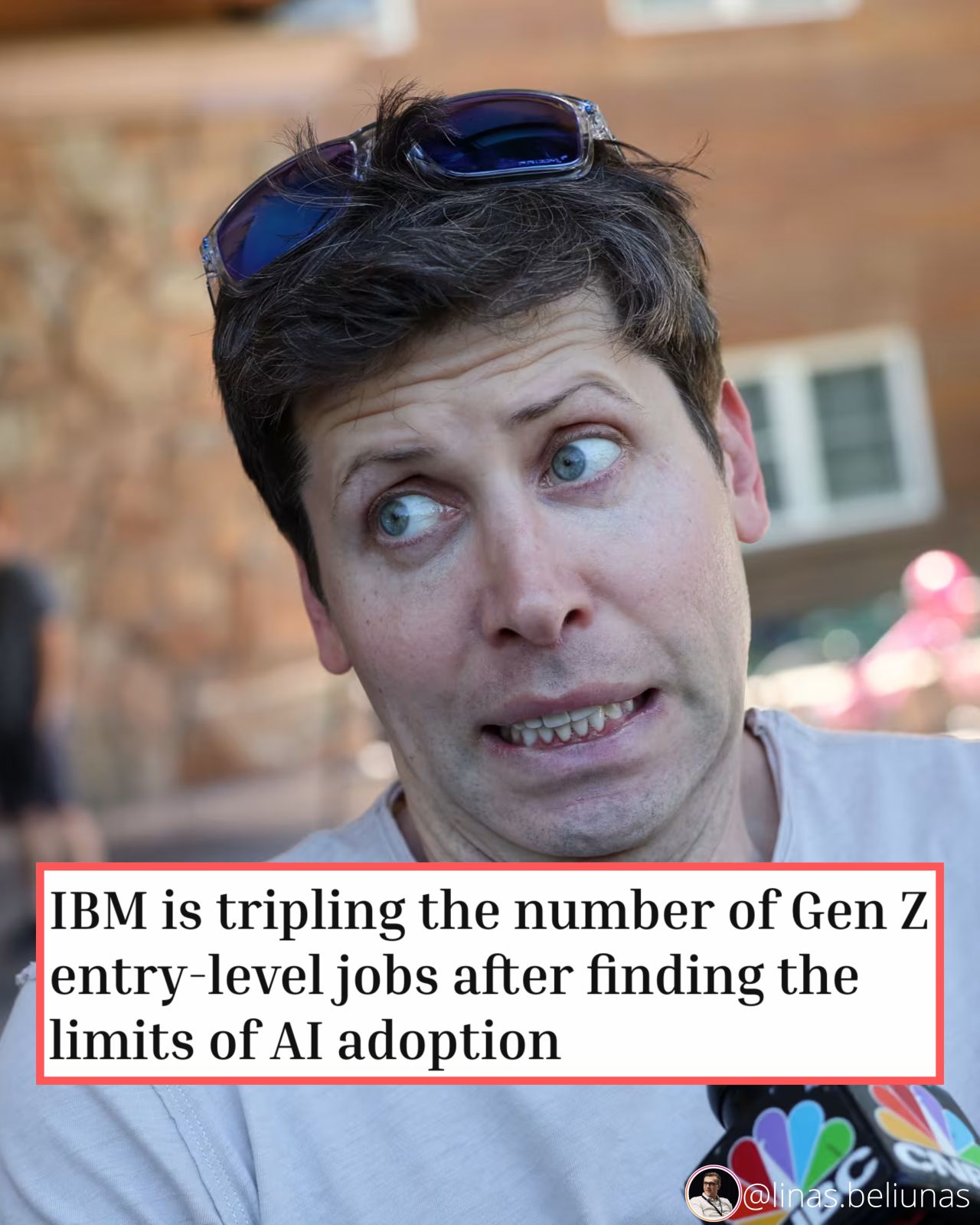
In a recent LinkedIn post, Linas Beliūnas discusses IBM’s unexpected strategy regarding entry-level hiring in the age of artificial intelligence, challenging prevailing predictions of widespread automation. Beliūnas highlights that while many companies anticipate reducing early-career roles due to AI, IBM plans to triple these positions by 2026, including those for software developers.
IBM’s Counter-Intuitive Approach to AI and Junior Talent
Linas Beliūnas points out the significant contrast between IBM’s actions and industry trends. While a substantial 37% of companies reportedly intend to replace early-career jobs with AI, IBM seems to be forging a different path. Beliūnas suggests that IBM’s realization is that the traditional entry-level role has evolved, with AI now capable of handling much of the routine work previously assigned to new hires.
“The old entry-level job? AI can do most of it. So IBM didn’t cut the role. They rewrote it.”
According to Beliūnas, IBM’s revised strategy involves redeploying junior employees to tasks that require more human interaction and critical thinking. For instance, junior developers are being directed to spend less time on routine coding and more time engaging with customers. Similarly, HR staff are shifting from answering every ticket to intervening on chatbot outputs, leveraging AI for efficiency while retaining human oversight for complex issues.
The “Post-Hype” AI Strategy: Developing Future Leaders
Beliūnas argues that this approach is not about resisting AI but about adopting a more mature, ‘post-hype’ perspective. He posits that the core of IBM’s strategy is to leverage AI to enhance, rather than replace, its workforce, thereby compressing the traditional apprenticeship timeline.
Addressing the Future Talent Pipeline
A key concern raised by Linas Beliūnas is the potential for a future talent deficit if companies solely rely on AI to handle foundational tasks. He warns that cutting junior roles indiscriminately could lead to a significant gap in experienced personnel within three to five years.
“Because if you cut juniors when AI handles “grunt work,” you don’t get leaner. You get a talent cliff in 3–5 years. No pipeline. No future managers. No one who actually understands how your AI systems evolved.”
In Beliūnas’s view, this strategic shift by IBM underscores a broader principle: the most effective AI strategy may not be about reducing the number of humans but about cultivating better, more skilled individuals. He frames this as AI compressing the apprenticeship process, enabling new hires to gain valuable experience in customer interaction and higher-level problem-solving earlier in their careers.
Ultimately, Linas Beliūnas suggests that IBM’s move to triple entry-level hiring, while seemingly counter to the automation narrative, represents a forward-thinking approach to talent development and AI integration. It emphasizes the creation of a more adaptable and skilled workforce, capable of working alongside AI rather than being displaced by it.
📝 About This Content
This article is based on insights shared by Linas Beliūnas on LinkedIn.
📅 Originally posted on February 14, 2026 | View original post on LinkedIn →