
In a recent LinkedIn post, Ben Eubanks questions the prevailing narrative surrounding recent layoffs in the tech sector, particularly the repeated assertion that Artificial Intelligence (AI) is the primary driver of these job cuts. Eubanks suggests that the stated reasons for layoffs may be masking more traditional cost-cutting measures.
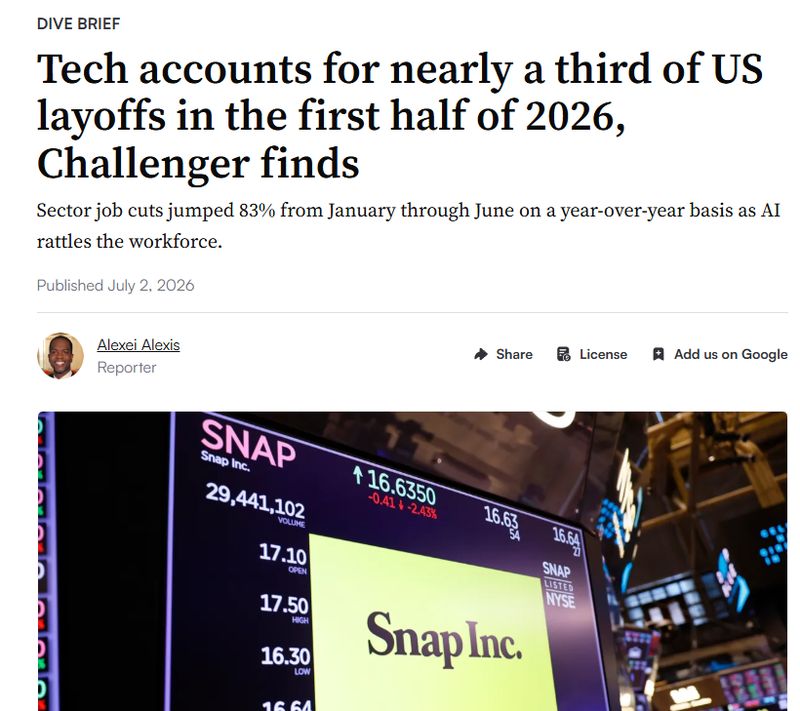
Eubanks points to a significant contradiction: while AI is frequently cited as the cause for job losses, the actual business data does not consistently support this claim. He highlights that for the fourth consecutive month, AI has been the leading stated reason for U.S. job cuts. In the first half of the year alone, AI was explicitly blamed for over 101,000 pink slips, representing approximately 23% of all tracked layoffs. Concurrently, the tech sector itself saw nearly 140,000 cuts, an 83% year-over-year increase.
“The narrative we’re being sold is simple: Machines are taking over the workload, so the humans have to go.”
Challenging the AI Layoff Narrative
Eubanks challenges this straightforward narrative by referencing data from a survey of 350 executives actively involved in AI deployment. According to Eubanks, this survey revealed that while about 80% of these executives reported workforce reductions, there was a notable absence of correlation between these staff cuts and improved Return on Investment (ROI). This finding, as Eubanks points out, directly contradicts the idea that AI implementation is leading to efficiency gains that necessitate human redundancy.
Furthermore, Eubanks brings up a previous post he shared concerning Ford. In that instance, the automotive giant reportedly had to rehire employees after transitioning some engineering roles to AI. This move resulted in financial losses for Ford because the company lost its ability to effectively solve quality issues in the manufacturing process. Eubanks uses this example to underscore that AI adoption doesn’t always translate to tangible business benefits and can, in some cases, hinder operational capabilities.
“So, let’s ask the provocative question: If AI isn’t actually delivering the scaled ROI to justify these moves, why are executives so eager to blame the algorithm for layoffs?”
The Convenience of Blaming AI
Eubanks posits that blaming AI for layoffs offers a convenient, albeit potentially misleading, explanation for executives. He argues that proving the financial viability of enterprise AI at scale is notoriously difficult. The sudden readiness to attribute widespread job cuts to AI, therefore, seems less like a genuine operational shift and more like a rebranding of standard cost-cutting strategies.
As Ben Eubanks notes, companies may be using “AI disruption” as a facade.
“When a company blames ‘AI disruption’ for mass layoffs without the data to prove the tech is actually doing the job better or cheaper, it’s smoke and mirrors. They get to signal ‘innovation’ to Wall Street/investors while masking standard bottom-line panic.”
In Eubanks’s view, this practice allows businesses to present a forward-thinking image to investors, suggesting they are embracing innovation, while simultaneously implementing measures driven by financial pressures. He concludes by posing a critical question about the true motivation behind these workforce reductions.
“In other words: ‘we’re not running the business into the ground and having to lay people off… we’re being smart with AI and having to lay people off instead.'”
Eubanks prompts readers to consider whether the current trend represents genuine automation of the future or if AI is being employed as a convenient cover story for flawed fiscal planning.
📝 About This Content
This article is based on insights shared by Ben Eubanks on LinkedIn.
📅 Originally posted on July 10, 2026 | View original post on LinkedIn →