
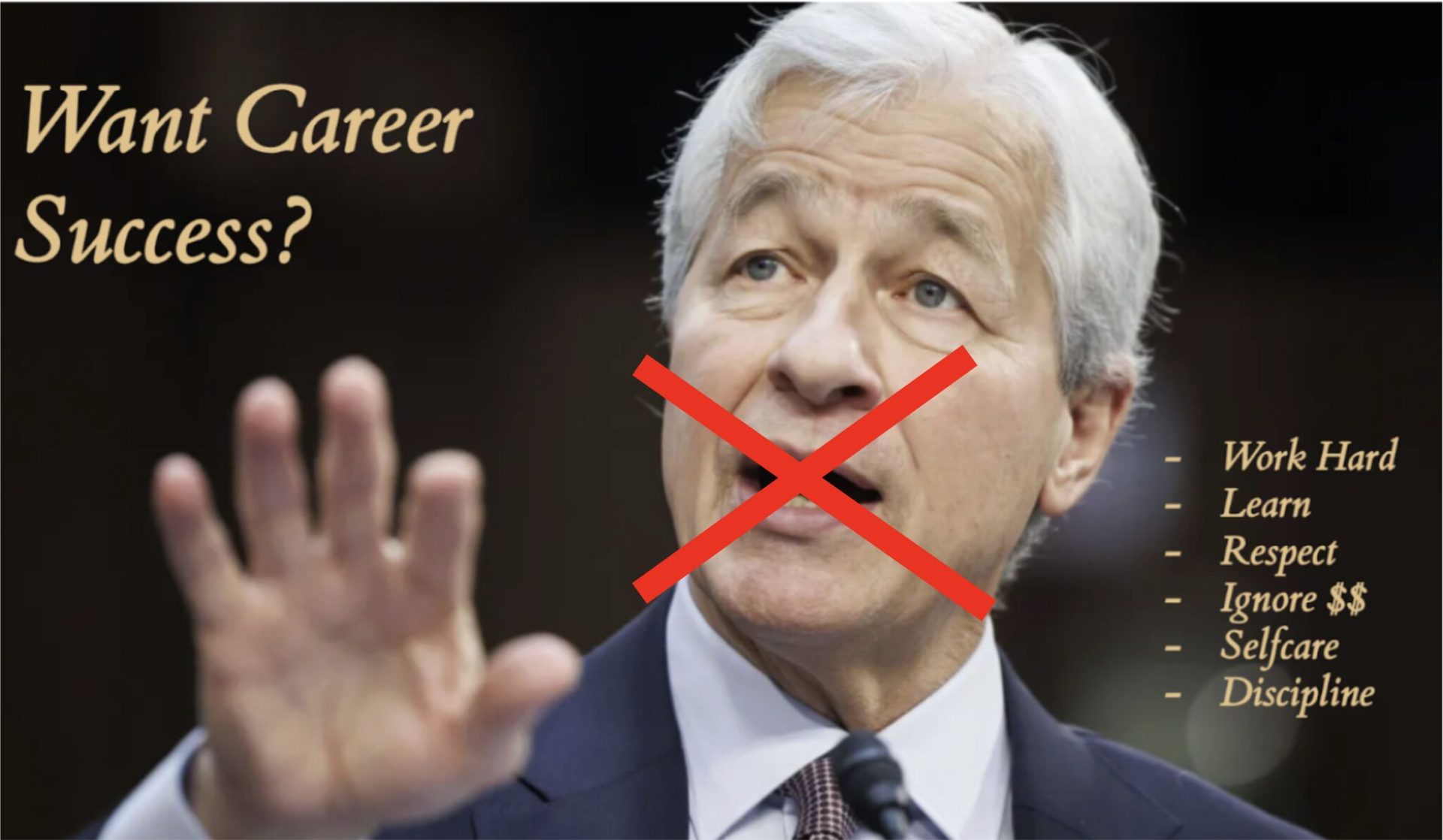
Jamie Dimon’s Career Advice: Why ‘Work Hard’ Isn’t Enough
Jamie Dimon, the titan of finance and CEO of JP Morgan Chase for nearly two decades, boasts a net worth of $2 billion. His extensive career and immense success naturally lead many to seek his wisdom on career advancement. However, Callum Laing of Enterprise Media argues that Dimon’s widely publicized career advice, while seemingly sound, is fundamentally incomplete and potentially misleading for the average professional.
Laing points to a popular LinkedIn post by Dimon outlining six rules for success:
- Work hard
- Learn as much as you can
- Respect colleagues
- Chase responsibility, not salaries
- Look after your health
- Be disciplined
On the surface, these principles appear reasonable – the kind of advice one might expect from parents or find on corporate HR posters. They embody a strong work ethic and personal responsibility. Yet, Laing contends that simply adhering to these tenets does not guarantee a Dimon-level career. Many individuals work diligently, continuously learn, and maintain discipline, yet never achieve such extraordinary success.
The Missing Ingredient: Access
Laing argues that hard work and continuous learning are not differentiators in today’s competitive landscape; they are merely entry requirements. He contrasts Dimon’s stated advice with the actual trajectory of his career, highlighting the pivotal role of relationships and access.
Laing breaks down Dimon’s early career, emphasizing his mentorship under Sandy Weill. Dimon was not just changing jobs; he was strategically following Weill through various financial institutions like American Express, Commercial Credit, Smith Barney, Travelers, and ultimately Citigroup. This proximity to a powerful figure provided Dimon with unparalleled opportunities and insights.
“One relationship shaped his entire trajectory,” Laing states. “Not his Harvard MBA. Not 80-hour weeks. Not ‘selfcare.'” The implication is clear: while Dimon’s personal attributes and efforts were undoubtedly crucial, the foundational element of his ascent was the access granted through key relationships.
The Power of “The Room”
Laing’s core argument is that Dimon’s advice, while not incorrect, is significantly incomplete. He posits that without being “in the room with the right people,” all other efforts can become mere “noise.” In many professional environments, Laing suggests, being known and trusted by influential individuals can be more advantageous than simply outperforming others.
He invites readers to reflect on their own experiences, asking if they have ever been overlooked for an opportunity in favor of someone with better connections, or conversely, if they have benefited from such relationships. This prompts a critical examination of how professional networks truly function.
Engineering Access: A Practical Approach
The good news, according to Laing, is that “Access Engineering” – the deliberate cultivation of strategic relationships and positioning oneself in influential circles – is a skill that can be learned and developed by anyone. While excelling in one’s role is still essential (scoring the goals), building the right network ensures one is “on the pitch” where opportunities arise.
Laing offers resources and a workshop designed to help professionals master the art of building these critical connections and gaining access to the right opportunities. He encourages readers to connect with him to learn more about how to engineer their own career access.
This article is based on insights from a LinkedIn post by Callum Laing.
📝 About This Content
This article is based on insights shared by Callum Laing on LinkedIn.
📅 Originally posted on September 17, 2025 | View original post on LinkedIn →